Volume
2, Issue 1
SCHOLASTIC
CHESS UPDATE 01.12.02
Edited
by Bob Ferguson, Member of USCF
Scholastic Council
If you prefer, you may read this news online at www.chess.isgenius.com.
The American Chess School funds this eNewsletter.
Please visit our sponsor’s website at
www.amchess.org and read the details
for the 2002 Castle Chess Camps.
|
 The USCF
Scholastic
Council
and the American
Chess School
wish you a successful New Year! The USCF
Scholastic
Council
and the American
Chess School
wish you a successful New Year!
Scholastic Chess
Update is emailed on or about the twelfth day
of each month. If you have
articles you would like to submit for inclusion please email them to [email protected].
If you know other
chess folks who would be interested in receiving the Scholastic Chess
Update, please submit their email for inclusion.
|
Book

|
|
|
|
Kids love this book. No notation.
Every page contains a single problem.
This book has 11
sample pages. See
all pages.
|
In this
issue:
1) The
George Koltanowski Memorial Conference on Chess and Education was a tremendous
success!
2) Many
coaches have tested the beta pages for chess coach certification and offered suggestions.
3) Scholastic
Council met in Dallas on Thursday, December 13.
4) Thank
you for contributing to the Coaches’
Corner.
5) Hey!
Look what one "Chess Mom" in Mississippi did!
6) The
Goodwill Ambassador of Chess
7) FREE
Chess Research Summary
Greetings
to All Chess Folks,
Welcome
to the fourth issue (Volume 2, Number 1) of the Scholastic Chess Update.
One of the Scholastic Council’s goals is to improve communication among
members of the scholastic community. This
e-Newsletter is the second step towards reaching this goal.
Our first step was the creation of a Scholastic Chess Website to
communicate what the Scholastic Council is and what goals are being pursued.
For details, please visit www.chess.isgenius.com.
If you are NOT
interested in scholastic chess, please click the reply button and type
“remove” in the subject line. If
you know others who would like to receive this information, please
forward the URL for the website to them. If you are receiving multiple copies, please let us know so
we can correct our error.
The
Koltanowski Conference on Chess and Education
by
Tim Redman, Past
President of the USCF
They came.
They spoke. They listened.
36 presenters (representing 42 authors) and about the same number of
participants attended the George Koltanowski Memorial Conference on Chess and
Education December 14-16, 2001, at the Dallas Hyatt Regency Reunion in downtown
Dallas. Dedicated to the memory of
my old friend George and in appreciation of his widow Leah, the conference
sought to determine what we know at the start of a new century about the effect
of chess on educational growth.
The conference
was held in four rooms in a secluded section of the mezzanine; downstairs, more
than two thousand chess players, parents, coaches, and staff attended the
National Scholastic Grade K-12 Championship.
As I told one reporter: "The
tournament is more exciting; the conference is more important."
Those who
participated enjoyed three days of wide-ranging discussions about the past,
present, and future of chess in education.
The last such conference was organized by Professor Howard Prince at the
Borough of Manhattan Community College in 1995. This conference was more academic in nature:
more than a third of the presenters held doctorates.
To accommodate the large number of papers, conference sessions were
divided into ten 75-minute time slots, four Friday, four Saturday, and two
Sunday morning; 9 of the time slots had three concurrent sessions, each with one
or two speakers. The talks ran 30 minutes or 60 minutes each, with 15 minutes
at the end for discussion. One of
the conference rooms was dedicated to refreshments so discussion could continue
informally during frequent breaks.
The last
session, Sunday morning, was a plenary session featuring Dr. Uvencio Blanco of
Venezuela, Secretary General of FIDE's Chess in School Committee.
Dr. Blanco is known for his two indispensable books in the field of chess
and education, Why Teach Chess in Schools? and The Chess Teaching
System, both published in 1998. The
Chair of the FIDE Committee, Nicola Palladino, was unable to come, but sent a
paper and another Committee member, IM Goran Antunac of Croatia, to represent
him.
For the rest of
Dr. Redman’s article, please refer to his upcoming Chess Life article.
Others have posted comments about the conference on the Web.
Here are two:
http://www.serve.com/williams/nmco//messages/1654.html
http://www.serve.com/williams/nmco//messages/1655.html
Many
coaches have tested the beta pages for coach certification
A big thank you to
Ryan Ferguson, Dewain Barber, Michael Aigner, Glenn Glorioso, Tom Brownscombe,
John Smith, Mike Hoffpauir, Lori Weidemann, Susan Herzing, Randy Grove, David
Mehler, Frank Oslick, Frank C. DelBonis, Lance C. Eck, David Clark, and the
other coaches who assisted with the beta testing. We are still working on the improvements and are trying to
integrate your suggestions. If you
would like to help us with this project, please visit the coach login
page at http://www.geocities.com/chess_camp/coach_login.html
and test the tests. Afterwards,
please email us your suggestions for improving them.
Thanks.
Scholastic
Council met in Dallas on Thursday, December 13
The
Scholastic Council met the day prior to the Koltanowski Conference and the
National Scholastic Grade K-12 Championship.
Until services improve, the Scholastic Council is strongly opposed to any
scholastic dues increase. Scholastics
expect ratings to be available within one week of a tournament by emailing
results to the office. The Canadian
Chess Federation and other organizations are able to post updated ratings within
24 hours of submission. We expect
the USCF to match the services of other organizations.
School Mates should be available both online, perhaps in PDF, and
in its current format. The Council also
discussed the possibility of inserting School Mates in Chess Life four
times each year provided the cost can be controlled and the integrity of School
Mates is maintained.
Ralph Bowman and Robert Ferguson are working on developing
a manual for coaches, which will include sections on developing a coaching
philosophy, training principles, tournament knowledge, how to teach chess,
psychology of chess, managing a chess team, and more. They are looking for individuals to submit ideas for the
manual and later write one or more chapters to make the Coaches’ Manual a
reality. Tentatively, this will be
a free publication like the Guide to Scholastic Chess.
Dewain Barber has indicated that he will help underwrite the publication
expense.
Thank
you for contributing to the Coaches’
Corner
Many coaches have
contributed ideas for the Coaches’ Corner pages. To visit the Coaches' Corner Home Page, go to http://www.geocities.com/chess_camp/coaches_corner_home.html.
If
you have an IDEA, STRATEGY, FORM, or LESSON to contribute
to the web site, PLEASE USE THE FOLLOWING FORMAT FOR YOUR SUBMISSION:
TITLE OF LESSON OR IDEA:
NAME:
SCHOOL:
CITY/STATE:
E-MAIL:
KEY WORDS:
GRADE RANGE:
SHORT 1-2 SENTENCE INTRODUCTION:
MATERIALS NEEDED:
STEP-BY-STEP METHODOLOGY (200-500 WORDS, simple enough that a teacher
could print it out and follow it on his/her own):
PLEASE NOTE: We prefer that all items be forwarded by email as an
attachment in Word, FrontPage, or PDF.
Send your
submissions to [email protected]
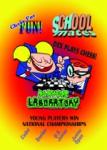 Hey!
Look what one "Chess Mom" in Mississippi did!
Hey!
Look what one "Chess Mom" in Mississippi did!
By Kelly
Jacobs, Chairperson of the Scholarship and Fundraising Subcommittees
of the
USCF Scholastic Committee
(Paste) http://www.uschess.org/about/smates.html
(or click) U.S. Chess
Federation
The United States Chess Federation has been gifted with permission to
use Dexter's Laboratory artwork on the cover of the newest issue of School Mates
Magazine. (My Dexter Chess Tournament is featured inside!) The importance of
possibly getting a HUGE conglomerate (AOL/Time-Warner) interested in supporting
chess is an opportunity just knocking at our door, but all of us need to help so
this opportunity doesn't pass us by. (Flattery, honey, sugar pour it on! Cartoon
Network, you are so wonderful!) Cartoons and comic books are not limited to the
USA but are known worldwide. Cute, kid related chess products would result from
a major cartoon that had chess playing in it those products would sell
everywhere.
It is my impression that the USCF is seriously
considering RAISING Scholastic fees because (now watch me dance) they need to
stay "in the black". The why they are almost bankrupt is a political
answer that would get me into trouble.
Nonetheless, the game of chess is still great for
kids and if one cartoon,
like Dexter's Laboratory, would portray kids having fun playing chess, it
would benefit every chess club and classroom by providing more interest in
chess. (Dexter's Laboratory is a cartoon about a 4th grade boy who is proclaimed
a genius by the Pentagon. He loves school, has a secret laboratory in his
bedroom where he invents all kinds of stuff and an older sister DeeDee who
should beat him with Scholars mate to get him hooked.)
I
hope you will help me in my "campaign" to get more chess on TV either
in cartoons, or regular programming. You can help by writing to the Cartoon
Network, send them art, mail, be creative! Forward this note to other chess
players!
Genndy
Tartakovsky is the Creator of Dexter's Laboratory, and other cartoons. He is
based in California, and the honchos in Atlanta say that they do not ever tell
their creators what to do. Maybe he will see this magazine cover as FLATTERY,
and will be interested in drawing chess into his 2002 shows, maybe not. Like a
good game of chess, we have to have a plan, even if it is long term. So please
write to Atlanta, let them know you appreciate Dexter's support!
SNAIL Mail:
WE WANT DEXTER TO PLAY CHESS!
The Cartoon Network
1050 Techwood Drive,
Atlanta, GA 30318
Feedback
E-mail site:
http://cartoonnetwork.com/feedback/
Cartoon Network: Feedback
Make your voice heard by using your circle of influence to let the
Cartoon Network and TV show creators (of your choice) know that you want chess
on TV! I did a little something, YOU CAN TOO!
The Goodwill Ambassador of
Chess
By
National Master Dan Heisman
Many
of our scholastic players may only know IM Donald Byrne as either the loser of
the "Game of the Century" against Bobby Fischer or GM Robert Byrne's
brother. Both are true, but Professor Donald Byrne was much more than that, a
real Goodwill Ambassador of Chess.
Donald
and his older brother Robert were two of the most famous prodigies of Brooklyn's
John Collins, who also coached Bobby Fischer.
Donald quickly became one of the country's top players and won the US
Open in 1953. He represented the US very successfully in radio matches vs. the
USSR and in many Olympiads. Further, Byrne was so popular among both US and
foreign players that he was selected to be the US Olympic Team Captain on
several occasions. Always quick with a quip or joke followed by a hearty laugh,
Bryne's presence could light up a room or create a warm atmosphere. Everyone who
came in contact with Byrne seemed to have a nice thing to say about how he
helped them or greeted them as a compatriot, even if they had been a stranger.
Unfortunately,
Byrne became seriously ill while still a young man. He held the position of
English Professor and Chess Coach for Penn State University for several years
before he passed away in the late 1970s. Because the ELO system was not instated
for international play until he was just about finished with serious play, it
was almost impossible for Professor Byrne to get the GM title since the US did
not hold "norm" tournaments, despite the fact that he was rated in the
Top-10 in the US and GM strength virtually his entire life. Today all of Byrne's
students and friends in the chess world fondly remember "The Coach"
and it is hoped that he will achieve the posthumous GM title and eventually be
elected to the US Chess Hall of Fame.
FREE
Chess
Research Summary is available
at www.amchess.org/research.
Educators around the world acknowledge
that chess is a powerful tool for developing higher order thinking skills,
creativity, numerical and verbal aptitudes, and memory.
Now, you can have the documentation to support your belief in the
positive value of chess
A
message from our sponsor:
Details for the 2002
Castle Chess Camps are available at www.amchess.org.
The Bradford Castle Chess Camp will be held July 21-28 and the Atlanta Castle
Chess Camp is scheduled for June 9-16. Both
camps feature current U.S. Champion Joel Benjamin.
Registration info is at http://www.amchess.org/camp/registration.html.
The full camp fee for residents at the Bradford camp is $739, but the early bird
price is only $599. Fees increase
$20 per month after the early bird deadline. For more info about either the
Atlanta or Bradford camp, please visit the www.amchess.org
website and click on the "Castle Chess Camp" button.
