 | | | | | | | | | | | | | |
 |
|
|
The 1918 Spring Offensive
21MArch - 18 July 1918 |
|
|
|
|
|
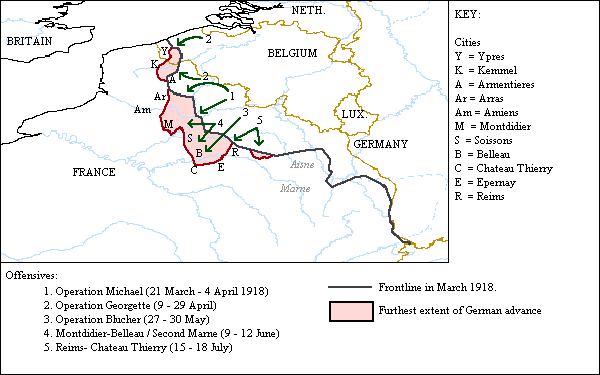
In preparation for its 1918 spring offensive, the German High Command brings forward huge numbers of men and materiel in great
secrecy to the Somme battlefields during February and March 1918. By 21 March, when Operation Michael begins, they have assembled fifty-nine infantry divisions, and the greatest artillery concentration in history, against the combined twenty-six
divisions of the British Third and Fifth Armies, which are spread thinly (especially Fifth Army) over a 50-mile front. The 21 March attack on the British line in the St Quentin area achieves complete surprise, and Fifth Army's portion of the line is
overrun. By end of day, both Third and Fifth Army are in retreat, and British losses total 38,512 men - their greatest number of casualties for any day of the war except the first day of the Battle of the Somme.
By the end of the first week of
Operation Michael, eighty-three German divisions have been thrown into the attack, and have advanced the frontline by as much as forty miles. But although the British line bends into a deep salient, it remains unbroken. By the end of March, the German
advance slows, as supply lines lengthen and the defenders regroup and stiffen their resistance. Third Army rallies and holds the Germans at Arras, and the British Fourth Army - brought forward to replace the virtually-destroyed Fifth Army - stops the
advancing enemy short of the key communications hob of Amiens. Recognising that Operation Michael has lost its impetus, Ludendorff calls off the offensive on 4 April. The desperate British defence has cost them about 240,000 casualties, but it has
prevented the strategic breakthrough on which Ludendorff has gambled so many of his remaining reserves. Operation Michael has cost the German Army about 250,000 casualties who will not be easily replaced, as Germany has reached the limit of her
population of men of serviceable age.
|
|
|
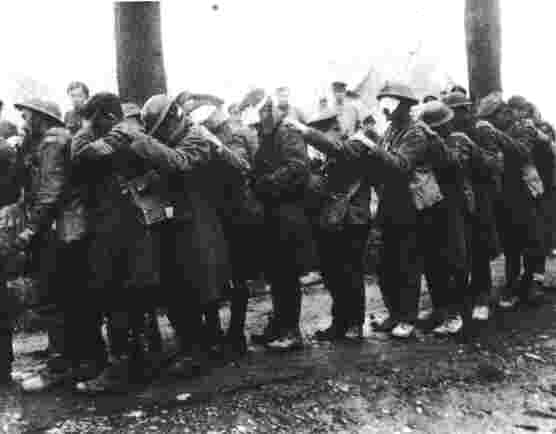
Ludendorff quickly follows up his first offensive with a second thrust - Operation Georgette - which is aimed at a short area of
the British front further north around Armentieres, and at the British defences around Ypres. Ludendorff's aim is to break through to the Channel ports, cutting off the Belgian Army and British Second Army from the rest of the Allied line. The
offensive opens on 9 April, with a heavy artillery bombardment and gas attack, which achieves deep penetration around Armentieres, and forces the British out of all of the gains won at such cost during the 1917 Passchendaele campaign. But once again,
although the line is pushed back, it does not collapse, and Ypres does not fall. A final attempt by German stormtroopers to breakthrough British and Belgian defences is halted after savage fighting around Mt Kemmel from 24 to 29 April. When Operation
Georgette is called of on 29 April, the Allies have lost 120,000 men. The advancing Germans have suffered probably 110,000 casualties, and have irreversibly exhausted the offensive capabilities of their Fourth and Sixth Armies. |
|
|
 |
|
|
|
Operation Georgette - British soldiers blinded by the German gas attack on Armentieres wait for treatment at an Advanced
Dressing Station near Bethune, April 1918. |
|
|
|
|
|
|
Germany's Spring Offensives, March - July 1918
|
|
|
|
 |
|
|
|
Although their principal aim remains a knockout blow in Flanders, on 27 May the Germans turn their attention south for a
diversionary attack on the French in Champagne. In Operation Blucher (The Third Battle of the Aisne), the German First and Seventh Armies launch a surprise attack on the French Sixth Army. They succeed in crossing the River Aisne, and make the
greatest territorial gain on the Western Front for any single day of the war, pushing a salient twenty miles deep and thirty miles wide, from Soissons to Reims. In the final two German offensives of the war, Ludendorff attaempts to widen the salient.
His 9 June attack on the western side of the salient - from Montdidier to Belleau Wood - is stopped by a Franco-American counter-attack (The Second Battle of the Marne) which begins on 11 June. To the east, his 15 July attack between Reims and Chateau
Thierry grinds to a halt almost immediately against strong French defences, save for 14 divisions of the German Seventh Army which advance across the Marne, before being halted by the stubborn defence of the American Third Division at Epernay.
With his successive offensives producing diminishing returns, and clearly failing to either break through or destroy the Allied will to fight on, Ludendorff admits failure. He withdraws his troops from the Soissons-Reims salient, abandons his
proposed decisive offensive in Flanders, and reverts to defensive warfare, which will be the German Army's policy for the remainder of the war. |
|
|
|
|
|
 |
|
 |
|
|
|
or return to The Great War home page |
|