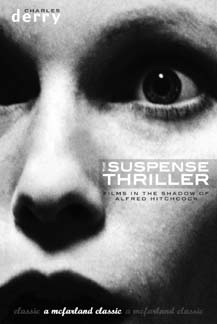
 The
Suspense Thriller: Films in the Shadow of Alfred Hitchcock [book]
The
Suspense Thriller: Films in the Shadow of Alfred Hitchcock [book]
McFarland Press, paperback edition published in December of 2001, originally published in 1988, 351 pages, illustrated. Why do we enjoy works of art which so invoke our sense of anxiety? The Suspense Thriller--a structural, psychological, and historical examination of the film genre favored by Alfred Hitchcock, Claude Chabrol, John Frankenheimer, Michelangelo Antonioni, Costa-Gavras, and others--explores the recurring elements of this genre, including murderous passions, political intrigue, exchanged or acquired identity, psychological trauma, moral confrontation, the innocent-on-the-run, and the crucial psychological mechanism of suspense itself. And what exactly are “thrills," and why do so many of us crave them, if only vicariously, delivered through the motion picture images of our television and cinema screens? Indispensable to anyone interested in understanding how suspense thrillers work and what they mean, The Suspense Thriller provides insightful analysis of hundreds of memorable films, at the same time working as a virtual "how-to manual" for anyone trying to write a Hitchcockian thriller.
On Fatal Attraction: "Issues of feminism compete with the the issue of AIDS, which hangs over Fatal Attraction like a dim specter--never quite visible except over-the-shoulder, peripherally. In the era in which Nancy Reagan's 'Just say no' dictum has become the watchword of a generation, Fatal Attraction becomes a clear, cautionary tale. Sexual intercourse can literally kill as surely as the knife of your mistress. Fatal Attraction suggests that we must retreat from the Sexual Revolution and the New Morality and return to a happier, simpler time in which the nuclear family prospered--a time in which a well-appointed home in the suburbs remained the ideal, and a woman's place was clearly there, taking care of her well-mannered children. [...] And yet, one can never truly go back home. The moving finger writes, and having writ, moves on: what has been thought or done cannot be unthought nor undone. If Fatal Attraction can be read as embracing the nuclear family, it can as easily be read as a stunning condemnation of the nuclear family's shortcomings. Dan loves his wife, certainly, but like too many traditional marriages, their marriage is taken for granted, unfulfilling, devoid of excitement and passion. That Dan is so easily willing to sleep with Alex in the first place is testament to the film's primary truth: that all the excitement and passion in life is truly to be found outside the nuclear family, outside the boundaries of behavior prescribed by the dominant ideology. Much of the suspense and tension arises from these contradictory truths."
[click here to purchase from Amazon] Cover design by Ben Putman.
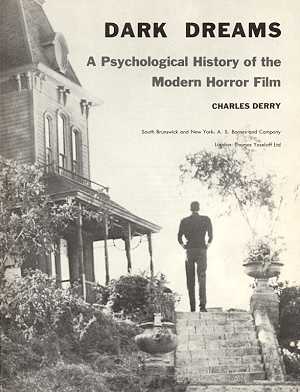 Dark
Dreams: A Psychological History of the Modern Horror Film [book]
Dark
Dreams: A Psychological History of the Modern Horror Film [book]
A.S. Barnes, 1977, 143 pages, now out-of-print. An aesthetic, sociological, and psychological examination of the horror film since 1960, this book divides the contemporary genre into three primary fears: of personality, of Armageddon, and of the demonic. What do these distinctive films say about the cultural and social fears of the fifites, sixties, and seventies? Includes much about the influence of Alfred Hitchcock's Psycho and The Birds, as well as an appendix which includes interviews with William Castle, Robert Aldrich, George Romero, William Friedkin, and Curtis Harrington.
On The Exorcist: "By scaring the devil into the audience, The Exorcist reaffirms some absolute, religious, moral order, and provides a hopeful alternative to the audience's 'God is Dead' cynicism. The consistent reports of vomiting and fainting in the theaters where The Exorcist was playing (planted at first perhaps by publicity departments?) probably attracted those so predisposed to vomiting and fainting that they needed no more than the title of the film to set them off in fine Pavlovian style. Yet in some strange way, the possibility that a viewer might faint or vomit was an attractive one; seeing The Exorcist was a rite of passage, and only those who fainted or vomited were the winners. In an era where death--in the form of Vietnam killing, riots, and assassinations--was watched daily and our responses to violence had become complacent and anaesthetized, going to The Exorcist and throwing up reaffirmed our ability to be revolted, our ability to feel: thus the viewer's vomit almost becomes a valid aesthetic response to the world."
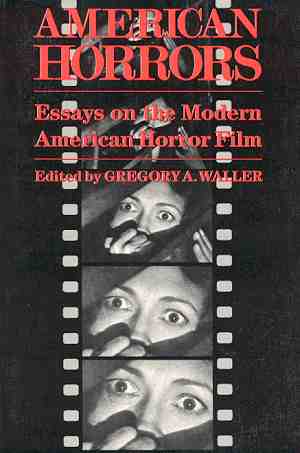 "More
Dark Dreams: Some Notes on Horror Films of the Seventies" [essay in anthology]
"More
Dark Dreams: Some Notes on Horror Films of the Seventies" [essay in anthology]
Essay can be found in American Horrors, an anthology edited by Gregory A. Waller, University of Illinois Press, 1987. An updating of Derry's critical ideas, focusing on horror films released since the initial publication of Dark Dreams. Includes information about the work of David Cronenberg.
On the psychology of horror films: "Why are horror films so popular? Certainly horror films connect with our profound and subconscious need to deal with the things that frighten us. In the way they work upon us, films are much like dreams, and horror films are like nightmares. Some horror films deal with our fears more directly than others, but in general, horror films speak to our subconscious and--as do our dreams--deal with issues that are often too painful for us to deal with consciously and directly... Many reason-oriented adults, so sensitive to the lack of sophisticated surface in horror films, often take a defensive and negative attitude toward this cultural ly devalued genre, finding the films unpleasant or unimportant... Children, on the other hand, less connected to the value judgments of a culture, often take an attitude of joyful anticipation and enthusiasm , even though the horror films sometimes traumatize them. Children have not yet learned to civilize and repress their fears: they know that there are monsters in the closet who will kill them if the nightlight goes out."
 St.
James Film Directors Encyclopedia and
International
Dictionary of Films and Filmmakers [series of critical essays]
St.
James Film Directors Encyclopedia and
International
Dictionary of Films and Filmmakers [series of critical essays]
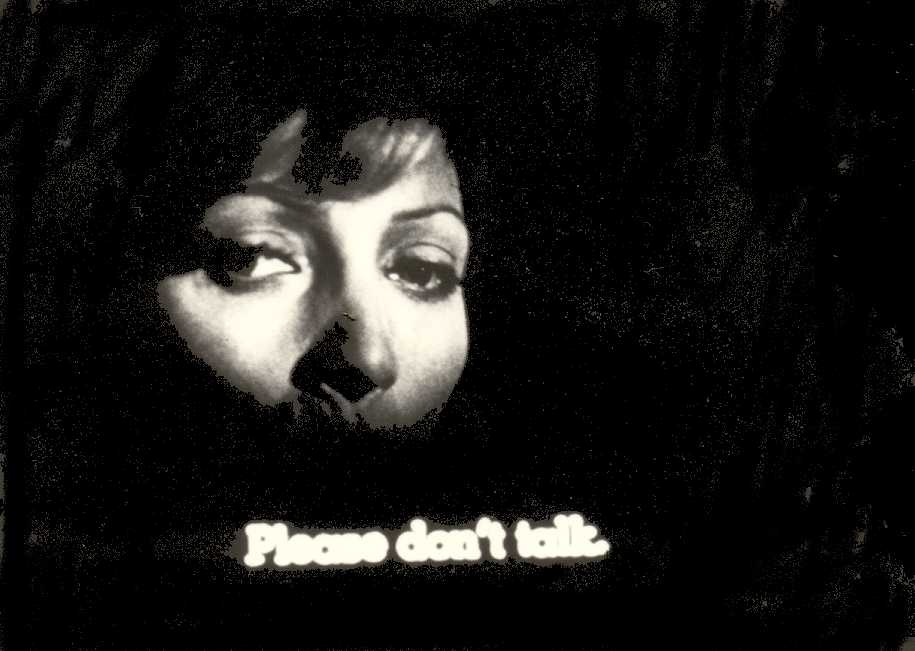
Essays can be found in St. James Film Directors Encyclopedia, edited by Andrew Sarris, Visible Ink Press, 1998; and International Dictionary of Films and Filmmakers [some editions including 4 volumes: Films, Directors, Actors and Acresses, Writers and Technicians], St. James Press, various editors and editions published in 2001, 1996/97, 1990/91, and 1988. Essays by Charles Derry are on a variety of film artists, including Claude Chabrol, Otto Preminger, Jerry Lewis, Robert Altman, Robert Mulligan, Steven Spielberg, Barbra Streisand, Ronald Reagan, Tippi Hedren, Mia Farrow, Glenda Jackson, Stephane Audran (pictured), Raquel Welch, Jay Presson Allen, Saul Bass, Ross Hunger, Jean Rabier, Steve Martin, Ann-Margret, Spike Lee, Sandy Dennis, Rob Reiner, La Femme Infidele, The Go-Between, Le Salaire de la Peur, and The Birds, among others.
On Steve Martin: "His use of catchphrase (such as 'Excuuuuuuse me' and 'I'm a wild and crazy guy') entered popular parlance, although they were as much reflexive ruminations on the concept of the catchphrase, as they were catchphrases. Indeed, his egocentric persona was so self-consciously a put-on, that on their second level, his routines became structural treatises on the stand-up form: 'New Comedy' which was funny because it was sly parody of comedy, rather than comedy."
On Steven Spielberg: "He followed the winning of his first Academy-award by directing The Lost World, a Jurassic Park sequel unnecessary for any motive except craven profit, in the process becoming more a designer of amusement park attractions than an artist. Psychologically vacuous, The Lost World shows men with gadgets who say things like "Lindstrade air rifle. Fires a subsonic impact delivery dart.' The exposition is obligatory, the villains cardboard, a black Disney child improbably appears to improve the film's demographics, and characters behave stupidly so that dinosaurs can attack them. When at one point, we even see a man ripped in half by two dinosaurs competing for their dinner, we understand that the humanism of Schindler's List has been replaced by the expediency of efficient, crowd-pleasing violence: it feels like a pornographic vision."
On Ronald Reagan: "One could say, with only a trace of irony, that Reagan's single most notable performance was as President of the United States. His appearance in the Republican National Committee's election film, with its uplifting message--'It's Morning in America"--was imbued with an incredible archetypal grandeur which only John Wayne at his peak could have matched. It can be argued that turning points in his two Presidential elections were both due to Reagan performance moments: the first, the famous 'I paid for this microphone,' reprimand where he communicated righteous anger with wonderful economy during a debate prior to the Republican convention; the second, in his re-election campaign debate with Michael Dukakis, where his joke about his own age was delivered so perfectly that he totally deflected any discussion of his potential mental incapacity or infirmity. Reagan was the perfect movie President..."
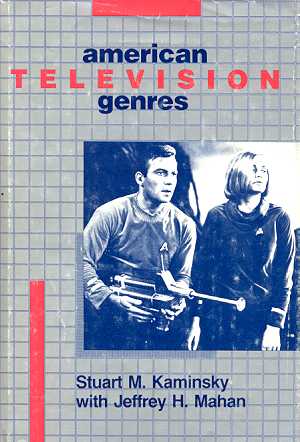 "Television
Soap Opera: Incest, Bigamy, and Fatal Disease" [article in book]
"Television
Soap Opera: Incest, Bigamy, and Fatal Disease" [article in book]
Essay can be found in American Television Genres, edited by Stuart M. Kaminsky, Chicago: Nelson Hall; abridged versions of original essay also appear in The Journal of the University Film and Video Association, Winter 1983; and in Popular Culture: An Introductory Text, edited by Jack Nachbar and Kevin Lause, Bowling Green State University Press. An analysis of soap opera in the context of feminism, emphasizing the potential for the melodramatic form to deal with progressive issues.
On Mary Hartman, Mary Hartman: "More than any other soap, Mary Hartman was the most self-conscious about its form, which it used to criticize the organization of American life and its inherent chauvinist, unhealthy premises. Television, for Mary Hartman, was the great value-leveler, presenting images of the Vietnam War alongside those of Bugs Bunny, Lucille Ball, and toothpaste commercials. Thus the American woman is bombared by messages from a variety of sources, none of them clearly more valuable or important than any of the others. In the opening episodes of Mary Hartman, Mary is sent word that a mad killer has killed the entire Lombardi family and their two goats and eight chickens. Mary's response--'What kind of madman would shoot two goats and eight chickens... and the people, of course, the people...'--and her immediate attention to the waxy yellow buildup on her floor revealed her tragic and comic inability to make distinctions of value."
 The
Film Book Bibliography: 1940-1975 [reference
book]
The
Film Book Bibliography: 1940-1975 [reference
book]
Scarecrow Press, 1979, 752 pages, compiled by Jack Ellis, Charles Derry, and Sharon Kern in equal participation. A comprehensive bibliography of all film books written in English since 1940, including dissertations. Over 5000 titles, with selective annotations.
"The Film Book Bibliography developed from our seminar in film historiography at Northwestern University in 1976. After familiarizing ourselves with the available film reference literature, we realized that a large-scale classified bibliography of books on film would be a useful addition to the field. The first major film bibliography, The Film Index, edited by Harold Leonard and published in 1941, provided bibliographic information on both books and periodicals. The New Film Index, edited by Richard Dyer MacCann and Edward S. Perry and published in 1975, attempted to bring The Film Index partially up to date by indexing film periodical material published between 1930 and 1970. From the outset, we have regarded our project as essentially complementary to these two works, in that it attempts to list comprehensively books and monographs on film published in English between 1940 and 1975."
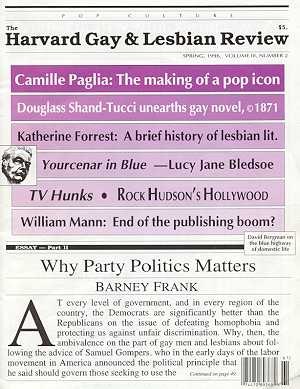 "Gay
Directors, Gay Lives" [article]
"Gay
Directors, Gay Lives" [article]
Essay can be found in The Harvard Gay and Lesbian Review [now called The Gay and Lesbian Review], Spring, 1996, Volume III, No. 2. Analysis of contemporary gay filmmakers and traditional Hollywood representations of gay men and lesbians.
On Tea and Sympathy: "We often rewrite films in our heads after viewing them, without quite realizing that we're doing so; and like dreams, films get mixed up with our own hopes, our own subconscious needs. I remember being moved as a child by Tea and Sympathy and taking great comfort from its presentation of a male protagonist who does not conform to the male stereotypes around him. Seeing the film again recently, I was surprised to discover that the film's coda projects the adolescent into a secure heterosexual future, a fact that I had forgotten. From a certain perspective, Tea and Sympathy can be regarded as a monstrous film, saying that the protagonist is deserving of our sympathy only because he is not really a homosexual. And yet, for many young gay men coming of age in the 50's and 60's, Tea and Sympathy showed that someone who acted as they did and had artistic interests could be considered heroic."