|
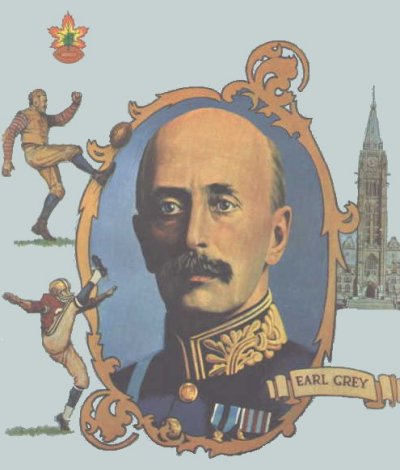
Lord Albert Henry
George Grey
|

|
|
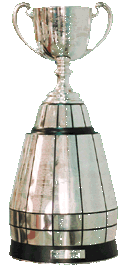
The Grey Cup as
it
|
|
looks today
|
|
(since 1987).
|
|
|

|
|
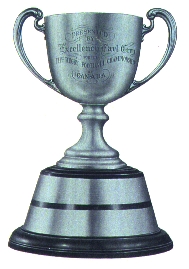
The Grey Cup on
its
|
|
second base
|
|
(1950-1986).
|
|
|

|
|
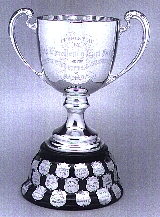
The Grey Cup
with its
|
|
original base.
|
|
|
|
The
Grey Cup trophy, a symbol of Canadian football supremacy, was originally an
amateur award, destined to be presented to the senior hockey champions of Canada.
However, after Sir H. Montague Allan offered the Allan Cup for hockey
competition, Lord Albert Henry George Grey, the fourth Earl and Governor
General of Canada,
donated the Grey Cup in 1909. It was destined to be awarded to the
team winning the Senior Amateur Football Championship of
Canada.
|
|
The first Grey Cup game pitted the University
of Toronto against Parkdale at Varsity Stadium in Toronto in front of 3,807 football fans
in 1909. The Grey Cup was presented, albeit three months later - he'd
forgotten to have the cup made, but did so after a gentle reminder by the
cup trustees - by his excellency Lord Grey to the
team representing the University
of Toronto, who won
the game by a score of 26-6. The U of T team would go on to win the
Cup the next two years and again in 1920, following a three-year hiatus as
a result of the First World War.
|
|
The
Grey Cup Game would again be affected by world unrest in 1940, as it took
two games over two weekends, held on November 30 in Toronto
and December 7 in Ottawa, to crown the team
from Ottawa
the Grey Cup Champions.
|
|
As some amateur football organizations became more
professional, the Intercollegiate Union felt that it was at a disadvantage
and ceased to challenge for the Cup. In both the West and the East,
the Inter-provincial Football Unions became the strongest organized
football associations, and eventually evolved into the Western and Eastern
divisions of the Canadian Football League. Since 1954, only teams in
the CFL have competed for the trophy.
|
|
Over
the years, many stories both famous and infamous have become associated
with the cup:
|
|
In
1950, the infamous "Mud Bowl" game between Toronto
and Winnipeg took place at Toronto's Varsity Stadium. The CRU,
fore-runner to the CFL, could have bought a tarp for $6,000, but decided to
gamble. The result: the night before the game, eight inches of snow
fell on the unprotected field. To further complicate things, the
temperature began to rise before game time, completely thawing the
field. A huge tractored vehicle was brought
in to haul a mud-mired snow-removal truck off the the
field, creating deep ruts of oozing swamp. By ten o'clock the morning
of the game, the field resembled, as Jack Sullivan put it, "...the site of a plowing match." The mire all but
obliterated the numbers on the players' jerseys. At one point in the
game, Winnipeg's
Buddy Tinsley was spotted face-down in the muck, apparently unconscious,
and had to be 'rescued' from drowning by the late Hec
Creighton. In actual fact, Tinsley was, by his own admission, "...in
full command of my senses and was by no means drowning."
Makes for a great story though, one which has become legendary in the
annals of Grey Cup lore.
|
|
In 1962, in the infamous "Fog Bowl", Winnipeg needed two days to defeat Hamilton,
as the game was halted by fog and the remaining 9:29 played the next day in
Toronto.
|
|
1965
saw the less famous, but equally infamous "Wind Bowl", when gusts
of up to 50 miles an hour coming off Lake Ontario blasted Exhibition
Stadium, and Winnipeg coach Bud Grant opted to concede three Safety Touches
over the course of the game, rather than attempt to kick into the
gale. The margin of victory for the Ti-Cats was those six points.
|
|
The 1975 contest in Calgary
witnessed a female streaker during the national
anthem -- in minus 30 degree temperatures!
|
|
In
1977 the first Grey Cup played at Montreal's
Olympic Stadium saw what has come to be known as the "Ice Bowl",
or "Staplegate". This was back in
the days before "the Big Owe" had a roof -- and long before parts
of it caved in, but that's another story -- and heavy snow had fallen on the
field the week leading up to the game. Officials had tried a chemical
on the turf to melt the snow, and it worked like a charm. Only
problem was, the water from the melted snow froze into an impenitrable hunk of solid glare ice! The
Montreal Canadiens and Edmonton Oilers would've felt more at home, but it
was the Alouettes and Eskimos. Montreal
players fired staples into their cleats, and totally routed the Eskimos
41-6.
|
|
In 1994 the first American team played for the cup, but BC's
Lui Passaglia booted
the game-winning field goal with no time left on the clock. But Baltimore would roar
back the next year to take "Earl" south of the border for a brief
visit.
|
|
Unlike
the NFL's Vince Lombardi trophy, the Grey Cup has survived the test of
time, passed annually to new champions, while celebrating former legends by
listing each winning player on its third (and present) base, which was
added to the original trophy in 1987. Along the way there have been
heroes and goats, of course. Names like Jackson, Sunter,
Gabriel, Passaglia and Flutie
conjure up images of past triumphs. And on the other side, Mosca's "late" hit on BC's Willie Fleming in
the '64 game is rivalled only by the ferocity
with which Ottawa's Wayne Smith and Jerry
"Soupy" Campbell
delivered the hellacious hits that broke three of Eskimo QB Tom Wilkinson's
ribs in the 1973 game.
|
|
It has been stolen, broken, sat on, and held for
ransom. It was nearly destroyed by fire in 1949, but snagged on a
nail where it clung to live on to become arguably the most storied chalice
in the annals of North American Professional sport. It conjures up
memories of legendary rivalries -- the Eskimos of the fifties, led by
Parker, Kwong and Bright versus the Alouettes,
led by Etcheverry, Patterson and Hunsinger; Kenny Ploen's Blue
Bombers versus Bernie Faloney and the Ti-Cats in
the late 50's and early 60's; the Ray Jauch/Hugh
Campbell vs. Marv Levy coaching duels of the
seventies. It brings players and fans alike to the brink of total
euphoria and heart-rending anguish. I still recall the first time
"my" team lost the Grey Cup: I was 13 and convinced there would
be no sunrise the next day.
|
|
Since
its inception, a team from Toronto has won
it on 21 occasions, while Hamilton
teams have won it 15 times. Edmonton
has taken it home 11 times, including a record five consecutive times from
1978 through 1982. Winnipeg teams have
won the trophy 10 times, Ottawa nine, and Montreal seven.
The Calgary Stampeders have won it five times, while the B.C. Lions have won
it on four occasions. The Queens University Golden Gaels won the Grey
Cup in three consecutive years in the 1920s, while a team from Sarnia, Ontario
- the Imperials - and the Saskatchewan Roughriders have each won the cup on
two occasions. The Baltimore Stallions were the first and only
U.S.-based team to win the Grey Cup. One player on that team -- O.J. Brigance -- went on to win the Super Bowl in 2001 with
the Baltimore Ravens, becoming the only player to win both a Grey Cup and a
Super Bowl with teams from the same city, a feat likely to never be
repeated!
|
|
|
|