A movie review by Balaji Balasubramaniam


| Cast: | Kamalhassan, Shah Rukh Khan, Naseeruddin Shah, Rani Mukherjee, Vasundhara Das, Atul Kulkarni, Vaali, Girish Karnad, Hemamalini |
| Music: | Ilaiyaraja |
| Direction: | Kamalhassan |
Kamalhassan has always shown a penchant for pushing the envelope and that is amply evident here. Apart from the controversial theme, he pulls no punches be it in the violence, the steamy scenes or the script. For instance, the scene where his wife is raped is raw and brutal and the behaviour of the guy who holds Kamal down is definitely something new in tamil movies. Both opinions in a communal divide, that of the fanatics and the others, is well brought out by some sharp dialogs between Kamal and Shah Rukh in Delhi. The scenes between Kamal and his heroines are also quite passionate though never vulgar or explicit.
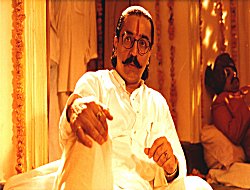
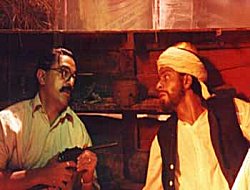
The movie is the flashback of a bedridden, 89-year old man Saket Ram. Saket Ram(Kamalhassan), a South Indian Brahmin, and Amjad Ali Khan(Shah Rukh Khan), a muslim, were archeologists and friends. Saket was married to Aparna(Rani Mukherjee) and lived in Calcutta. In the riots leading upto Partition, Aparna was brutally raped and killed and he turned on the muslims. This brought him into contact with Shriram Abyankar(Atul Kulkarni), a Hindu fanatic, who firmly believed that Mahatma Gandhi was pandering to the Muslims. Saket then moved back to Tamil Nadu where he married Mythili(Vasundhara). A trip down memory lane brought him back into contact with Abyankar. Saket and Abyankar were recruited to kill Gandhi. But Abhyankar's death left Saket on his own and after renouncing his family, he travelled to Delhi to assassinate Gandhi.
 Kamalhassan, the director, stands tall in Hey Ram. The
riot scenes are realistic and a couple of images like the blind
girl in the hut or the sight of a pile of bodies being
taken away in a truck, are tough to forget. The pains taken to
go the extra step to maintain realism are evident (for instance,
Kamal reading an old edition of 'Ananda Vikatan'). He has tried the
concept of visual imagery (the scene of the lizard drinking up
blood) and it is effective. The scenes in Kasi are grand and
handled efficiently. The climax is strong and Gandhi's dialogs
here are simple but forceful and sensible. The graphics though,
leave a lot to be desired. The kaleidoscope of images with a
swastika, a lotus, etc. and Kamal and Vasundhara's fall through
the sky wrapped in satin sheets seem tacky. The graphics also seem
out-of-place in the scene where he decides to take up the gun but
the scene which shows him standing with a gun against a tornado is
visually impressive.
Kamalhassan, the director, stands tall in Hey Ram. The
riot scenes are realistic and a couple of images like the blind
girl in the hut or the sight of a pile of bodies being
taken away in a truck, are tough to forget. The pains taken to
go the extra step to maintain realism are evident (for instance,
Kamal reading an old edition of 'Ananda Vikatan'). He has tried the
concept of visual imagery (the scene of the lizard drinking up
blood) and it is effective. The scenes in Kasi are grand and
handled efficiently. The climax is strong and Gandhi's dialogs
here are simple but forceful and sensible. The graphics though,
leave a lot to be desired. The kaleidoscope of images with a
swastika, a lotus, etc. and Kamal and Vasundhara's fall through
the sky wrapped in satin sheets seem tacky. The graphics also seem
out-of-place in the scene where he decides to take up the gun but
the scene which shows him standing with a gun against a tornado is
visually impressive.
There are lots of non-tamil dialogs in the movie. The initial portions in Calcutta are almost entirely in Hindi (which led some audience members to complain that they had walked into the Hindi version by mistake!) and key pieces of dialog uttered by Gandhi towards the end are in English. Though this retains authenticity(lacking in movies like Uyire when a terrorist in a jungle in a North-eastern state speaks in tamil!), it alienates the audience. Wonder why Kamal did not resort to even tamil subtitles, a common tactic when dialogs are forced to be in other languages.
Kamal appears in almost all frames of the movie in a tour-de-force performance. But he does appear to be running out of variations in his bag of acting skills. His moaning after his wife's death is similar to his famous scene from Naayagan. Naseeruddin Shah is fantastic as Gandhi with his facial and hand gestures. Shah Rukh shines in the stand-off between him and Kamal in Delhi. Among the heroines, Vasundhara catches the eye as the docile but perky second wife. Though her interaction with Kamal exhibits shades of the Kamal-Revathi portions in Thevar Magan, she holds her own against Kamal in her first movie. One does feel Kamal has wasted the talent of actors like Girish Karnad, Sowcar Janaki, Nasser and especially Om Puri with their minute roles. Ilaiyaraja's strong background music plays an important part in many of the scenes. Hey Ram... song is powerful in the background while Nee Paartha... is melodious and well-picturised.
