PUDHUPPETTAI
A movie review by Balaji Balasubramaniam

| Cast: | Dhanush, Sneha, Sonia Agarwal, Bala Singh |
| Music: | Yuvan Shankar Raja |
| Direction: | Selvaraghavan |
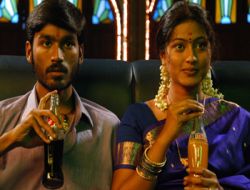
We�re first introduced to �Kokki� Kumar (Dhanush) when he is a student at a nearby school. Forced to run away when his father kills his mother in a fit of rage, he joins the group led by Anbu (Bala Singh) and does odd jobs for the Opposition party, with whom the group is aligned. Along the way, he befriends Krishnaveni (Sneha), a prostitute. Kumar slowly begins to rise within his group and then beyond it, but earns a number of enemies along the way.
Pudhuppettai comes off as a bold film in the characterization of its protagonist. �Kokki� Kumar is probably the least sympathetic protagonist we�ve had in Tamil cinema in a long time as Selvaraghavan presents him with his warts in full view. He smokes, does drugs and sells them, visits prostitutes and kills with impunity. We watch him and are fascinated by him but we rarely feel for him. When he receives verbal whiplashes from people around him one after the other at one point, we feel no sympathy for him and simply feel he deserves the words. We are not expected to have any emotional investment in him and that is Selvaraghavan�s biggest gamble.
Nowhere is the movie�s intent to be different more evident that in the protagonist�s relationship with his women. This might well be the first Tamil film without a real romance. Dhanush�s relationships with Sneha and Sonia Agarwal are both developed along usual lines but then take turns that defy Tamil cinema conventions. On one hand we have a hero who dumps his girl because he is infatuated by another as soon as he sees her. And on the other hand we have a heroine who, with one stinging line, flushes Tamil cinema�s venerated thaali sentiment down the drain.
The first half of the film captures Dhanush�s rise to the top of one of Chennai�s rowdy gangs. There are a few nods (like his relationship to Sneha) to Naayagan here but for the most part, the movie is fresh, fast and furious. Dhanush�s character is defined in this segment as we realize that he is someone who will stop at nothing to get what he wants, whether it is money, power or the woman he likes. The film also draws some nice parallels between him and Sneha (there is a wonderfully composed shot that illustrates how similar they are).
Once Dhanush establishes himself as top gun in his gang, he turns his attention to politics. At this point, the movie turns into a treatise on the criminal-politician nexus. We�ve had enough movies chronicling this and the film offers nothing new as Dhanush works like a dog for his party only to be thrown aside when his usefulness runs out. But the bigger problem is that this takes our attention away from Dhanush. The movie introduces us to people who, even if they have less screen time, are worse than Dhanush. He is no longer the baddest of �em all. Our focus turns to the wily ways of the politicians and as a result, the film loses its focus.
But the movie reels us back in with a strong emotional hook. By introducing a character that Dhanush - and more importantly, we - finally caree deeply about, the movie gets our attention and gets our pulses racing. One scene in particular, that stops our heart before making us smile in relief, is really intense (there is a similar scene with the same emotional arc in Crashtoo).
Selva unfolds the film as a series of flashbacks and as he did in 7/G Rainbow Colony, he uses the opening scenes to create a certain impression in our minds before breaking it in the end. But what was a shocking surprise there seems more like a cheat here. The open-ended climax is acceptable but the way it is brought in makes it seem like he led us on for the sake of a twist.
Dhanush gives a strong performance. But he shines in the quieter moments than when he tries to �act�. The wide-open eyes and loud voice seem artificial at places. On the other hand, see the frustration in his eyes when he gives up asking a girl for alms and moves on to the next car. Very realistic. Sneha is wasted in a role that has little scope. She has a couple of places to show the actress in her but it�s not much. Sonia is non-expressive as usual but makes a mark because of her character. She gets some of the bluntest lines in the film and relishes them. Most of the supporting roles are filled by unfamiliar faces but they do their job perfectly. Like the actors in Kaadhal, they fit their characters perfectly and look less like actors and more like real politicians and rowdies.
Visually and technically, the movie is a treat for the eyes and ears. Color tones have been chosen with care to complement the mood of the movie. A lot of camera techniques have been used to make the movie seem almost alive and full of energy. There are split screens, fade-outs, color accents(where everything is in B&W except for the bright red of the blood � a la Sin City) and even the famous tracking shot(seen first in Jaws) where the foreground zooms closer while the background moves back at the same time. Such tricks catch our eye but are not overused to make Selvaraghavan seem self-indulgent.
The song sequences are picturized with a lot of flair and are nicely choreographed. Enga Area�, with its group dance, is the pick of the lot but Vaariya� and Pul Pesum� are also fun numbers. Only one half of Neruppu Vaayinil... is heard while Oru Naalil... is completely absent. The instrumental pieces like Going Thro Emotions� provide some haunting background scores but barring the key pieces which are on the album, the rest of the background score fails to stand out.
Pudhuppettai - Well worth a visit...
