VIRUMAANDI
A movie review by Balaji Balasubramaniam


| Cast: | Kamalhaasan, Abhirami, Pasupathi, Napolean, Rohini, Nasser |
| Music: | Ilaiyaraja |
| Direction: | Kamalhaasan |
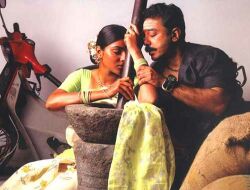
Virumaandi(Kamalhaasan) and Kuthala Thevar(Pasupathi) are both in jail, the former given the death penalty and the latter, life imprisonment. Angela(Rohini) arrives in prison to make a documentary opposing capital punishment and gets the chance to interview both of them. Though their versions are different, Angela learns about Virumaandi's love for Annalakshmi(Abhirami) and Kuthala Thevar's scheming that led to Virumaandi's arrest for 24 murders and the rape of the very woman he loved.
Virumaandi contains a rather strong message against capital punishment. But apart from the direct declarations (like the documentary at the beginning, Rohini's reasons for her stance and Kamal's interview that closes the movie), the movie's story by itself does not present a strong case supporting its message. It says that an innocent man could be awarded the death penalty but then, an innocent man should never be convicted and getting him life imprisonment isn't really justice either. The story would have stood just as well on its own without being bookended by the messages. Nevertheless, Kamal's attempt to convey a strong message through the movie, his strong belief in his convictions and his persistence in bringing his vision to the screen are all laudable.
Kamalhaasan adopts a new approach to story-telling, narrating the same events from two different points of view. Pasupathi's story initially seems a little choppy but once Kamal's version starts and the gaps are filled in, we understand the reason behind that. Some scenes are picturised with just small changes from one version to another but the results are radically different. Sure we are no stranger to the events that take place on screen. We have romance, song and dance, temple festivals, land deals and double and triple crossings. But the way the story has been picturised is so fresh that it gives us the impression that we are seeing something completely new on screen. To do it this way instead of a regular flashback is a brilliant technique and kudos to Kamal for that.
Aside from the story-telling technique, the screenplay makes for a rollicking ride as long as the setting is the village. The well-picturised bullfight sets things off on a fast pace. The romance between Kamal and Abhirami is delightful, with both fun and tenderness at the right places. The movie is also extremely bloody and violent with decapitations, mutilations and spraying blood. But the violence is always matter-of-fact and is never dwelt upon. So it does not seem crude or exploitative.
The majority of the action in the second half takes place within the confines of the jail and its claustrophobic nature has been exploited very well. The scenes where the inmates chase Rohini and her cameraman is one example of this. It is tense and has also been choreographed very well with its dashes through the narrow corridors and use of the different doors and other articles(note the way Kamal deals with one his attackers in the hanging room). Things get a little cinematic with the riot it doesn't extend so long that we lose interest. And the usage of Garba graham vittu... at a key point here is one of the best examples of both aspects of a song (music and lyrics) making a normal scene rousing to the point of creating goosebumps!
Kamalhassan the actor plays second fiddle to Kamalhassan the director but there are still a few scenes(like his lament at his grandmother's death) where the actor catches our attention. The find of the movie is undoubtedly Abhirami. The actresses is wonderful as Annalakshmi, with just the right mix of cuteness, affection and bravery. Her accent is perfect (it seems more natural than even Kamal's accent at times) and enhances quite a few otherwise regular dialogs. Pasupathi is perfect as the wolf in sheep's clothing. The character has several nice touches designed to earn our revulsion and Pasupathi's sly look and wolfish grin convey the perfect impression. Napolean is dignified and Rohini is convincing as the interviewer with a cause.
Ilayaraja's contribution, whether in background music or the situational songs, cannot be measured easily. Songs like the slow and romantic Unna Vida... and Kombula Poova... convey the mood perfectly. And the background music elevates the scene at so many places too. The cinematographer and art director deserve special praise among the other technicians. Political problems prevented Kamal from shooting in the actual village and the village was recreated in Chennai. But only one who knew this beforehand would realise this. So realistic are the sets. The photography also adds to the mood, whether the grim indoors of the jail or the romantic outdoors where Kamal and Abhirami spend their first night.
