NANDHAA
A movie review by Balaji Balasubramaniam


| Cast: | Surya, Laila, Rajkiran, Rajasri, Saravanan, Karunas |
| Music: | Yuvan Shankar Raja |
| Direction: | Bala |
The second film is undoubtedly the most difficult for any director who made a name with his debut. Tamil cinema has seen more directors fail(Suryah, Ravichandran, Erajakumaran) than succeed(Shankar, Charan) when following up their initial successes. While Nandhaa is by no means a disappointing feature, it is definitely a step backwards for Bala after Sethu. He can be praised for eschewing commercial trappings like vulgar comedy and flashy duets in exotic locales but the distinctive characterization and freshness in relationships that were seen in his first feature are seen only occasionally here.
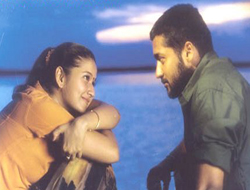
Nandhaa(Surya) has been released from reform school, into which he was inducted after killing his father. Though he did that to save his mother from his unfaithful father, his mother hates him for it. Her attitude towards him is unchanged even after his return and he is take under the wings by Periyavar(Rajkiran), the village biggie. Periyavar provides a home for Sri Lankan refugees and Nandhaa falls in love with Kalyani(Laila), one such refugee. He continues yearning for his mother's love but his violent lifestyle only alienates her further.
As long as the movie focusses on Surya and his mother, it is on solid ground. His pleadings to her to accept him are heartfelt and the recurring images in her mind(of the bloodied face of her husband and her smiling son) give us a very solid reason for her inability to do so. But Surya's violent nature, the very reason for his mother keeping away from him, doesn't desert him even when he is reasoning with her. His acts of pushing her down and forcing her to feed him reveal the anger that is always lurking beneath his skin and are something new in Tamil cinema, that always deifies motherhood. The climax too reveals another new facet of the relationship between a mother and son and is touching even if predictable and a tad abrupt.
But the movie spends more time on Surya and Rajkiran. Rajkiran treating Surya as the son he never had and Surya looking upto Rajkiran as his father(and even replacement for his mother's love) seem realistic. But the mentor-protege relationship between the two holds nothing new and is developed along the lines of movies like Thalapathy and Dheena with Rajkiran sending Surya off on missions of revenge (the punishment Surya metes out to the rapist is sure to deter potential rapists!). The fights during these portions are one-sided and go on for way too long. The Sri Lankan angle offers something new but doesn't contribute much by way of story. It only serves to provide Surya with his romantic interest.
Surya, who has so far portrayed soft, lover-boy roles, transforms convincingly into the angry, young man. The close-cropped hair, dark grey eyes, beard and blackened lips suit him and he conveys menace with his brooding look and few words. Inspite of the serious tone of the rest of the movie, Laila's role isn't much different from her role in other movies as she pursues Surya to clear up her confusion and falls in love with him. Rajasri is brilliant and manages to convey a lot thrugh her expressive eyes. Rajkiran comes up with another poised, dignified performance after Paandavar Bhoomi though his mumblings are a little difficult to decipher sometimes. Pop singer Karunas is introduced as a comedian and brings life to his character of 'Lodukku' Pandiyan. He is casual in front of the camera and has most of the best lines in the movie.
Yuvan Shankar Raja manages to do the tough job of equalling his dad's contribution to Sethu. Songs like Oraayiram Yaanai... and Maayane... are soulful and fit in perfectly with the sober tone of the movie. Munpaniya... is a very melodious duet and features some glorious visuals of very beautiful locales.
