
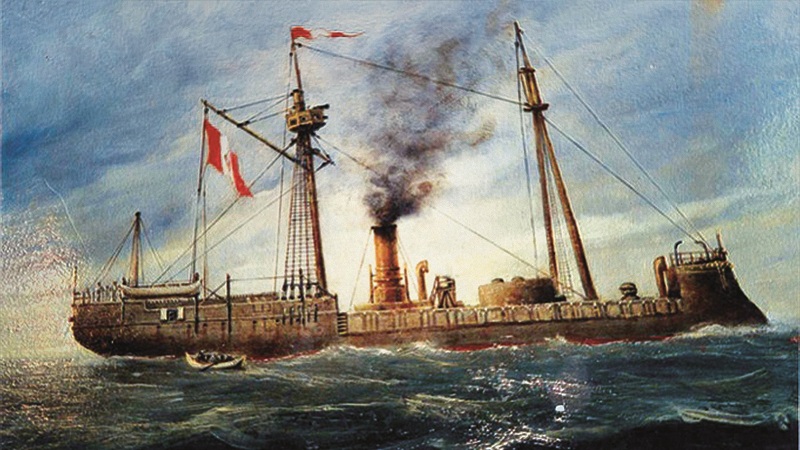
 The Peruvian Ironclad “Huascar”, somewhere off the coast of Chile in the late 1870’s (painting by Peruvian artist Fernando Saldías) |
The Huascar is a two mast square-rigged brick, measuring 67 m. long between perpendiculars and 11 m. wide at the master-beam. She displaces 1,130 tons1 and had a crew of 200 sailors and officers.
The battleship was constructed in 1865 at the Laird & Sons shipyard in Birkenhead (Liverpool) and included a turret designed according to the plans of Commander Cowper P. Coles of the British Royal Navy. She was ordered by Peru and was built under the supervision of one of its navy officers. She was baptized Huascar in memory of the 13rd. Inca emperor.
TECHNICAL DETAILS
The ship has two steam-powered horizontal engines developing a true power of 1,500 HP with only one propeller providing a maximum speed estimated at 11 knots.
She could turn 180° in two minutes. Her coalbunkers have a capacity of 300 tons.
The hull is covered by 35 cm thick teak planks on which are fixed 11.4 cm thick iron plates in the middle of the ship, this thickness being progressively reduced to 6.35 cm at the two extremities. The turret is protected by 14 cm thick iron plates and was operated manually. It took close to 15 minutes to maneuver a full 360° revolution of this turret. A heavy ram made of cast iron passing through the bow prolongs the ship.
The turret was equipped with two 10-inch (or 300-pounder) muzzle loading Armstrong guns. The firepower of the ship was increased by the addition of two pivoting 40-pounder guns mounted on the port and starboard sides of the ship, and by a 12-pounder gun on the rear forecastle. The battleship was later provided with a .44 cal. Gatling machinegun mounted on the front forecastle.
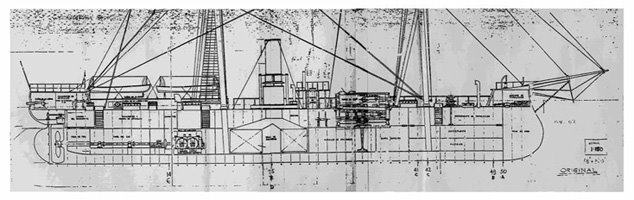 Original design drawing of the “Huascar” by Cowper Coles |
HISTORICAL DETAILS:
Armed in 1865 for the Peruvian navy, the Huascar significantly reinforced the country’s naval forces at the time of the war of independence against Spain. The destiny of the Huascar was truly exceptional, the ship becoming the jewel of Peru’s defenses. In 1866, she captured several Spanish merchant ships. In 1877, she successively fought off two cruisers of the British naval squadron of South America.
It was in 1879 during the “Nitrate War” between Chile and the defensive alliance Peru-Bolivia that the Huascar really became of fame. Facing on her own the entire Chilean fleet during more than 6 months, she truly contributed in preventing the invasion of Peru by Chile.
She fought against on shore batteries, against merchant ships, sometimes against two armored vessels at the same time, her most famous action being the sinking of the Chilean Esmeralda at the battle of Iquique on May 21, 1879. In total she captured 17 hostile ships and broke the enemy’s blockade of Peru’s coasts on numerous occasions.
Six battleships of the Chilean navy finally managed to catch up with the Peruvian ram and surrounded her during a clever maneuver. Attacked by two heavily armed ironclads and a armed schooner during the battle of Angamos on October 10, 1879, the Huascar was hit several times and badly damaged, but she nevertheless continued to fight until the very end, her crew displaying exceptional bravery. Eighty men lost their lives during this ultimate encounter, including admiral Miguel Grau, the ram’s commander who became a national hero, and his two principal officers.
ENGAGEMENT WITH WARSHIPS OF THE ROYAL NAVY:
On 20 May 1877, the Whitehead Torpedo made its combat debut, when HMS Shah fired a single Whitehead at the rebel Peruvian ironclad Huascar. The Shah initially attempted to disable Huascar with a well-aimed broadside, but found her armor impenetrable. With no other options, the Shah’s captain decided to employ this new, unproven weapon as the only option remaining to defeat his foe. The torpedo missed, but its use in combat marked a turning point in naval strategy. Just as in the case of the clash between Monitor and Virginia off Hampton Roads, armor once again proved superior to naval guns. This time, however, the automobile torpedo offered another option and, if successful, technological supremacy to those who possessed it.
The Peruvian ironclad Huascar, designed by Captain Coles, built in Great Britain, and mounting two 12-ton, 10-inch rifles in a single turret. By 1877, Huascar had fallen into Peruvian rebel hands and began to bombard coastal towns and interfere with British shipping. The large unarmored Royal Navy cruiser HMS Shah and its small, unarmored consort Amythest were ordered to halt Huascar’s depredations. Shah fired 280 rounds from its two 9-inch and 16 5-inch, 6.5-ton rifles at Huascar; one round penetrated the Peruvian ironclad’s thin hull armor and killed one crewman. According to Britons the other shot embedded in Huascar’s 5.5-inch turret armor. The British cruiser also unleashed a Whitehead torpedo at Huascar that missed, but it was the first-ever firing of a motor torpedo in action. (The Shah’s busy commander also ordered two spar torpedo attacks on Huascar; the boats’ crews could not even find the fugitive Peruvian.). According to Britons “Huascar then missed all its shots and attempted, also unsuccessfully, to ram”. With the light fading fast, the British commander ordered his two warships to cease firing. But Huascar soon after surrendered to the Peruvian government.
Hardly a glorious passage of arms, the Huascar-Shah clash, the last action by a Royal Navy warship against an armored enemy until 1914, can be seen as demonstrating the resisting power of the armor plate of the time, or as demonstrating the era’s abysmal gunnery accuracy. (In fairness, it should be noted that the two unprotected Royal Navy warships had to maneuver smartly to dodge Huascar’s shells and ram bow, as well as to avoid hitting a nearby Peruvian coastal town before which the Peruvian rebel turret ship had inconveniently drawn up.). The deficiencies of the broadside arrangement of heavy guns was also evident in this clash, as Shah’s crews sweated to manhandle heavy guns from one gun port to the other to follow Huascar’s maneuverings.
NITRATE WAR:
Two years later, Huascar would be involved in a far more sanguinary clash, this time with two Chilean broadside ironclads, during the Nitrate War (1879–1883). The Chilean “Blanco Encalada” and “Almirante Cochrane” were Reed-designed box battery ironclads, armed with six British-built Armstrong 9-inch, 12-ton main guns, protected by a maximum 8 inches of wrought iron. The Peruvians, in addition to Huascar, had two former Union monitors of the Canonicus class that they wisely avoided risking against the Chilean navy’s British-built guns, which would have easily penetrated the ironclads’ laminated armor. (Ever ingenious, the Peruvians also cobbled together a 48-foot-long submersible designed by a locomotive engineer, but it simply could not maneuver quickly enough to get within torpedoing distance of the Chilean ironclads.) The Peruvian-Chilean naval clash off Iquique (21 May 1879) saw two ramming by Huascar causing a bit damage to enemy ship. Huascar did succeed in ramming the halted unarmored Chilean corvette Esmeralda, sending it to the bottom.
Belligerent Huascar then raided up and down the Chilean coast and encountered a Chilean squadron off Point Angamos on October 8th, 1879, composed of the Reed-designed broadside ironclads Blanco Encalada and Almirante Cochrane, purchased from Great Britain, plus four unarmored warships. Outgunned, Huascar again tried to ram, but the twin screws of its opposing ironclads easily outmaneuvered the obsolete single-screw turret ship. Chilean shot penetrated the Peruvian ironclad’s stack, and its upperworks were riddled. One shot penetrated the turret, killing everyone inside. Huascar’s commander was killed, as were the four officers who succeeded him. The survivors (32 of a crew of about 200) didn’t hauled down the flag and attempted to scuttle the warship, but they were thwarted by a boarding party of Chileans, pistols in hand. The two Chilean ironclads had fired 76 9-inch projectiles at a range of 500 feet in dead-calm weather, scoring 20 hits on Huascar, 13 of which penetrated armor. Huascar itself had replied with 40 shells, all of which hit Cochrane, causing little damage but killing or wounding 12 men.
THE HUASCAR AFTER ANGAMOS:
The hastily repaired Huascar was taken into Chilean service. In the bombardments of Arica (27 February and 11 December 1880), Huascar exchanged fire with the Peruvian monitor Manco Capac (former USS Oneota) in the only known clash between Ericsson- and Coles type turreted ironclads.
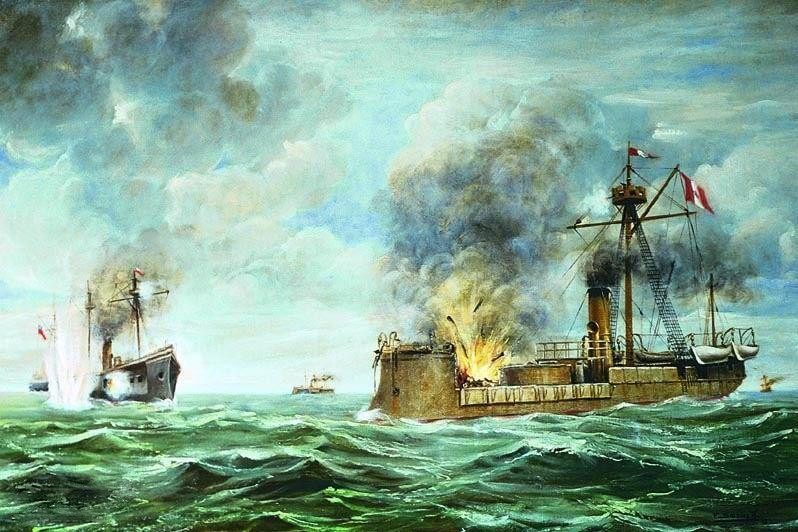 The “Huascar” is badly damaged at the battle of Angamos in 1879 (painting by Peruvian artist Fernando Saldías) |
NOTES:
1 Tons in this article are metric tons. One metric ton = 1.102 long ton.
| More information about Ironclad "Huáscar": | ||
 |
More about Ironclad "Huáscar" |
 |
| Huascar's guns | |
| The Huáscar's designs | |
