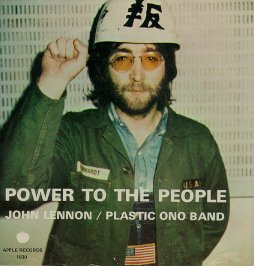
 There was a relaxed dishevelment - piles of clothing, electronic equipment, a guitar, magazines in English and Japanese. The only uncluttered horizontal surface was a bed. A television set, picture on, sound off, perched at the foot - a prompter's box. John Lennon wearing jeans and a blue tank top, sat cross-legged on the bed. John: TV to me is like what the fireplace used to be. You always get these surreal things happening. I used to watch the fire as a child, but since they took the fire away from us, I've decided that TV is it. It's like the window - only this picture continually changes. John: We stand out more in Britain than in America as a mixed-marriage couple. Although there is race hatred in America, you see more different-colored people in America than in Britain. John: Like Yoko says, most people spend so much time trying to be proper, they waste all their energy. People wonder where we get all our energy from. We're like children; we don't spend any time trying to be proper. John: "She" he begins with an affectionate smile at Yoko "changed my life completely. Not just physically. The only way I can describe it is that Yoko was like an acid trip or the first time you got drunk. It was that big a change, and that's just about it. I can't really describe it to this day" Yoko: I like the idea of everything being transient, so that all that is with me is somebody I love and myself. He is drinking tea and eating cherries from a large teak bowl set on an enormous natural pine table. John has mellowed. Gone is the Jesus hairstyle, the long beard, the four-letter words, the arrogant, prickly young man. In his place is a cleanshaven, reasonably short-haired man of 30. He studies you through yellow tinted spectacles and says he swears only occasionally. He is fond of recounting that he and Yoko met over a hammer and nail. John: From that moment (you all know the one) it was love, love, love all the way. On the idea that Yoko was responsible for the break-up of his marriage: John: You don't get divorced and then look round, so Cynthia and I hung on. We were carrying on with a non-violent marriage that was slowly dying. There was nothing in it, no spark. When I met Yoko, I came face to face with reality and realized I had been living in a vacuum. The "Song for John" track on "Approximately Infinite Universe" album was written before she met Lennon Yoko: I met John in 1966 to be exact, but we weren't really good friends then. A record company had suggested I do an album of my sort of freak-type freestyle things, one of which was Song for John. When I was writing it, I was thinking about wanting to meet somebody who could fly with me. Then suddenly, he came into the picture and was the first person who listened to the demo - so I felt a sentimental reason for the name to be John. "Yoko, I love you!" sang out one guy in the audience. "Why the f*** does John put up with this crap?" the guy sitting behind complained bitterly. And there you have it. It's Yoko Ono's fate to forever polarize people's attitudes. She's on her feet doing "What a Bastard the World Is" giving that microphone hell. She brings out two young girls from the wings, has them blindfolded, then tells them to go search in the audience for a guy who's had a tail pinned to his bottom. What's happening is a happening of sorts, and though there are several who happen to the exits, most of us like our ass pinched. A brush with nubility. So two unseeing girls, touching us up, while she does "Kite Song" Sits on a stool, legs akimbo, for "Is Winter Here to Stay?" There's only three lines to it, but she's screaming and moaning in the old routine - it's like a trip to the Wailing Wall - and the sax is raspberrying and the lead guitar has a lovely break. Slow blues. East meets West. Is winter here to stay? You never know, but "Is Winter Here to Stay?" and that's it. It had only lasted an hour. It's all right if you don't like Yoko because there's enough of us who do. She's a good larf and a good cry. One of these days she might even have a hit. John Lennon is married to her, you know. You remember him? How do you feel women are oppressed by society and what can be done about it? Yoko: Well, women have been oppressed by the society for ages and in such a way so that some of them are brainwashed to the extent that they love to be slaves or they feel that they have to say that they love to be slaves. The woman's role is to say that you are a slave and you love to be one and that's considered to be feminine and it's a very sad situation. I'm very proud that my husband is the first man in the world who sang about women's problems and I think it's very meaningful for the female liberation too that we're getting an understanding from the most male chauvinest business in the world - the star industry. He's in that world and he's singing about it. John: EMI killed our album Two Virgins because they didn't like it. With our last record, they've censored the words of the songs printed on the record sleeve. F***** ridiculous and hypocritical - they have to let me sing it but they don't dare let you read it. Insanity. Yoko: I think we were really meant to meet, you know. I didn't realize it at first because I was such a thoroughly conceited artist. I thought I was doing brilliantly as far as my protest were concerned. But then we met and started to fill each other with our ideas. I've always thought that it's better to work on your own, but's it's not. John: Two heads are definitely better than one! On The Amsterdam Hilton Honeymoon Bed In: John: It was no use pretending to have a private life; none of that Mick and Bianca bullshit: having tantrums outside the church after they had invited everyone to the wedding in the first place. Daft, I call it. How would you characterize George's, Paul's and Ringo's reaction to Yoko? John: You can quote Paul, it's probably in the papers; he said it many times that at first he hated Yoko, and then he got to like her. But it's too late for me. I'm for Yoko. Why should she take that kind of shit from those people? They were writing about her looking miserable in the film Let It Be, but you sit through sixty sessions with the most bigheaded, uptight people on earth and see what it's f***** like and be insulted. And George, shit, insulted her right to her face in the Apple office at the beginning, just being �straightforward� you know, that game of �I'm going to be upfront, because this is what we've heard� and Dylan and a few people said she'd got a lousy name in New York. That's what George said to her! And we both sat through it. I didn't hit him; I don't know why. Ringo was all right, but the other two really gave it to us. I'll never forgive them, I don't care what f***** shit about Hare Krishna and God and Paul with his �Well, I've changed me mind'' I can't forgive 'em for that, really. Although I can't help still loving them either. John: People accused us of doing everything for the sake of publicity. Wrong again. Everything we did was publicised anyway. It still is - even though we haven't talked to the press in a number of years. It makes no difference; it seems they can't get along without us. Our press-clipping service, which is world-wide, is full of the most bizarre stories. Amongst my favourites is the one that I've gone bald and become a recluse "locked in my penthouse" - a cross between Elvis Presley, Greta Garbo and Howard Hughes - occasionally making cryptic statements like "I've made my contribution to society and don't intend to work again" At the dizziest heights of Beatlemania he lost contact with reality John: That happened many times, but then a lot of other people go the same way. A working guy will get lost for a weekend, get pissed, and forget who he is or dream that he's so-and-so in his car. Well, it was just the same with us. But instead of getting blotto for a weekend, we got blotto for two months, trying to forget whatever it is that everybody tries to forget all the time. Around the time of Help! I began to wonder what the hell was happening, because things were definitely starting to get very weird by then. You had success beyond most people's wildest dreams John: Oh, Jesus Christ, it was a complete oppression. I mean we had to go through humiliation upon humiliation with the middle classes and showbiz and Lord Mayors and all that. They were so condescending and stupid. Everybody trying to use us. It was a special humiliation for me because I could never keep my mouth shut and I'd always have to be drunk or pilled to counteract this pressure. It was really hell. When did you start breaking out of the role opposed on you as a Beatle? John: Even during the Beatle heyday I tried to go against it, so did George. We went to America a few times and Epstein always tried to waffle on at us about saying nothing about Vietnam. So there came a time when George and I said "Listen, when they ask next time, we're going to say that we don't like that war and we think they should get right out" That's what we did. At that time this was a pretty radical thing to do, especially for the "Fab Four". It was the first opportunity I personally took to wave the flag a bit. But you've got to remember that I'd always felt repressed. We were all so pressurized that there was hardly any chance of expressing ourselves, especially working at that rate, touring continually and always kept in a cocoon of myths and dreams. It's pretty hard when you are Caesar and everyone is saying how wonderful you are and they are giving you all the goodies and the girls, it's pretty hard to break out of that to say "Well, I don't want to be king, I want to be real" So in its way the second political thing I did was to say "The Beatles are bigger than Jesus" That really broke the scene. I nearly got shot in America for that. It was a big trauma for all the kids that were following us. Up to then there was this unspoken policy of not answering delicate questions, though I always read the papers, you know, the political bits. The continual awareness of what was going on made me feel ashamed I wasn't saying anything. I burst out because I could no longer play that game any more, it was just too much for me. Of course, going to America increased the build up on me, especially as the war was going on there. In a way we'd turned out to be a Trojan Horse. The "Fab Four" moved right to the top and then sang about drugs and sex and then I got more and more into the heavy stuff and that's when they started dropping us. Wasn't there a double charge to what you were doing right from the beginning? Yoko: You were always very direct� John: Yes, well, the first thing we did was to proclaim our Liverpoolness to the world and say "It's all right to come from Liverpool and talk like this" Before anybody from Liverpool who made it, like Ted Ray, Tommy Handley, Arthur Askey, had to lose their accent to get on the BBC. They were only comedians but that's what came out of Liverpool before us. We refused to play that game. After the Beatles came on the scene everyone started putting on a Liverpudlian accent. In a way you were thinking about politics even when you seemed to be knocking revolution? John: Ah, sure, Revolution. There were two versions of that song but the underground left only picked up on the one that said "Count me out". The original version which ends up on the LP said "count me in" too; I put in both because I wasn't sure. There was a third version that was just abstract, musique concrete, kinds of loops and that, people screaming. I thought I was painting in sound a picture of revolution - but I made a mistake, you know. The mistake was that it was anti-revolution. On the version released as a single I said "When you talk about destruction you can count me out". I didn't want to get killed. I didn't really know that much about the Maoists, but I just knew that they seemed to be so few and yet they painted themselves green and stood in front of the police waiting to get picked off. I just thought it was unsubtle, you know. I thought the original Communist revolutionaries coordinated themselves a bit better and didn't go around shouting about it. That was how I felt - I was really asking a question. As someone from the working class I was always interested in Russia and China and everything that related to the working class, even though I was playing the capitalist game. At one time I was so much involved in the religious bullshit that I used to go around describing myself as a Christian Communist, but as Janov says, religion is legalized madness. It was therapy that stripped away all that and made me feel my own pain. I was working in Cuba when Sgt Pepper was released and that's when they first started playing rock music on the radio John: Well I hope they see that rock and roll is not the same as Coca Cola. As we get beyond the dream this should be easier; that's why I'm putting out more heavy statements now and trying to shake off the teeny-bopper image. I want to get through to the right people and I want to make what I have to say very simple and direct.  The reporters asked why the government was pursuing the case [they wanted to deport John] John: It's very strange. There doesn't seem to be any rational reason. I don't understand it. Was it, he was asked, people who were "out to get you" for his anti-war stands... Self-indulgent is a put-down constantly aimed at John Lennon, and his reply to such criticism is explicit John: When people say I'm self-indulgent, it's only because I'm not doing what they want me to do. Simply because they're still hung up on my past. You have pretty much given up now on dope and God and politics. What are the things you do now to get yourself high? John: I wouldn't say I've given up politics in that way. I mean, I never took up politics. Things I do or for that matter that anybody does are done politically. Any statement you make is a political statement. Any record, even your way of life is a political statement. So in that way, I haven't given up politics. I get high by working. There's some old cliche that I used to despise: work is noble or some jazz like that. Well, I don't know about noble, but that's what I dig doing. And always have, you know. And my work is music and things like that. Of all the songs that you've written, is there any one particular song that you personally enjoy listening to? John: Maybe Walrus. John: I don't feel satisfied unless I've had a dream. I dream in color, too. If you're going to ask me that. It's always very great and very surreal. My dream world is complete Hieronymus Bosch and Dali. I love it. I look forward to it every night.  Have you ever met Elvis Presley? What was that like? John: Yes, I did once. The four of us met him. It was very exciting. We were all very nervous as hell. We met him in his big house in Los Angeles. It was probably as big as the one we were staying in, but it still seemed like a big house; big Elvis. And he has lots of guys around him, you know sort of all these guys that he used to live near. You know, just like we did. We'd always have tons of Liverpool people around us, so I guess he was the same. He had pool tables. I don't know, maybe a lot of American houses have them. But it seemed amazing to us. It was like a nightclub. He had the tv on all the time, which is what I do anyway, and in front of the tv he had this massive Fender amplifier with a bass plugged into it, and he's playing bass all the time with the picture off on the tv (laughter) So we just got in there and played with him. You know, plugged in to what was around and we all played and sang. And he had a jukebox, like I do, but with all his hits on there. If I made as many as him, maybe I'd have all mine on, too. Why do you think rock n roll means so much to people? John: Because the best stuff is primitive enough and has no bullshit. It gets through to you; it got through to me, the only thing to get through to me of all the things that were happening when I was fifteen. Rock & roll then was real; everything else was unreal. The thing about rock & roll, good rock & roll - whatever good means and all that shit - is that it's real, and realism gets through to you despite yourself. You recognize something in it which is true, like all true art. Whatever art is, readers. Okay. If it's real, it's simple usually, and if it's simple, it's true. Something like that. John: The Beatles made it four years ago, stopped touring, had all the money and fame they wanted, and found out they had nothing. And then we started on our various LSD trips, the Maharishi, and all the other mad things we did. It's the old line about money, power and fame not being the answer. We didn't lack hope just because we were famous though. I mean, Marilyn Monroe and all those other people had all the things the Beatles had but were still very unhappy. John and Yoko have the same problems, of the position we're in or the money we have. We have exactly the same paranoias as everybody else, the same petty thoughts - everything goes just the same for us. We have no super answers that came through the Beatles or their power. The Beatles in that respect are irrelevant to what I'm talking about. Do you have a rough picture of the next few years? John: Oh no, I couldn't think of the next few years; it's abysmal thinking of how many years there are to go, millions of them. I just play it by the week. I don't think much ahead of a week. John: There's no other time but the present. Anything else is a waste of time. |
