CIRCUS
December 12, 1978
In praise of 'JAZZ'
the boys conjure up a bizarre junket
Mark Mehler
On Bourbon Street, in the heart of New Orleans' fabled French Quarter, the sign reads, "Bob
Harrington-Chaplain of Bourbon Street." Upstairs, the freelance minister administers to the wicked
minions below, while across the street, the Hotsy Totsy lounge features
naked women parading across an oak bar from dawn to dusk, and next door, the "X-rated Shop" specializes
in scatological posters and joy sticks.
This is Freddie Mercury's favorite American city, where the Mississippi ends its majestic flow and
zealots with big dreams fight a losing battle against hustlers, procurers, and all
purveyors of sleaze.
It is Freddie Mercury's favorite city because the lead singer and bucktoothed frontman of Queen is, above all, an actor.
And in New Orleans, anyone can be anyone they want to be. Tonight, October 31, 1978-Halloween-Freddie Mercury and Queen
have flown in 80 reporters from the U.S., Europe, Latin America and Japan, to see a show and be a part of a show at the same time.
The third concert on Queen's 28-city U.S. tour is in the ornate Civic Auditorium.
Above the stage are listed the names of the mighty: Shakespeare, Michelangelo, Cellini, Durer, Gounod.
Out of the soft blue and green lights and smoke, Freddie Mercury sruts like a rooster,
striking ballet poses, under an astral guitar blare that neatly skirts the sharp edges of rock & roll.
The melodies are undistinguished, but the constant tempo changes of "Bohemian Rhapsody" and "We Will Rock You", keep
an audience awake for nearly two hours of uninterrupted music.
The lighting show is one of rock's most ambitious. Eerie purple lights shine out over the heads
of the audience, making their hair seem cloudlike and inanimate. At the midpoint of the show, a smaller stage
is lowered from the ceiling and 400 lamps meld into the sheer white plane of curtain light.
Freddie is a whirling dervish, dominating every corner of the stage.
"Some people call this song 'Spread Your Legs', he tells the audience,
introducing 'Spread Your Wings'. "And I like it that way".
Starting out in black sequins, he comes out for the first encore bedecked in
orange hot pants, dancing around like Peter Pan. For the second encore he's
wearing a revealing, white body stocking. As he wails 'We Are The Champions', his voice
warbles with mock emotion, and he grasps the michrophone for support.
At the apex of the triumphant denouement, the top executives
of Elektra Records, who have sat smiling throughout the show, arise as one and walk out.
Moments later, the show closes with a taping of 'God Save The Queen'.
Body and soul spent, Freddie ambles off stage, drained and sparkless. But Halloween night in New
Orleans has just begun.
Back in the ballroom of the Fairmont Hotel, over 400 people have gathered to await Queen
and much on a sumptuous table of hors d'oeuvres, such as Oysters Rockfeller and Shrimp Creole. A Dixieland
band plays uninspired jazz jingles, until, shortly before midnight, the
Olimpia Brass band comes marching through the hall accompanied by Queen-the mercurial Mercury,
the winsome Brian May, the puckish John Deacon, the velvety Roger Taylor.
Suddenly, like a giant circus orchestrated by a deranged ringmaster, a legion of
strippers, vulgar fat-bottomed dancers, snake charmers,drag queens, and bizarrely festooned revelers,
begin to strut their stuff before the assembled masses.
Freddie Mercury is beseiged by hungry autograph seekers, groupies and
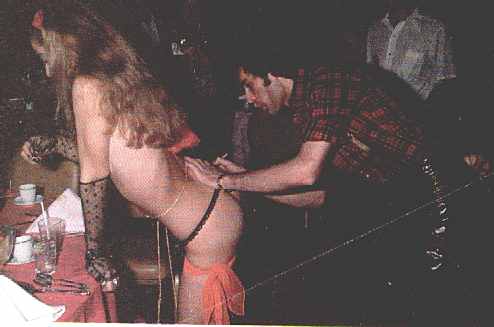
fame-worshippers. People begin shelding their clothes, as an ever-imaginative photographer snaps Freddie
signing the bare backside of a willowy transvestite. Freddie begins sucking on his giant overbite
nervously, and by 2 a.m., he is mercifully gone.
Brian May, who seems to be the true organizer of the night's carnival,
is cornered by persistent Japanese newshounds. "It's wonderful," he keeps saying. "It's so nice to be back."
As the evening wears on, epicene men and butch women act out charades of power
that would have embarrassed Hemingway.
Three obese black women in g-strings do a pathetic bump and grind, and another female participant
amuses a small gaggle of onlookers by putting a cigarette in an unlikely place.
People leave to check out the scene on Bourbon Street and drift back to the party like cigar smoke.
At 4 a.m., a Queen security guard, haggard and irritable, inquires when it will all be over.
"Queen wants the naked disco dancers going to dawn," informs his partner. And it does.
The following day, Queen reappears at a press conference at Brennan's, one of the French Quarter's most elegant restaurants.
Again, it is Roger Taylor and Brian May who dominate the conversation, as Freddie
Mercury seems vaguely preoccupied. The subject of all this is 'Jazz', Queen's new album, which contains no jazz.
"People think we take ourselves a lot more seriously than we actually do," says Roger
Taylor. 'Jazz', Queen's reunion with former producer Roy Thomas Baker, offers 'Mustapha', an up-tempo Hebrew rocker;
'Fat Bottomed Girls', a song that owes a lot to Pure Praire League's 'Amie'; and more indulgent rhapsodies like 'Jealousy'
and 'Bicycle Race', with its topical references to Star Wars, Jaws, and Superman.
The ad campaign, like everything about the Band, goes to the limit of good taste: 11 bare-chested,
major-league-yabboed women racing bicycles.
"It's cheeky", admits Freddie, "naughty, but not lewd. Certain stores, you know, won't run our poster.
I guess some people don't like to look at nude ladies."
Freddie, 32, was born in Zanzibar and educated in India, and was a childhood table tennis
and hockey prodigy. He studied art and became a graphic designer and illustrator,
having given up piano lessons in the fourth grade.
But he continued singing, fronting his first band at 14 and forming Queen
with Roger and Brian in 1970.
After the routine easy grilling, Mercury is cornered outside.
"You seem to be removed from the character up on stage. Is that really you?"
"No," says Freddie, "of course it's an act."
He denies pandering to gays; or for that matter, to anyone. He hints at a quiet, restless
man who needs to step outside of himself for ego-stimulation.
"I have fun wearing all those costumes," he says. "I can really cut loose up there".
Freddie is then swiftly ushered out, and again, Brian May is left
behind to field the endless questions of the Japanese.
The two-day junket, painstakingly directed by and for Queen, ends with
a few straggling journalists eating Bananas Foster and being more cynical than usual.
Outside, on Bourbon Street, a kfolk singer entertains an empty house of red velour seats,
affirming that a falling tree makes a sound whether it's heard or not.
Which conjures up something Brian May had said about Queen constantly seeking "direct
communication with our audience." For all the words that describe Queen's trip
to New Orleans, direct is surely not one.
 To Go Back
This page hosted by
 Get your own Free Homepage