|
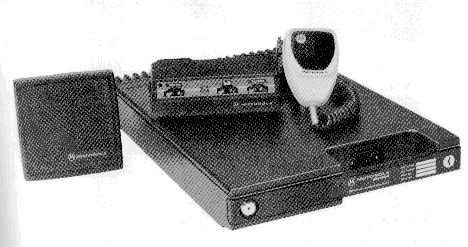
Motorola Syntor radios are synthesized 32 channel radios for VHF high
band and 440 MHz UHF. Manufactured in the 1980's, they were available in
outputs from 35 to 110 watts and with a wide variety of options in the
sys90 heads. A simple modification, not always necessary, can re-range any
of them into the ham bands. Standard models have excellent rf and audio
characteristics, and outstanding reliability, and a cost well under $50,
They are perhaps the best FM radio one could want.
picture
(if you can get it programmed)
|
They use an inexpensive 16 pin bipolar prom to hold the frequency,
but therein lies the reason the radios can be purchased for so little.
Most hams don't have access to programming facilities.
CTCSS PL encode/decode is on an optional board (mounted upside down
at the middle left opposite the VCO) which also using a bipolar prom or
a codeplug. Scanning is rare but possible in banks of 8 channels with a
sys90 head. Cables and heads are the same as are used with Micor radios
except for color. Micor uses grey heads and speakers, whilst Syntors are
black (very dark purple).
Control Heads
generally limit the number of channels fewer than 32. Two schemes are available to
select the channels and two types of radio cables are used.
Radios are all 32 channel, and have a unique interface IC at the
cable connector which accomodates both systems.
Twelve frequency lines, called F1 to F12 are used to input the
desired channel number.
Grounding one of these will select one of 12 channels.
For greater than 12 channels, a binary system is used, grounding
F11 and F12 places the interface chip in binary mode and grounding
combinations of F1 to F5 selects up to 32 channels.
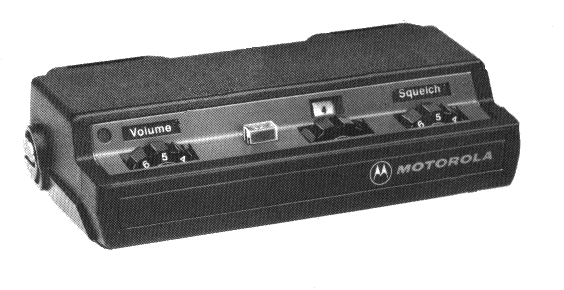
Control heads have rotary switches (
clamshell
head
) or push button switches (rectangular sys90 heads). Cable connectors are
color coded as many, many sys90 boxes are available for many special options.
(Control head cable connections
cable info)
A special tool is available from Motorola to remove wires from the
head connectors and rejumper them to suit the application. The UHF version has limited bandwidth, about 6 MHz which seems to
bother some hams.
The VCO's were available in many ranges but can be easily modified
to shift the range. The microstrip oscillator has strings of capacitors
to precisely set the range at the factory. The wire connecting these
capacitors will be cut. Simply add back or remove more capacitors. When
done, check voltage on the steering line to insure it is still between 3
and 8 volts for the frequencies desired.
| |
If you can obtain bipolar proms, consider building a
bipolar prom programmer
and use the dedicated software to produce the Syntor bit pattern and drive the programmer.
|
|