|
Characteristics
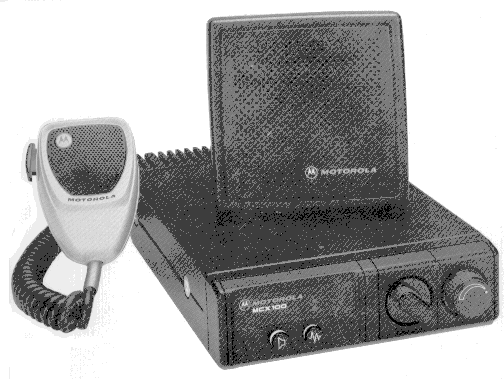
Control heads have LED channel indicator, volume and channel knob,
non adjustable squelch on/off button, one or two digit channel LED, and
additional buttons depending on options
The frequency algorithm is virtually identical to the Syntor.
Frequency is held in an inexpensive 82S129 bipolar prom.
The radios are about half the size of a Micor or Syntor trunk radio.
Integral control head radio uses the same Microphone as a Syntor or Micor.
Speaker, although appearing the same as the Syntor is a 2 ohm
speaker as no output transformer is used.
These radios trade hands for as little as $10 as access to
programming hampers most users. They use an inexpensive bipolar prom for
frequency, and similar proms for pl and scan options.
Squelch action better than a Micor - absolutley no tails.
Sensitivity 0.25 or better - no preamp available or needed.
Many optons were available and not well documented, often using straps on the main pc board. It is frustratingly impractical to attempt changing, removing, or adding an option that wasn't manufactured into the radio.
|
Options
Two channel switches: 16 and 32 position binary encoded. The 32
channel switch is no longer available from Motorola.
Remote head: about 2 by 2 by 8 inches and 20+ foot cable. Microphone
hard wired to backside of the head.
Front ends: The standard helical is 4.5 MHz bandwidth, the wide one is 6 MHz and a dual wide was used to cover non contiguous frequencies. For example, one could have the weather channels (receive) and ham frequencies in the same radio without compromising out of band rejection.
Output: 10W or 30W - I have never seen the 10W version
VHF band splits: Range I 114.6-162 MHz Range II 124.6-174 MHz Bits
in the prom set subrange. Use high side injection on Range II radios to receive below 146.
UHF band splits: Rand I 403-430 Range III 418.6-470 (there is no range II)
PL: optional board uses 82S129 bipolar prom. Enabled with front panel button and hangup box.
Scan: optional board uses 82S129 bipolar prom. Enabled with front panel switches. Many variations of scan available.
|