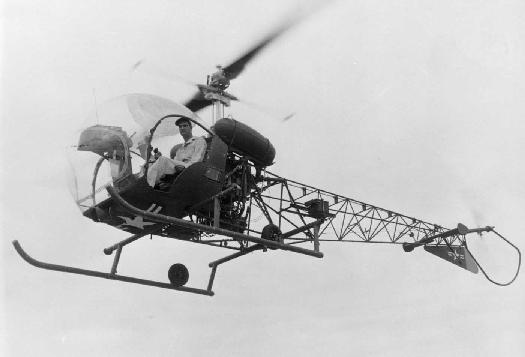
H-13
Sioux
YR-13/H-13/OH-13 Series Sioux light
observation helicopter (1946). The Bell (model 47) H-13
Sioux, with a crew of three, was one of the most popular light
utility helicopters ever built. The Bell model 47 was produced
continuously from 1946 to 1973, and in other countries through
1976. Produced in 20 different configurations, with model numbers
ranging from A to T, the Bell model 47 was used in 40 countries.
The combined total of commercial and military versions of this
series was 5,000. The U.S. Army Air Force procured it's first
YR-13 (model 47B) in December 1946. The OH-13 had a cruising
speed of 70 mph (60 knots). An important Bell inovation during the early development of
the helicopter was the use of short weighted gyro-stabilizer bar
at 90° to, and beneath, the main rotor. The gyro-stabilizer bar,
with streamlined counterweights at both tips, was linked to the
rotor in such a way that it determined the plane of the rotor,
and maintained it generally in the horizontal, regardless of the
angle of the mast. The stabilizer bar, connected to the cyclic
pitch control, acted as a hinged flywheel utlizing gyroscopic
inertia to keep the teetering rotor blades in-plane and
independent of fuselage movement due to gusts of wind, providing
stability during flight. Arthur Young, Bell's designer, ensured
the system had high enough inertia so sufficient energy would be
stored in the rotor to permit safe autorotation in event of
engine failure, an important safety consideration. The H-13 was used for observation, reconnaissance and in the
MedEvac role as a litter carrier in Korea, following initial
fielding in 1951. In the MedEvac role a cacoon-like stretcher pod
could be mounted on each skid. A distinctive feature of the Bell
(model 47D) H-13D/H13E was the now familiar "Goldfish
bowl" plexiglass canopy, featured in the TV-series MASH
(Mobile Army Surgical Hospital). The H-13 earned the nickname
"Angel of Mercy" for evacuating some 18,000 United
Nation's casualties during the war. The OH-13 Sioux also saw
service during the early days of the Vietnam war before the
fielding of the OH-6A Cayuse in early 1968. The Sioux had a
single two-bladed main rotor and a metal two-bladed tail rotor.
The H-13 had a speed of 106 mph (92 knots). The Sioux could be
armed with twin M37C .30 Cal. machine guns on the XM1 armament
subsystem or twin M60C 7.62mm machine guns on the M2 armament
sybsystem. The XH-13F, powered by a Continental-Turbomeca XT51 Artouste I
220 hp turboshaft engine, was Bell Helicopter's first turbine
powered aircraft. Bell (model 47) powerplants were:
| Model 47, 47A, 47B, 47B-3, 47D | Franklin 178 hp |
| Model 47D-1, 47G, 47H | Franklin 200 hp |
| Model 47G-2, 47J, 47K | Lycoming 250 hp |
| Model 47G-3 | Lycoming 225 hp turbo-supercharged |
| Model 47G-2A, 47G-3B, 47G-5 | Lycoming TVO 435 265 shp turbo-supercharged |
| Model 47J-2 | Lycoming 305 hp |
