 |
 |
Nick Drake Home page | Discography | Lyrics | A-Z | Interviews | News | Links
Nick Drake Home page | Discography | Lyrics | A-Z | Interviews | News | Links
Things Still Behind The Sun
-by Suellen Holland
Imagine holding a guitar. Imagine being told how to play a Nick Drake song. Imagine someone describing where to place your fingers, what strings to pluck, what words to sing.
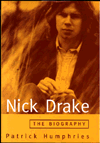
Imagine you're having to do this without ever hearing the song in the first place. Now imagine the frustration Patrick Humphries must have felt as he wrote NICK DRAKE: THE BIOGRAPHY (UK, BLOOMSBURY, 1997) .
Humphries, a compassionate journalist in a time when that phrase is almost an oxymoron, received little or no help from the key figures in Drake's brief life. Nick's sister Gabrielle Drake and his mentor and producer Joe Boyd refused to cooperate. Nick's close friend John Martyn declined to make any new statements. Even the usually loquacious Linda Thompson didn't have much to say; her quotes are often vague, repetitious, or somehow beside the point.
What is it these people don't want to talk about? Humphries can't say, since he is a journalist who will not put forth an idea unless he has a quote to back it up. Such an admirable trait nevertheless leaves holes in his account of Drake's musical career, decline, and death in 1974.
Still, Humphries does as well as anyone could do with both hands tied behind his back. He pads a little in the beginning, going into puzzling detail about the Titanic (yeah, okay, Pat, we get the metaphor) as well as about slightly more relevant matters such as the history of Burma. Fortunately, he writes so well that it's interesting reading, and almost makes you overlook the sketchy information about Nick's childhood.
He had better luck researching Drake's years at his prep school, Marlborough, and the year afterward. Several of Nick's friends from that time were eager to talk about him. Their memories are vivid and poignant, as are those from Nick's housemaster Dennis Silk. This is the book's high point: a detailed picture of what Nick was like when he wasn't depressed. We discover a smiling, gregarious teenager in love with music, confident in athletics, and avid for new experiences in France and North Africa.
Nick's own parents seem to have spoken freely and lovingly about their son to anyone who was interested. Although they are now deceased, Humphries cites previously published interviews with them to frame his account of Drake's few adult years. He was also allowed to interview Gabrielle and Joe several years ago, before the iron curtain inexplicably crashed down, so he is able to draw upon those sessions and upon published quotes from John Martyn.
He fleshes these out with remembrances from many people like Anthea Joseph of Witchseason, who sometimes acted as Nick's "nanny," Robert Kirby, who admired Nick equally as friend and musician, and several other Cambridge cronies who kept in touch with Nick until the end of his life. He includes many eyewitness accounts of Nick's performances, set against the background of the London music scene. Through interview after interview he shows Drake's tendency to "compartmentalize" the various people in his life, and raises the probability that no other drug took as much of a toll on Nick's brain as his prescribed antidepressants.
Humphries pulls no punches, faithfully documenting negative aspects such as Drake's unwillingness to speak to people and his rather "precious" attitude about himself as an artist. Yet the reader is touched by the certainty that no one who knew Nick - with the possible exception of the curmudgeonly Richard Thompson - could help being fond of him.
The book includes only one quote from Thompson, published while Nick was still alive. Since Humphries held extensive interviews with Richard for Thompson's own biography, it is remarkable that he includes no other statement from the man who wrote THE POOR BOY IS TAKEN AWAY. In fact, that song - apparently about Nick's death - is never mentioned, either here or in the Thompson biography. Hello??
What Humphries leaves unsaid sometimes takes on more importance than what he does say. Arthur Lubow, in his 1978 sleeve notes for the box set FRUIT TREE, spoke of Nick's deep affection for Joe Boyd, and stated that Nick's friends sometimes wondered if he were homosexual. Out of 271 pages, Humphries devotes only a few paragraphs to these significant ideas. He mentions no friends who wondered if Nick were gay, although he is careful to include a few half-hearted "oh we woulda known" denials. Again you have the feeling that he was muzzled - or that other people were.
The lack of an index adds to the sense of incompletion, as does the telling subtitle on the back of the book's jacket: "The first biography of Nick Drake." Conscientious journalist that he is, Humphries may be hoping that some day Nick's full story can be told.
Joe Boyd states that Nick told this story himself through his songs. But Humphries was not permitted to cite any lyrics, so the songs are left to speak for themselves. The book also holds very few photos. This is disappointing, not just because Nick was so photogenic, but because pictures of him are another way to glean traces of his elusive personality.
For someone new to Drake's work, NICK DRAKE: THE BIOGRAPHY is a moving and fact-filled overview of his life. For those who have already inhaled his music and any available information along with it, Humphries can provide little more than anecdotes and minor clarifications. In the end, we are no closer to making sense of what happened to this young man than before we started. What the book does make clear is that something did happen to him. Nick's mental and emotional problems were an aberration, not a definition of his personality. He was ill for only a few years out of an otherwise normal life, and it seems a shame that later friends can speak only about the manifestations of that illness. But Humphries' commendable research of Nick's teenage years goes a long way toward erasing the dark myth of perennial tragedy and doom that has enveloped Drake since his death.
John Martyn has expressed himself as being disgusted with that myth, and you wonder why he didn't see that the best way to dispel it might jolly well have been to talk to Nick's biographer. The same goes for Gabrielle, who could have illuminated her brother as a happy and creative child, and for Joe Boyd, who as the other half of Nick's music surely had more of a window into his head than anyone else.
It seems unfair to Nick Drake - almost a denial of him - that none of them wanted to talk about what they know and remember. Imagine what myths can be cleared up when people speak the truth. Imagine what this biography could have been if they had done so.
© 1997 Suellen Holland
Suellen Holland is a freelance writer from Texas, who's currently working on a novel inspired by Drake's music, called RIVER MAN.
Interview with Patrick Humphries | ordering the biography from Bloomsbury