I would like to express my appreciation to Diana Reid and Lynne Graham descendant 's of Johan Valentine Foland for the material on this page.

Henry Foland married in Virginia sometime before 1818, to Mary Emsmiller. Their son John, was born December 12, 1818. Just what happened to this family we do not know today, though there are some old tales of a wife who would not follow her husband to the Indiana wilderness. Be that as it may, there certainly was much bitterness between henry and Mary. In 1822, Henry is said to have walked from Virginia to Indiana, carrying his double-barreled shotgun and a willow walking stick. He was said to have been accompanied only by a hound dog, but I think he had a companion by the name of Wood, at least these two names were associated on the Deed records of the land bought that fall. All this land was, however in Henry Foland's name at the time of his death in 1839.
The story of the land sale has been long told among the early families here. Henry had no money and traded skins or game for his lodgings or his few supplies. His hair, beard and clothing were ragged and unkempt, in fact, a very disreputable figure. At the land sale, the government commissioner rather pointedly observed that he wanted no bids from any parties who were not prepared to pay for the land. Henry is said to have told him to, "Tend to your selling and let the buyer tend to the paying." Soon a tract of land was knocked off to Henry and the commissioner said, "I have attended to the selling. Let us see you attend to the paying." With a quick movement Henry Jerked the ramrod out of the gun, inserted the screw end in one barrel, drew out a rag to which there was a string tied. With this he drew the money from the gun and paid for the land on the spot. The land bought that day was more then 500 acres. Henry was said to have gone down to the river, taken a bath, cleaned up his clothes, combed and trimmed his hair, and beard and returned to the tavern, a Virginia gentleman and an Indiana landowner.
The following January, Hamilton County was created and divided into townships. The first election in his part of the county was held at the house of Henry Foland. He was one of the first two trustees of the poor for his township. He was a member of the first jury to try a case in Hamilton County. Later he was a Commissioner for his district.
Henry died the spring of 1839 and Elizabeth Freel (the Indiana wife) in December of the same year. After her death (to whom henry had willed all but one dollar of his property and at her death to her children) the Virginia wife , Mary Ensmiller, came into court and fought for a share of the estate. The state gave her a dower in the estate, but evidently did not like doing so for they assessed the cost of the suit against her.
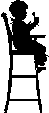 CRADLE LORE: Taken from "My folks Came In a Covered Wagon", published by Capper Publications Inc. -1956.
How pioneer mothers saved time on a busy day. One mother said she put her baby in the high chair, put molasses on its fingers and gave it a feather to play with. That kept it happy for hours. Another mother said she put her baby in the cradle, gave it a piece of fat meat to suck. She tied a string to the meat and attached the other end to the baby's toe. If the baby choked on the meat, it would start kicking and pull the meat out. A third mother said she always put the big baby in one end of the cradle and the little baby in the other. As the big baby played it kept jiggling the cradle and kept the little baby content.
 In the spring of the 1880's many homesteaders went West in covered wagons. In one wagon was a man, his wife and three children. They had a fine team, a cow tied on behind and a dozen chickens in a box. On one side of the canvas was printed, "In God We Trust", and on the other,"Kansas or Bust".
Two or three months later the wagon returned, minus the cow and the chickens. On one side was painted, "In God We Trust", on the other "In Kansas we Busted".
The people going West were cheerful and hopeful. Those going East were ragged, gaunt and tired.
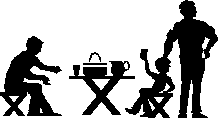 Taken from " My Folks Came In a Covered Wagon", published by Capper Publication, Ind. -1956.
Food supplies pioneers took with them when they went West- barrel of crackers, barrel of sorghum, barrel of flour, a keg of kraut and some cured meat.
 Taken from "Early Life in Decatur County, Iowa
Settlements were mile apart and social communication was difficult. Log rollings, husking bees, barbecues, cabin raisings and other entertainment significant to the pioneers supplied the only opportunity for the people to congregate together and these periods were often months apart. So the pioneer lived alone with his family, in the silent and mighty forest and on the monotonous level of the prairie, going out before dawn to shoot the game for the day's food or to cast a line in the nearby stream. The clothes were make by the goof housewife who sat for days before the loom and spinning wheel. She carded the wool, spun it, wove it and made it into clothes.
 The Weaning House
Michael Foland built a house-one large room with a lean-to kitchen on the north on his farm, located on the second ridge west of the Foland School. This became known as the "Weaning House", for it was here that five of his sons lived after marriage and farmed a part of their father's land until they were ready to start farming for themselves.
A sorghum mill was built just north of the "Weaning House", and people came from miles around with their loads of cane to make their sorghum.
Chris and Lucinda were the first to live in the weaning house and it was here that Frank was born in 1872. They soon moved to a farm, which they later purchased, and John with his wife and two children moved in. Lizzie and Jennie were born in the weaning house. John bought and moved to his farm about 1877 . After Ike and Betty were married in August 1881, they lived with his parents until spring, then moved to the weaning house where their first four children were born. They bought and moved to their farm about 1890. Sanford and Martha lived with his parents until Ike moved out of the Weaning House, then they moved in and lived there until about 1893 when they bought and moved to a farm. George and Celeste lived with his parents a while before moving to the Weaning House where they lived until after the death of his mother. They then moved back with his father to keep house for him.
Lulu and husband George Grimm were living in the Weaning House at the time of Vernie's birth in 1899.
In the fall of 1903, the Weaning House was sold to Laura Foland and husband Leo McConnel for twenty five dollars, moved to the southeast corner of the Chris Foland farm, remodeled and here they lived for two years while they farmed Chris's place. It was then moved to then Frank Foland farm where it was used for a smokehouse and later a corncrib.
 Back to Foland/Voland Genealogy