|
|
|
| It is certain that soon after the first of the Diana,
FWB and Walther pistols hit the market, a formal type of competition was
developed to take advantage of their incredible accuracy and precision.
Although initially contests were fired at a variety of distances, soon
the 10 meter standard we all use today was confirmed. The targets developed
as well, and with each new edition the scoring rings became smaller. What
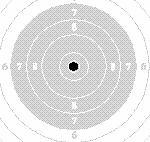
we have today is a target such as this:
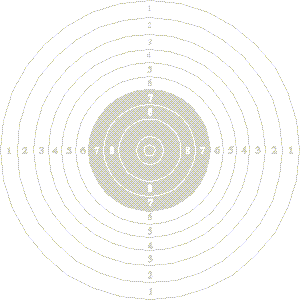 The outside scoring ring has a diameter of 16.5 centimeters ( 6 1/8" ). The 10 ring has a diameter of just 1.15 centimeters ( 7/16" ). That doesn't leave much room for error now does it! Inside of the 10 ring is a still smaller X ring with a mere 5.2 mm diameter. It is possible to shoot a pellet so perfectly on center, that you punch out this ring and leave the white visible around the hole. I know because I have done it, but only twice in five years! Some major changes have taken place in just the last two decades. In 1980, the UIT changed the men's competition from a 40 to a 60 shot format. Women's competition stayed at 40 shots and has remained there since. Also in 1980 the firing of sighter shots was changed, allowing unlimited shots - but all had to be taken before the first shot for record. Before this change a maximum of 15 sighters could be fired, but they could be taken before or after any ten shot string during the match. These were accounted for on the two sighting targets each competitor was given. Now, according to UIT rules, a ten minute preparation period takes place before the match starts, and this prep period is broken into two parts - three minutes of general equipment preparation where you may not handle the gun, followed by seven minutes during which you may dry fire, etc. The length of time a competitor has during a match has been shortened from two hours, to just one hour and forty-five minutes including sighter shots. The X count is no longer used as a major scoring component. I believe that it is used as the third tie breaker, behind number of tens, and the last ten shot string's score. One of the best developments in 10 meter competition came in 1986
with the advent of "finals". This is currently used in all major matches
worldwide. The method is this: After the 60 shot match is complete, the
top 8 competitors are placed in the order they finished the 60 shot match
on the line - first place on position #1, second on #2, etc. They then
begin a 10 shot final shoot-off. In this finals, the competitors have a
75 second time limit to fire each shot. After the last competitor has fired
shot number 1, the targets are scored, and the score is given. The competitors
then shoot shot number 2, after which the scoring is again done, and so
on through all 10 shots. The scoring of each shot is given a numerical
value to the tenth of a point. The lowest possible shot for score would
be a 1.0 with the pellet just touching the outside of the lowest value
scoring ring. The highest value shot would be a 10.9, or a perfect center
shot. This 10.9 maximum value rule has been in place since 1989 when the
11.0 value was dropped by .1 of a point. The maximum score now possible
is 709.0 with the 10 shot finals included. That would be sixty consecutive
tens, followed by ten consecutive 10.9 shots. I can honestly say that I
feel this will never happen. If it does, well ... we can make the
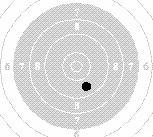
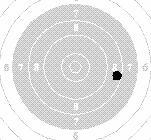
target smaller still I guess?! To further illustrate this scoring method,
here are a few samples of shots and how they would be scored.
|
 |
Third place was decided by a sudden death shoot-off.
Competitor #1 had a 10.1 and competitor #2 had a 9.3. So competitor #1
finished third. For the second competitor this was a heartbreaker, he even
called the shot a 10.5 or better! Before 1989, the tie was broken by the
shooter with the higher ten shot finals score (current National Pistol
Coach Erich Buljung lost a tie in the 1988 Olympics under the "higher final"
rule, and brought home the Silver). In another instance to show how close
competitions can be, Roberto DiDonna of Italy beat the excellent champion
from China, Yifu Wang by just .1 of a point to win the Olympic gold medal
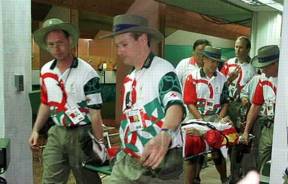
in Atlanta! One tenth of a point! No wonder Yifu collapsed and had to be
taken from the Wolfcreek 10m range on a gurney.
|
| [Webmaster's Note: This incident sparked various expressions such as "I shot a Wang" (i.e. Doing very well in the preliminaries) or the nefarious "I got Wang-ed" or "I did a Wang" (i.e. Doing poorly on the last shot). A real pity to be remembered that way... Oh well, that's how the cookie crumbles...] | |
 |
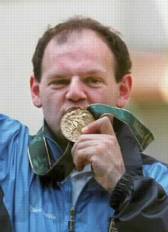
 |
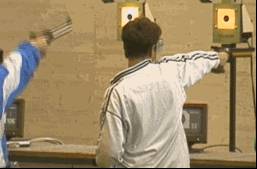
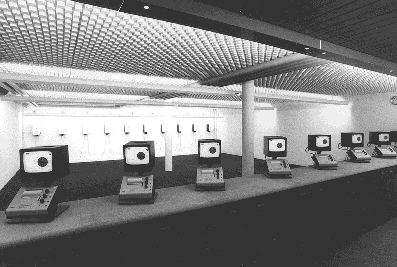
With the advent of finals and the electronic scoring monitors used
at world class competitions, air pistol shooting has become something of
a spectator sport. One of the true injustices in sports broadcasting today,
is that shooting gets no airtime at all during Olympic games. This is a
sport that has drawn more athletes from more countries every Olympics than
any sport except for track & field. Beach volleyball had 4 hours of
total coverage, shooting - none. This is something that I really hope will
change before the next games in Sydney. You can do your part to help this
come about by writing to the major networks and letting them know how you
feel. I have written to NBC, CBS, ABC & ESPN as well as writing to
Sports Illustrated and Inside Sports magazines. To date I have not received
any response. I will, however, keep on writing and I urge you to do the
same.
 Where will air pistol competition go in the future? With the explosion of personal computing and the amazing quality of the internet's communication, I can foresee a competition system whereby thousands of shooters could take part in global on-line matches, without leaving their hometowns. The days of the paper target must surely be numbered as well, if you can imagine a holographic bullseye which contains a grid work of lasers beams, able to measure the shots value to the .0001 of an inch (while at the Olympic Training Center in August of 1997, I had a chance to check out a target system that uses audio location to plot the value of shots that are fired on a strip of paper that scrolls through the frame after each shot - really interesting). But if these developments never take place, one thing will remain certain. Air pistol competition is an enjoyable sport in which to participate - young or old, male or female, standing or sitting in a wheelchair. And that is why we remain involved. |