|
|
|
Rifle Events
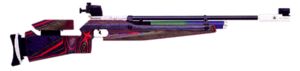
In Air rifle shooting (cal. .177) competitors stand at a firing line 10 metres from the target. The bullseye measures just 0.5mm in diameter! To shoot a world record, a male shooter would have to hit the bullseye 58 times out of 60, a female shooter 39 times out of 40. Male and female standards are therefore exactly the same. No telescopic sights or artificial supports may be used, just the shooter's own anatomy.
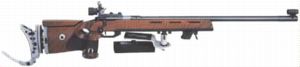
In smallbore (cal. .22LR) rifle shooting, competitors shoot from prone, standing and kneeling positions at a firing line 50 metres from the target. At the Olympic Games, modern target systems use electronic sensors to detect the exact point of impact of the bullet with the target, and scores are instantly displayed on overhead monitor screens. Competitors in these events have to be able to 'read' the effects of the wind on the bullet and allow for it. The bullseye is just 10.4 mm in diameter and the Olympic record for the prone rifle event is a maximum 60 bullseyes with 60 shots.
This event is a men's event in the Olympics and several other international competitions, but some competitions women are allowed to shoot this event. In running target air rifle (cal. .177) shooting, a moving target runs across a range at 10 metres distance from the shooter. The shooter has to mount the rifle and shoot the target 15 times in each direction at one speed (slow run) and then repeat the task at twice the speed (fast run). The margin for error is extremely small and the final of this event, in which each of the top 8 competitors shoots for a medal one shot at a time under the eye of the spectators, is certainly the most demanding test of nerve that can be found anywhere on the Olympic programme. 45 bullseyes in 60 shots are necessary if you want to be the best!! Clothing, Equipment, Accessories: All rifle clothing and accessories
are governed by strict rules for thickness and stiffness. Shooters start
with sweatshirts and tights, then put on jackets and pants made of leather
or canvas. This ensemble improves physical stability and helps muffle the
pulse during these lengthy contests. Flat-soled leather boots aid the rifle
shooter’s stability from the standing and kneeling positions. Leather gloves
with rubber-padded palms helps minimize the discomfort of the heavy rifle
and leather shoulder sling. Athletes use a leather sling (extending from
the triceps to the front of the rifle stock) and a floor mat for support
when shooting from the prone or kneeling positions. In the standing portion
of the men’s three- position match, athletes may use palm rests for extra
comfort and gun elevation. Between shots, competitors rest their rifles
on a shooting stand and use spotting scopes to view their targets. Shooting
glasses, ear and eye protection are other important accessories.
In trap shooting the shooter stands with gun mounted and calls for a target. Instantaneously a target is thrown from one of three traps concealed in a bunker 15 metres in front, at a speed of about 100km/h. Depending on which trap the target came from, it could be flying high or low, and to the left, the right or the centre. The shooter has no way of knowing, and just has to react as fast as possible to shoot the target and break it before it gets too far away (under 1 second). The shooter can fire both barrels of the gun at the target if the first shot is not successful. There are five different shooting stations and a round consists of five targets from each station. The Men's competition consists of three rounds on the first day and a further two, plus a final for the top 6, on the second day. Women shoot 75 target plus a Final for the top 6 in a single day. Olympic Champion Michael Diamond hit 149 targets out of 150 when he won the Olympic Gold Medal in 1996 - a new Olympic record.
In double trap the shooter stands with gun mounted and calls for a pair of targets. There are three rounds in a double trap competition, plus a final for the top six shooters. For each of the three rounds the shooters have different patterns of targets, the pairs being either widely spaced or close together. The shooter has to shoot both targets, one with each barrel. There are five shooting stations just as for trap. Double trap lasts for just one day and consists of 160 targets for women (including final) and 200 for men.
Skeet targets fly across, rather than away from, the shooter, and the shooter must have the gun held down in the ready position before the target appears. The gun has to be mounted, and the shooter has to swing to intercept the flight of the target and shoot it. From some of the eight shooting stations, 'double' targets are thrown which mean the shooter has to shoot two targets flying in opposite directions. Skeet shooting is relatively slow and the shooter has a long time to think about the next shot, a mental challenge similar to that of a golfer, for example. The structure of skeet competitions is the same as for trap - 25 targets in a round, 150 targets (including final) in a competition over two days for men; 100 in 1 day for women. Clothing, Equipment, Accessories: Shotgun shooters typically wear vests with ammunition pouches and extra padding where the gun is shouldered. Most competitors have vests for cold and warm weather. Glasses are used for safety and to enhance target-tracking ability. Competitors have various colored lenses for different weather conditions. For example, a bronze lens is appropriate for sunny weather, while a yellow or light orange lens would be best for overcast skies. Some competitors affix blinders to the sides of their shooting glasses to keep wind out of their eyes and prevent distraction from side motion. |

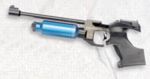 Air Pistol (men's and women's events)
 Free Pistol (men's event)
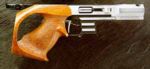 Rapid Fire Pistol (men's event)
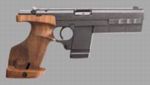 Sport Pistol (women's event)
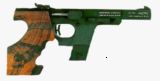 Centre Fire Pistol (men's event)
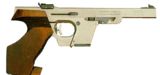 Standard Pistol (men's event)


