The Poetry of Edmund Spenser
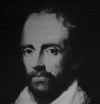 Edmund Spenser (1552-1599) is remembered principally for his "Faerie Queen". In 1580 he became secretary to Lord Grey de Wilton, lord deputy of Ireland. He was granted Kilcolman castle in County Cork, a residence he regarded as an exile. In 1598 he was forced to flee his lands after an insurrection led by the O'Neills. He died in London shortly afterwards, and was burried in Westminster Abbey.
One day I wrote her name upon the strand
One day I wrote her name upon the strand,
But came the waves and washed it away:
Again I wrote it with a second hand,
But came the tide, and made my pains his prey.
Vain man, said she, that dost in vain assay
A mortal thing so to immortalize!
For I myself shall like to this decay,
And eek my name be wiped out likewise.
Not so (quoth I), let baser things devise
To die in dust, but you shall live by fame:
My verse your virtues rare shall eternize,
And in the heavens write your glorious name;
Where, whenas death shall all the world subdue,
Our love shall live, and later life renew.
Questions
- Is this poem an Italian or an English sonnet?
- Give synonyms for the following words from the poem:
- strand
- prey
- vain
- assay
- mortal
- immortalize
- decay
- eek
- quoth
- baser
- devise
- Quote an example of:
- alliteration
- metaphor
- What is the poet trying to do in the first quatrain?
- What reason does the lady give that he will not succeed?
- How does Spenser say his lady's name will be immortalized?
- Paraphrase the last two lines of the poem.
- This poem is about .... (Fill in the blank space.)
- Do you agree with the poet?



