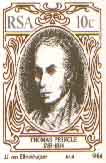
The Caffer by Thomas Pringle
 Lo! where he crouches by the cleugh's dark side,
Eyeing the farmer's lowing herds afar;
Impatient watching till the Evening Star
Lead forth the twilight dim, that he may glide
Like panther to the prey. With freeborn pride
He scorns the herdsman, nor regards the scar
Of recent wound - but burnishes for war
His assegai and targe of buffalo-hide.
He is a Robber? - True; it is a strife
Between the black-skinned bandit and the white.
A Savage? - Yes; though loth to aim at life,
Evil for evil fierce he doth requite.
A Heathen? - Teach him, them, thy better creed,
Christian! if thou deserv'st that name indeed.
Questions
- Give the rhyme scheme of the poem.
- What kind of sonnet is this poem?
- Identify the figures of speech in:
- lines 3 & 4
- line 5
- Give synonyms for the following words from the poem:
- cleugh
- dim
- scorns
- regards
- burnishes
- targe
- Quote two words in the first two lines which suggest
that "the Caffer" is up to no good.
- If "the Caffer" is a bandit, who else is a bandit?
- The "Caffer" is said to requite evil for evil.
What does this suggest?
- To whom is this poem addressed?
- In your own words say what Pringle is saying about
the "savagery" of the "Caffer".
The word "Caffer" or "Kaffir" was used extensively in the nineteenth century, as a generic term for the Bantu-speaking clans and polities in the Eastern Cape border region. Literally it means heathen. In Pringle's day it would not have had the racist overtones it acquired subsequently. Classes should be made aware of this fact.



