Ancient Bronze Weapons
| Chinese bronze objects first
appeared about six thousand years ago at the end of the Stone Period and the beginning of
the Metal Age. Weapons made of bronze were predominant in China for about four thousand
years at which point iron weapons became popular.Here we show some pictures of ancient bronze weapons which have been excavated in
China. Beautiful and historically interesting, they come from different ancient dynasties.
Although the earliest of them dates from the Xia Dynasty (2100 BC - 1600 BC), it was
during the Shang Dynasty (1600 BC - 1100 BC) that the technology of making bronze weapons
was developed to a high level. Bronze weapons of excellent quality were produced
throughout the following West Zhou Dynasty (1100 BC - 771 BC), the Spring and Autumn
Period (770 BC - 476 BC) and the Waring States Period (475 BC - 221 BC). Most of the
weapons unearthed today come from these time spans. Iron weapons began to appear toward
the end of the Warring States Period and quickly came into general use. Both bronze and
iron weapons were used during the Qin Dynasty (221 BC - 207 BC), but bronze weapons were
soon eclipsed by those of iron. Although bronze was used much earlier than iron,
more bronze weapons have been unearthed than iron because bronze
decays or rusts much slower than iron when under the earth.
|
�@

|
Ge: The most popular Chinese long weapon used in
ancient times was the Ge. In the very beginning, people just tied a piece of stone on top
of a staff as a weapon. When bronze was used, people made many beautiful Ge heads. In the
ancient world, soldiers fought from "fighting wagons" using long weapons. Ge was
very useful for this. When rider horse became popular, Ge was obsolete generally. Ge
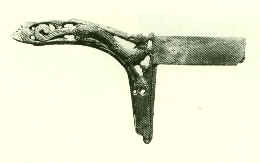
remained in use through the Three Kingdom Period (220 - 265). Because Ge was the most popular weapon in the ancient, it is common that it means fighting or war. The importance and popularity of Ge are reflected in the Chinese character WU meaning "martial." This character is made up of two parts: one, ZHI, means "stop"; the other, GE, is usually translated as "fighting." "Martial," therefore, means to stop fighting. There a important Chinese idea is that martial arts is not for fighting, is for stop fighting. The Ge heads shown here came from several different dynasties. Usually, one Ge would have been tied on top of a long staff but occasionally, two or three Ge heads would be attached to one staff. |
�@
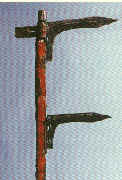 |
Zeng Hou double Ge Ji, Warring States Period, total long 310cm, unearthed from Hubei province | 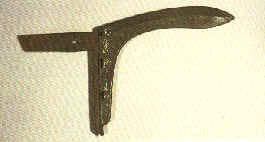 Tenghao Ge, Spring and Autmn Period, 26cm, unearthed from Shandong province
|
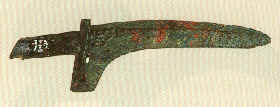 Taibao Ge, West Zhou, 33cm, unearthed from Henan province |
||
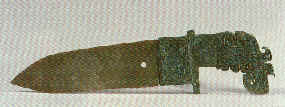 Shang Dynasty, bride grains Ge length 27.8cm, unearthed from Henan province |
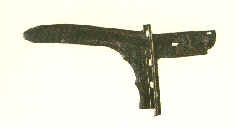 Yan Zhao Wang's Ge, 25.2cm, Warring States Period, unearthed from Hebei province |
|
�@
 |
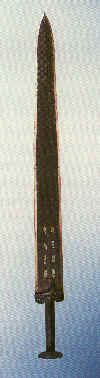
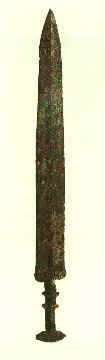
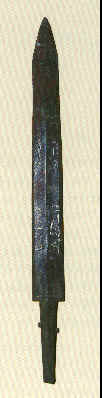
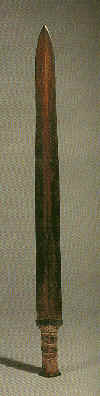
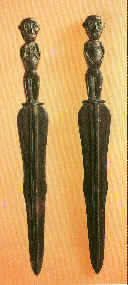
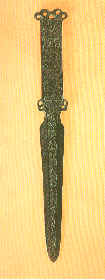
Jian: The most commonly used Chinese weapon overall is Jian, the straight double-edged sword. Not just a weapon, it also symbolizes many values of traditional Chinese culture and character. In the Spring and Autumn Period and the Warring States Period, bronze Jians of very high quality were produced. They were respected and revered as holy weapons. Many legends of heroes and their wondrous deeds date from these periods. |
�@
|
King Yue - Gojian's jian, Spring and Aotumn Period, 55.7cm, unearth from Hubei |
|
King Wu - Gelu's jian, Spring and Aotumn Period, 50.7cm, unearth from Shanxi | ||||
| Fanyang Jian, Warring States Period, 45 cm, unearthed from Henan Province | Chanhou Jian, Warring States Period, 62.2 cm, unearth Hunan Province | ||||||
�@
�@ |
�@
�@ |
||||||
�@
 |
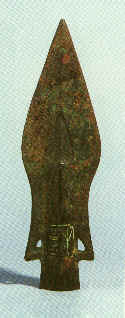
Qiang or spear is the most popular of the Chinese long weapons. Through many centuries of practice and research, spear skills were developed to such a high level that defense against spear skills became the most challenging of all defensive maneuvers. At the same time, of course, strategies and skills for such defensive maneuvers were avidly sought. Here we show some ancient spearheads. Although they are of varying shapes, more attention was actually paid to the quality and production of a spear’s staff than to the spear’s head. |
�@
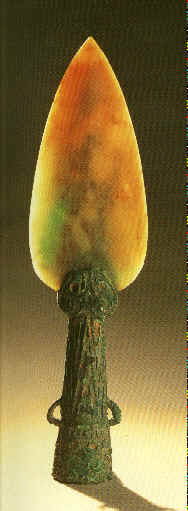 |
Jade spear head. 18.4cm, Shang Dynasty | 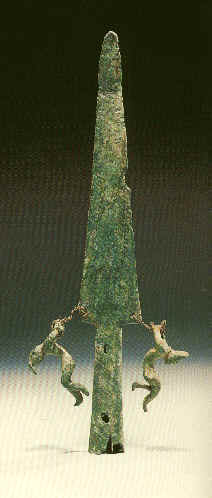 |
Tied Captures Spear Head, West Han Dynasty, 41.5 cm, unearthed from Yunnan Province |
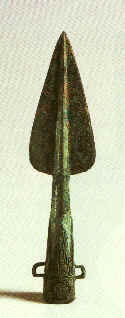
|
Spear head, Shang Dynastry, 24.3cm |
 |
King Wu - Fuchai's spear, Spring and Autom Period, 29.5cm, unearthed from Hubei province |
| Spear head, Warring States Period, 22.5cm, unearth from Sichuan Province | |||
 |
|||
| Spear head, Shang Dynastry, 23.1cm | |||
|
|
|||
| Spear Head, Warring States Period, 15cm, unearthed from Guangxi province |
�@
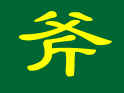 |
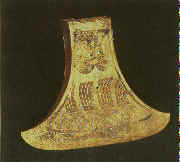
Fu, an axe, is not a common military weapon but it was commonly used by members of the security forces guarding emperors, kings, nobles or generals. It symbolized the power and prestige of the guard’s high-ranking employer. |
�@
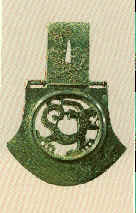 |
Dragon grain axe, Shang Dynasty, unearthed from shanxi province | 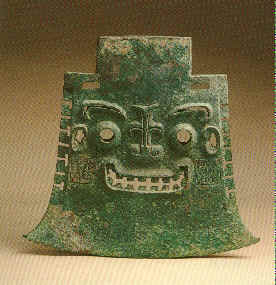 |
Face grain axe, Shang Dynasty, unearthed from Shandong province | ||
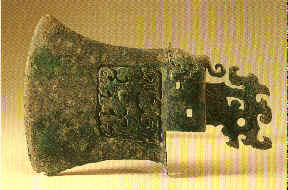 Dragon and tiger grain axe, Shang Dynasty, unearthed from south of China |
�@
|
||||
�@
 |
Dao or saber, became a popular weapon much later than Jian. Sabers made of bronze are, therefore, rare. By the time iron was widely used for the manufacture of weapons, Dao rather than Jian had become the predominant military short weapon. The shape of Dao has changed a lot over time so that today there are many different variations. |
�@
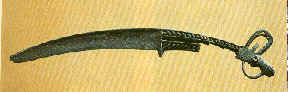 Horse head sword, Shang Dynasty, 32 cm, unearthed from Shanxi province �@ |
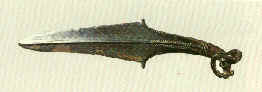 Sheep head dagger, 30.2 cm, unearthed from Hebei province �@ |
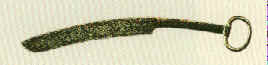 Cloud grain sword, Warring States Period, 14cm, unearthed from Hubei |
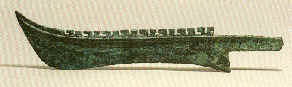 Mulei grain sword, Shang Dynasty, 38.7 cm |
�@
| Other Weapons: In China there are many different kinds of weapons. Usually, people refer to the "Eighteen Weapons" but there are many different versions of exactly which weapons are included in this count. In fact, the specific number is not important. It is meant to convey only that many weapons have been designed and used throughout Chinese military and social history. |
�@
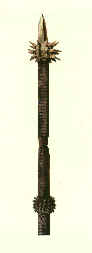 |
Zenghou Yi, Warring States Period, 329cm with staff, unearthed from Hubei Province | 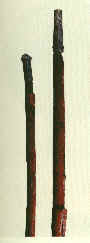 |
JinTuo, Warring States Period, 320cm with staff, unearthed from Hubei Province |
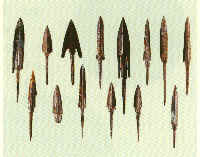 |
Zenghouyi Arrow heads, Warring States Period, 67 - 71 cm with staffs, unearthed from Hubei Province |
�@
�@