Jupiter
| Quick Facts about Jupiter Distance from the Sun (Semimajor axis of orbit) 778,412,010 km 5.20336301 A.U. Mean
Equatorial Radius Volume Mass Density Gravity Escape Velocity Sidereal Rotation Period Sidereal Orbit Period Mean Orbit Velocity Orbit Eccentricity Orbit Inclination Inclination of Atmospheric Temperature Major Atmospheric Constituents |
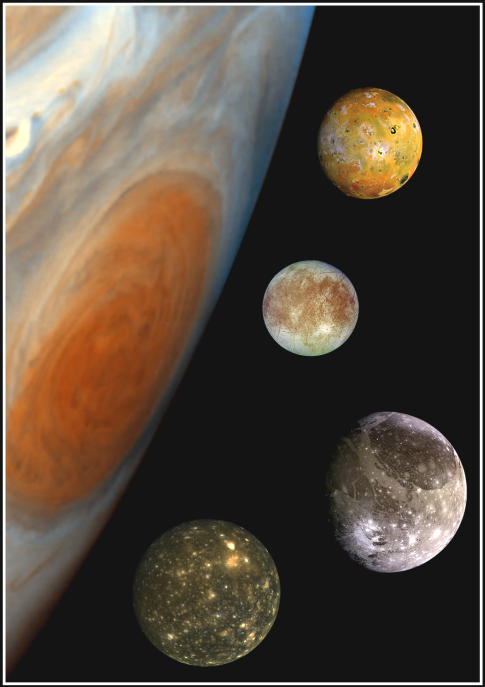
Jupiter's Place in the Solar System Jupiter reigns supreme among our nine planets, containing two-thirds of the planetary mass of the solar system. In composition it resembles a small star. Its interior pressure may reach 100 million times the pressure on Earth's surface. Jupiter's magnetic field is immense, even in proportion to the size of the planet, stretching millions of miles into the solar system. Electrical activity in Jupiter is so strong that it pours billions of watts into Earth's own magnetic field every day. Jupiter is endowed with 16 moons, a ring system, and an immense, complex atmosphere. Its atmosphere bristles with lightening and swirls with huge storm systems, including the Great Red Spot, a storm that has persisted for at least 100 years, perhaps as long as 300 years. Some scientists theorize that beneath the atmosphere there is no solid mass at the center of Jupiter, but that the planet's unique temperature and pressure conditions sustain a core whose density is more like liquid or slush. The reddish color of the "Great Red Spot" is a puzzle to scientists, but several chemicals, including phosphorus, have been proposed as a reason. In fact, the colors and mechanisms driving the appearance of the entire atmosphere are still not well understood. These mysteries cannot be solved by taking pictures. Direct measurements from within the atmosphere are necessary - measurements like those made by the Galileo Probe. 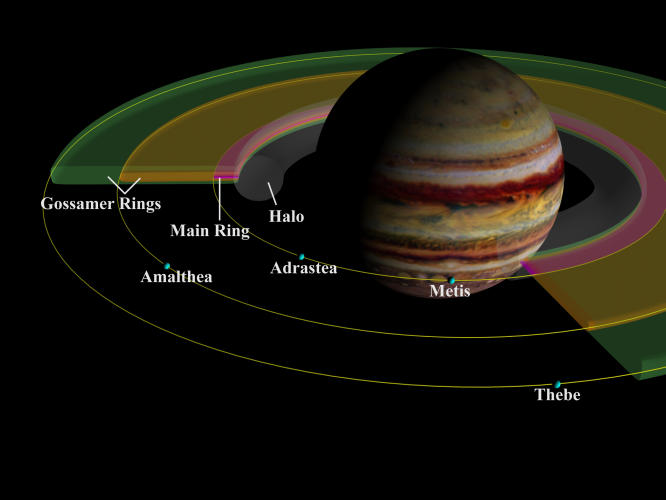
|
||
 |
|||