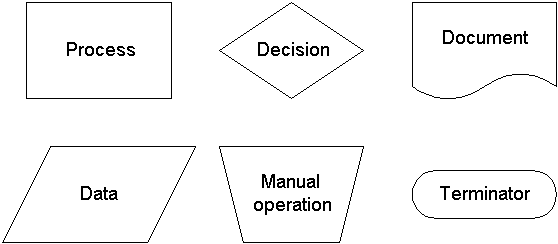
FLOW CHARTS
My Example

OVERVIEW
- Quality Improvement Tool: Flow charts used specifically for a process.
-
- A flow chart is defined as a pictorial representation describing a
process being studied or even used to plan stages of a project. Flow
charts tend to provide people with a common language or reference point
when dealing with a project or process.
-
- Four particular types of flow charts have proven useful when dealing
with a process analysis: top-down flow chart, detailed flow chart, work
flow diagrams, and a deployment chart. Each of the different types of flow
charts tend to provide a different aspect to a process or a task. Flow
charts provide an excellent form of documentation for a process, and quite
often are useful when examining how various steps in a process work
together.
-
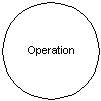 Drive Nail, Cement,
Type Letter.
Drive Nail, Cement,
Type Letter.
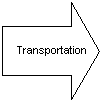 Move Material by
truck, conveyor, or hand.
Move Material by
truck, conveyor, or hand.
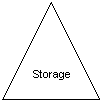 Raw Material in
bins, finished product on pallets, or filed documents.
Raw Material in
bins, finished product on pallets, or filed documents.
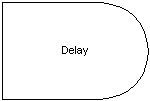 Wait for elevator,
papers waiting, material waiting
Wait for elevator,
papers waiting, material waiting
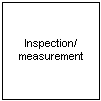 Read gages, read
papers for information, or check quality of goods.
Read gages, read
papers for information, or check quality of goods.
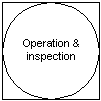 Any combination of
two or more of these symbols show an understanding for a joint process.
Any combination of
two or more of these symbols show an understanding for a joint process.
-
HISTORY
As a whole, flow charting has been around for a very long time. In fact, flow
charts have been used for so long that no one individual is specified as the
"father of the flow chart". The reason for this is obvious. A flow
chart can be customized to fit any need or purpose. For this reason, flow charts
can be recognized as a very unique quality improvement method.
INSTRUCTIONS FOR CREATING A FLOW CHART
Step-by-Step process of how to develop a flow chart.
- Gather information of how the process flows: use a) conservation, b)
experience, or c) product development codes.
- Trial process flow.
- Allow other more familiar personnel to check for accuracy.
- Make changes if necessary.
- Compare final actual flow with best possible flow.
Note: Process should follow the flow of Step1, Step 2, ... , Step N.
Step N= End of Process
CONSTRUCTION/INTERPRETATION tip for a flow chart.
- Define the boundaries of the process clearly.
- Use the simplest symbols possible.
- Make sure every feedback loop has an escape.
- There is usually only one output arrow out of a process box. Otherwise, it
may require a decision diamond.
INTERPRETATION
- Analyze flow chart of actual process.
- Analyze flow chart of best process.
- Compare both charts, looking for areas where they are different. Most of
the time, the stages where differences occur is considered to be the problem
area or process.
- Take appropriate in-house steps to correct the differences between the two
separate flows.
MY FLOW CHART EXAMPLE
Problem Scenario: Installing computer software