
 The
cause
The
cause
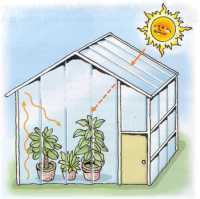
A greenhouse is a glass-built building for growing plants. With illumination from the sun, heat enters the house with little of it escaped as the glass traps it. The temperature inside the house ismuch higher than that of air outside. Plants grow there can have more warmth and healthier.
Our atmosphere is like a huge greenhouse. Greenhouse gases, like carbon dioxide, acts like the glass of a greenhouse. The changes in climate of the Earth and the subsequent effects are called greenhouse effect.
What are greenhouse gases?
| Name of gas | Contribution | Source(s) |
| Carbon dioxide (CO2) |
50%
|
From burning coal and oil, and the removal of vegetation |
| Chlorofluorocarbons (CFCs) |
20%
|
From air conditioners, refrigerators and aerosols |
| Methane (CH4) |
16%
|
From rice growing, animal waste, swamps and landfills |
| Ozone (O3) |
8%
|
From air pollution |
| Nitrous oxide (N2O) |
6%
|
From fertilizers and burning of coal and oil |
Source: Global Ecology Handbook
How the problem intensifies
 The
rapid growth of population needs more food. More cattles, sheep,
etc., are reared. More people breathe out more carbon dioxide, and
the waste of animals generates methane.
The
rapid growth of population needs more food. More cattles, sheep,
etc., are reared. More people breathe out more carbon dioxide, and
the waste of animals generates methane. Carbon dioxide and greenhouse effect
Much carbon dioxide is absorbed into oceans or used by plants for photosynthesis. Nevertheless, the production rate is higher..
Chemists have monitored atmospheric carbon dioxide concentration since 1958. Analysis of air trapped in ice cores from the polar regions permits us to know the past carbon dioxide levels from about 160,000 years ago. The level is fairly constant since the past ice ages some 10,000 years ago. Until the industrial revolution some 300 years ago, the concentration of carbon dioxide has increased by about 25%.
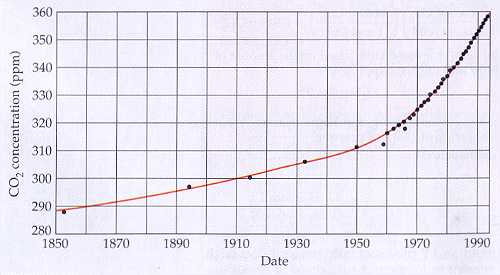
The accumulation or the gas has caused absorption of radiant
heat. The climate changes.
The impact
Greenhouse effect may be beneficial. When the Earth is warmer, there may be an increase in agricultural production. But the problem is that the amount of greenhouse gases increases dramatically. It grew 3 times in the past 100 years. Such rising may induce harmful effects to the environment:
Related topics
Carbon dioxide
Chloroflurocarbons (CFCs)
Ozone
I would love to hear your comments. Please e-mail to [email protected]