
Source
Carbon dioxide [CO2(g)] can be formed from 2 sources. The natural one is from the respiration of organisms. That produced by respiration is taken up by plants during photosynthesis, ensuring it does not accumulate.
The artificial generation of carbon dioxide is the burning of fossel fuels. The additional carbon dioxide in the atmosphere from such raises the atmospheric carbon dioxide concentration.
Social Effects
The change in carbon dioxide concentration in the air has triggered the so-called greenhouse effect. More heat from the sun is prevented to escape from the Earth, rather like the mechanism of a greenhouse.
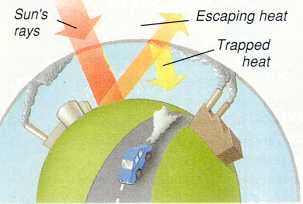
Greenhouse effect will cause expansion of the oceans and the gradual melting of polar ice caps with a consequent rise in sea level. This would in turn cause flooding of low-lying land where many capital cities lie.
But greenhouse effect is not totally bad. Its influence maintains the Earth's temperature at an average of 15°C rather than -18°C which would be the case without any greenhouse gases.
The long term emission (since industrial revolution) of carbon dioxide has posed great effects (50-70% contribution) on global warming. Though other gases like water vapour, methane and nitrogen oxides may absorb infra-red radiation from the sun more effectively and play a bigger role in the process. The long shell life of the gas in the atmosphere provides that it has the major influence on greenhouse effect.
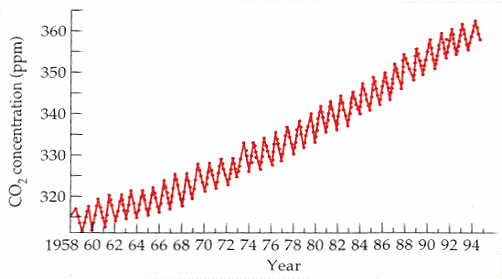
The concentration of atmospheric CO2 has risen more than 10% since the late 1950s. These data are obtained from the Mauna Loa Obseratory in Hawaii by monitoring the absorption of infrared radiation. The sawtooth shape of the graph is due to the seasonal changes in concentration each year.
Related Topics
Greenhouse effect
Ozone layer depletion
Chlorofluorocarbons (CFCs)
I would love to hear your comments. Please e-mail to [email protected]