Technology Enhanced Project Based Learning Review
Based on Project Based Learning
by William Lee
[email protected]
The concept of Technology Enhanced Project Based
Learning (TEPBL) is derived from Project Based Learning (PBL) itself.
PBL has been around for some time in education. It is in essence,
giving students an open ended approach to learning. The students
are able to delve into an area they are interested in and engage in learning
based on the questions they encounter while researching their project.
They are responsible for the direction of their content and presentation,
but at the same time, are cognizant that they are given an area or topic
(example: a strand from Science and Technology) to focus on. Expectations
from other subject areas can be included in the project. To allow
students benefit from learning, it is important they know what is expected
of them. The technological aspect of the project will no doubt enhance
the presentation, but also provide children another tool for learning.
TEPBL also allows students to be competent with technology as they enter
the workforce. For this reason, TEPBL does have a practical value
as it relates to the world.
As Howard
Gardner states in Introducing
Technology Enhanced Project Based Learning: Introducing Project-Based Learning,
it is important for children to ask questions in order to learn effectively.
I definitely believe in this philosophy and have integrated it into my
class, especially in Language Arts. During the last school year,
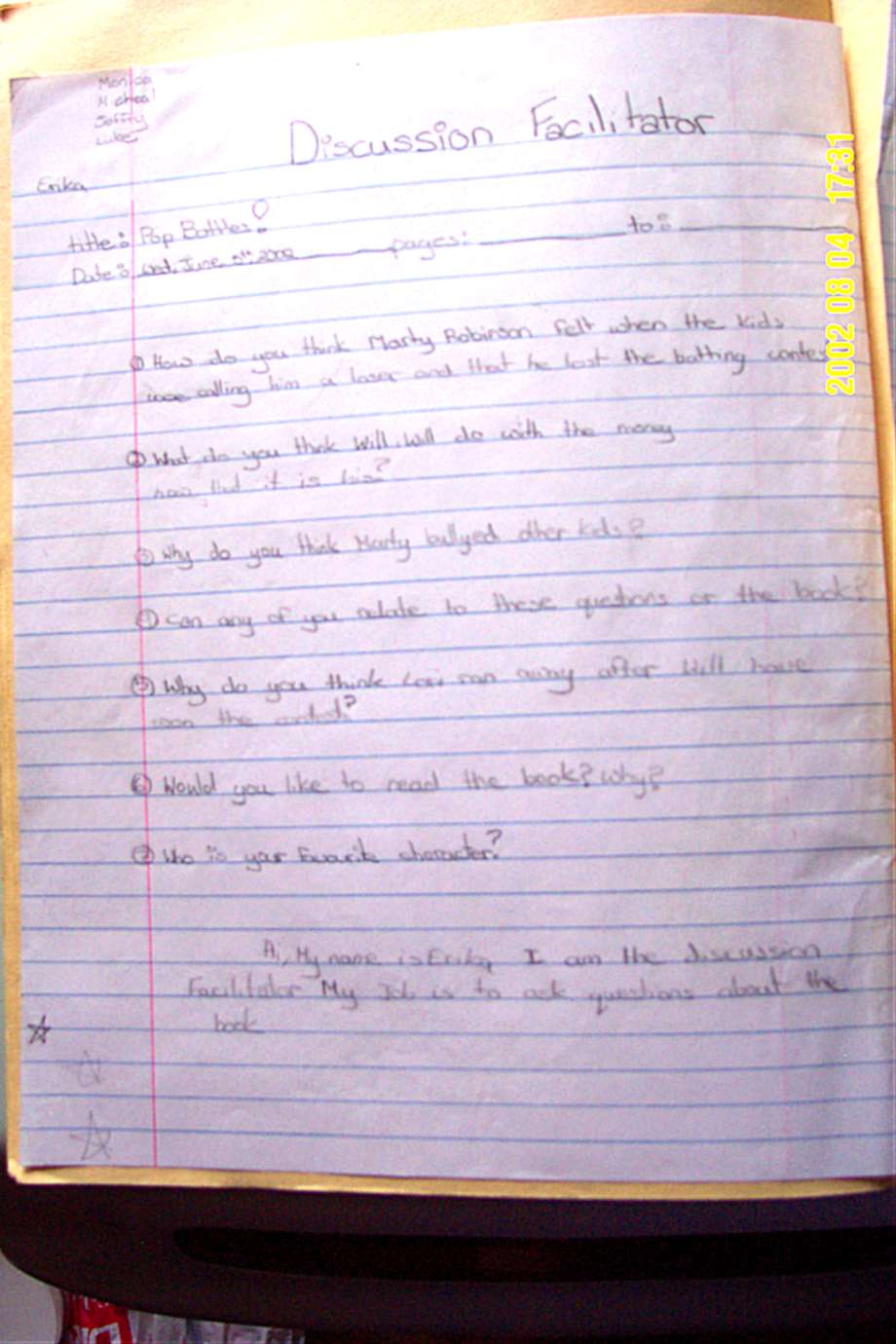
my students participated in Literature Circles and ask
questions regarding the three R's, Retell, Relate, and Reflect on the
five books I had selected. They really enjoyed it and some actually
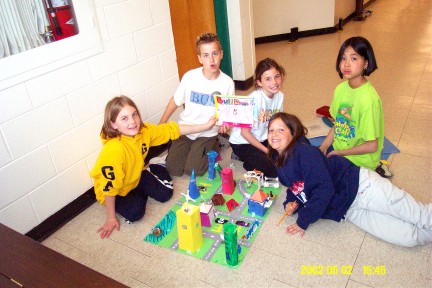
used technology to produce works in preparation for the discussion.
In the end, students were very much interested in reading more books, however,
the school year was coming to an end. Many students who pursue post-secondary
education must have the foundation of being able to ask questions on their
findings and interpret the answers to them. This will ensure students
to become lifelong learners as they leave the classroom and enter the workforce.
Neil
Rudenstine's view of Students
as Researchers compliments the idea of students becoming more responsible
for their learning and instead of being spoon fed the information, they
have to perform the actual research. I know this is not the traditional
approach to learning, however, I do believe there are many children out
there, including my students, who are struggling with the Ontario Curricula.
The last thing they need is another teacher directed lesson. I actually
believe some expectations related to technology were included in the Curricula
to compliment some of the more difficult expectations not normally covered
through regular resources (e.g., books). If students are intrigued
by technology and used it for school projects, they will become more enthusiastic
about learning. TEC
Lesson Plans is a site which demonstrates great strides to integrate
technology into unit plans. Educators see the benefits of integrating
technology in order to help students become lifelong learners and to enter
the workforce knowing they can adapt easily into a technological environment.
There are quite a number of unit plans found at this site covering areas
from elementary to high school.
In Sharing
Research through Multimedia ,
the main points are responsibility and direction of the content and presentation.
Students are given the responsibility of engaging themselves in learning
and finding meaningful ways to present information through the use of multimedia.
They must learn to refine their research because of the large amount of
information out there via multimedia sources (Encarta, Internet, other
educational software, etc...). By learning how to refine their research
and creating a multimedia reports, students will have little difficulties
performing research as they attend post-secondary institutions. Relating
the use of research through multimedia was almost impossible to do in my
class. I did not have enough computers in class or library for the
students to use, however, seventy five percent of the students had computers
at home. The mini project I assigned was Missionaries (Social Studies
- Medieval Stand), I had the kids perform research at home via internet
and other sources. Three quarters of the class handed in reports
typed and on diskette. They had also handed in printouts of their
research from the internet. I did limit the research in terms of
providing them with questions. They were able to select from a list
of Saints of the Medieval Times.
,
the main points are responsibility and direction of the content and presentation.
Students are given the responsibility of engaging themselves in learning
and finding meaningful ways to present information through the use of multimedia.
They must learn to refine their research because of the large amount of
information out there via multimedia sources (Encarta, Internet, other
educational software, etc...). By learning how to refine their research
and creating a multimedia reports, students will have little difficulties
performing research as they attend post-secondary institutions. Relating
the use of research through multimedia was almost impossible to do in my
class. I did not have enough computers in class or library for the
students to use, however, seventy five percent of the students had computers
at home. The mini project I assigned was Missionaries (Social Studies
- Medieval Stand), I had the kids perform research at home via internet
and other sources. Three quarters of the class handed in reports
typed and on diskette. They had also handed in printouts of their
research from the internet. I did limit the research in terms of
providing them with questions. They were able to select from a list
of Saints of the Medieval Times.
As for the upcoming year, we will receive our new computers.
Once these computers are networked ready, I will be able to use the unit
I created (module 3) integrating the use multimedia.
In Assessing
Project Based Work, the main idea is having the students offer their
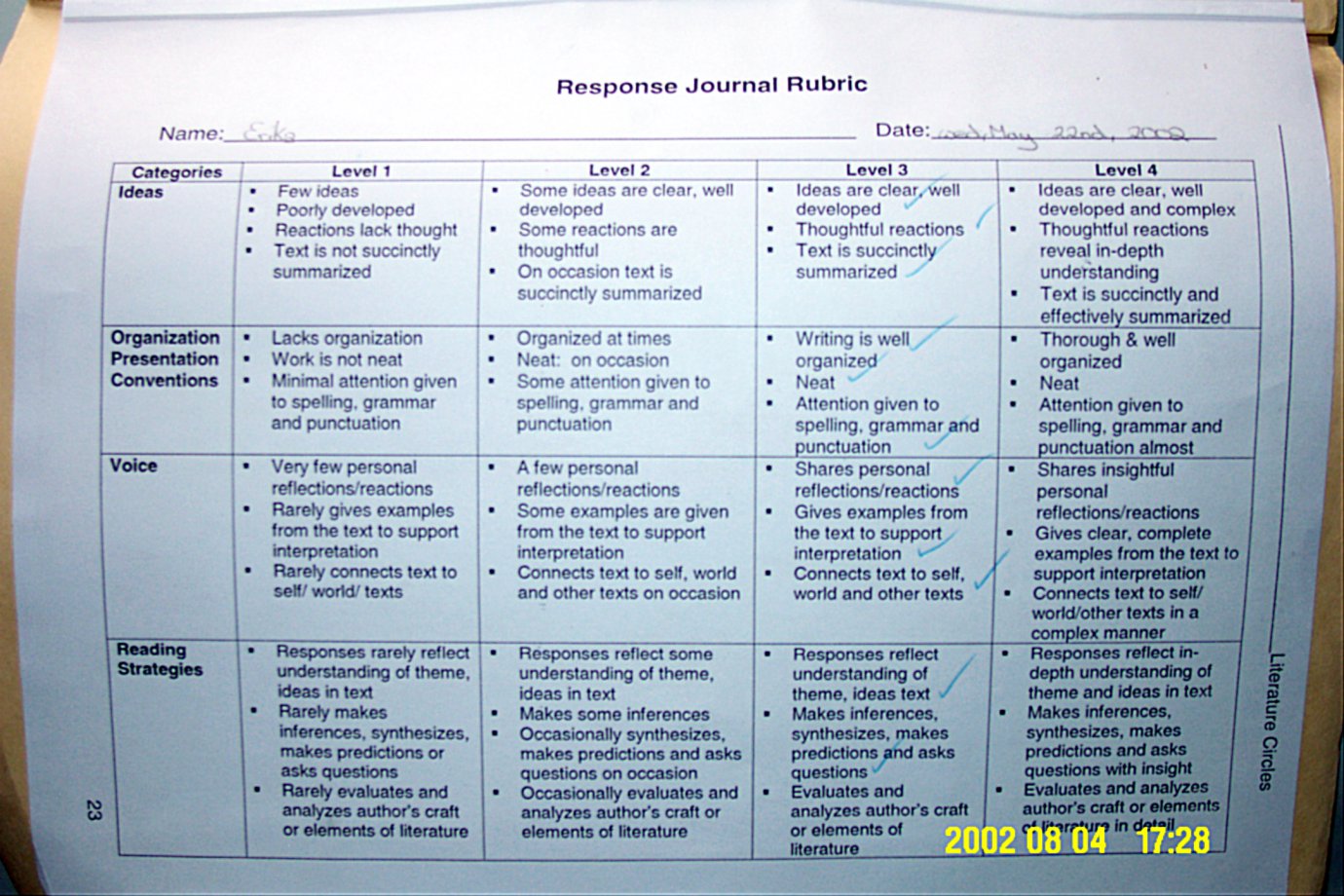
input on the rubric so they know what to expect when being assessed.
They will also be able to receive feedback from their peers, teachers,
and themselves. I do believe in the importance of having the students
know what is expected of them. For projects and major assignments,
I normally hand out rubrics and have a discussion so that they understand
what is expected. We normally brainstorm on what might be a level
one, two, three, and four on the rubric. I have never tried the approach
Jim Dieckmann uses in his classroom where he asks his students to create
the rubric. It does make sense to have the students decide what the
rubric should be since they are the ones who will be completing the projects.
The teacher also saves time trying to think of expectations for multimedia.
However, for the content portion of the rubric, the expectations have to
coincide with those found in the Ontario Curricula. I have a rubric
I used for Literature Circles - Response
Journal. We discussed each expectation and the levels that accompanied
it. Perhaps, for the upcoming year, I will ask students first on
their input before handing out the rubric. Their responses would
likely be general (e.g., spelling, punctuation, etc...), but they'll feel
more responsible for their learning having contributed to the rubric discussion.
Of all the ideas behind TEPBL, I welcomed the idea
of Learning
to Work as a Team. I am quite adamant on the idea of co-operative
learning. I had researched this topic in the mid 1990's by comparing
two education systems (Canada and Japan). Japan discouraged the "I"
and "me" approach and adopted the "we" and "us" since people entering the
workforce would work as teams. I found this idea fascinating and
practical, but wonder why my associate teachers would stress individual
activities. I have used the team approach at every opportunity.
I promoted this concept not only in Science and Language Arts, but also
Math, Physed, Social
Studies, and Health. Students learned from one another.
However, there were a few instances where one student (behavioural) did
not want to co-operate and therefore completed an independent study project.
In Engaging
Parental Involvement, parents meet with teachers regularly in an open
forum environment. They discuss plans and innovations in relation to the
curriculum. These meetings seem to establish good relations between
the school and parent community. At my school, we have an evening
dedicated for this, but it is held in the classrooms. We do not have
all the teachers on the stage collaborating with all the parents.
I do not believe it is a viable option to have the whole parent community
in a gymnasium since parents are mainly concerned with only their child's
current situation. If I had a child in Grade 7, I would not want
to sit in and listen to a Grade Four teacher discussing plans for the current
year. At the same time, if all parents were listening on the plans
and innovations from each teacher and one plan was well received, other
teachers would feel pressured to change their style of teaching.
I know some of my colleagues are not inclined to accept change.
Linda Darling-Hammond mentions the role of a teacher
will need to include understanding what the student is thinking about in
case problems arise. In The
Changing Role of the Teacher, a problem arises when Albert constantly
tells Jim Dieckmann his group has not captured the wasp. Dieckmann
suggests a bee since it is related to the wasp. He attempts to make
the situation positive even though Albert is still discouraged about not
capturing the wasp. In essence, Jim Dieckmann is acting as the facilitator,
a role we are in almost all the time. This role is definitely not
new and therefore I would have to disagree with Linda Darling-Hammond on
her comment regarding it. Nonetheless, there are other roles of the
teacher that have changed, especially with the introduction of the Ontario
Curriculum. A case
study by the Huron Public Education System (1996) shows there are major
changes (see chart) not only in the role of the teacher, but also in how
things are done.
In The
Project's Culmination, we see the class is linked with two scientists
at a local university. The scientists interact with Albert's groups
and discuss the mouth of the specimen. In this case, it is a bee
instead of a wasp. Dr. Kathy Williams shares information and asks
important questions that will allow the group to synthesize and respond
based on what they have learned over the last few months. It is a
great idea to finish the project with this innovation. Having scientists
share information via link up can have very positive outcomes in student
learning and achievement. It is also an excellent idea to involve
experts whenever appropriate. I recall at the end of the Geology
unit, I had a Scientist in the School come into the class. She brought
in microscopes, which our school lacked, and rock specimens. The
kids enjoyed her expertise and the activities. I know the innovation
between Jim Dieckmann's class and the scientists can be established, however,
we do not have the proper resources to complete something of this magnitude.
Governments will have to offer more funding in order to accomplish this
innovation.
Overall, I believe technology enhanced project based
learning is an area teachers must focus on. We live in an everchanging
society where technology is a constant. Most of these students have
grown up with technology and therefore want to complete tasks, assignments,
and projects using it. For the older generation of teachers, it can
be difficult. Just as the generation of teachers from the early nineteen
eighties had to learn to integrate multimedia (VCRs, TVs, Tape Decks, etc...)
into their plans, we will need to adapt new innovations in order to keep
up with the twenty first century.
Resources:
TEC Lesson Plans
The Huron Public Education System.
Introducing
Technology Enhanced Project Based Learning