TROPICAL
| MERENGUE
The merengue is the dance of Dominican Republic, Haiti and neighbour of around. There are two versions of the origin of merengue. One story alleges what the dance originated with slaves who were chained togetherand, of necessity were forced to drag one leg as they cut sugar to the beat of drums The second story alleges that a great hero was wounded in the leg during one of the many revolutions in Dominican Republic. A party of villagers welcomed him home with a victory celebration and, , everyone dancing felt obliged to limp and drag one foot Merengue has existed since the early years of the Dominican Republic. It is possible the dance took its name from the confection made of sugar and egg whites because of the light and frothy character of the dance or because of its short, precise rhythms. The Merengue is very popular throughout the Caribbean and South American, and is one of the standard Latin American dances. There is a lot of variety in Merengue music. Tempos vary a great deal and the Dominicans enjoy a sharp quickening in pace towards the latter part of the dance. The most favored routine at the clubs and restaurants that run a dance floor is a slow Bolero, breaking into a Merengue, which becomes akin to a bright, fast Jive in its closing stages. The ballroom Merengue is slower and has a modified hip action. The Merengue was introduced in the United States in the New York area. However, it did not become well known until several years later. Ideally suited to the small, crowded dance floors, it is a dance that is easy to learn and essentially a "fun" dance. Merengue is a combination of two dances, the African and the French Minuet, from the late 1700's - early 1800's. The black slaves saw the ballroom dances in the Big Houses and when they had their own festivities started mimicking the "masters' dances". But the Europeans dances were not fun, they were very boring and staid, so over time, the slaves added a special upbeat (provided by the drums), this was a slight skip or a hop.
EL SANJUANERO
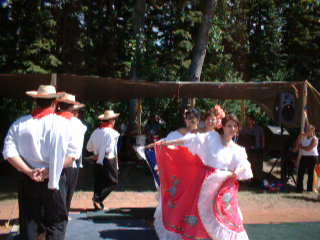
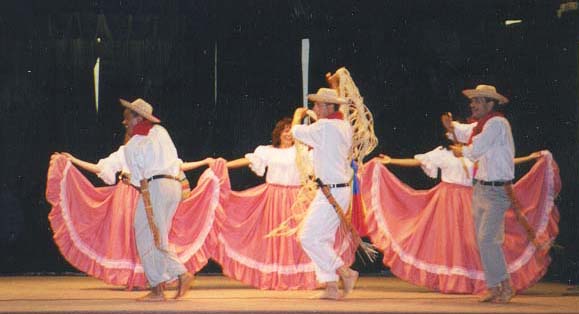
is a very soft and elegant dance that dates from 1790. It was created in a celebration in honor of Saint Juan Baptist in the department of Huila (South Colombia) Its choreography is marked by very smooth and synchronized movements. El Sanjuanero displays the courtship created between men and women during the dance. Today, Sanjuanero is considered one of the most significant cultural expressions of Colombia.
MAPALÉ
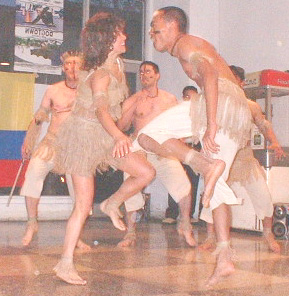
The Mapalé was brought to Colombia by Guinean slaves. The Mapalé involves erotic and wild movements based on jumps, falls , and encounters between men and women. This folk dance represents good fishing time, mainly « El Mapale », which is a fish where the dance took its name from. Fast movements make this dance enjoyable to watch and peform.
JOROPO The Llanos Orientales are located between Colombia and Venezuela. Some dances and rhythms such as Joropo, which involves careful foot work, are derived from Spanish Flamenco. Other dances are; Pasaje Llanero and Contrapunteo,. all of them danced with the electrifying music done with the Capachos (maracas), Cuatro (four-stringed instrument which looks like a guitar) and the harp.
CUMBIA
The cumbia derives its name from the root “Cumbé”, which is a dance from Continental Spanish Guinea, in the Batá region of West Africa.The cumbia is of African origin and it evolved from the end of the 17th century on the north coast of Colombia. Cumbia combines Hispanic melodic structures with African rhythms and native American harmonic components. The cumbia relies on the influence of three cultures, the African, the Spanish and the Native. This mixture of three such different races results in a rhythm of unique characteristics. The drums sound mark the beginning of the performance of the most beautiful rhythm of Colombia's folk tradition: the Cumbia.
VALLENATO Most people would simply describe "Vallenato" as a type of music from the northern coast of Colombia, more precisely from Valledupar, capital of the state of Cesar. To a certain degree this may be true since Vallenato is a combination of three basic musical instruments such as an accordion, a bongo, and a guiro producing as a result a unique type of music that after many years of being confined to that region it expanded nationwide and later crossed many borders of Spanish-speaking countries as well as selected European and North American cities. The word "vallenato" comes from the phrase "nato del Valle" (native of the Valley) a common answer given by people of that region when asked where they are from. The vallenato music has four basic rhythms: son, paseo, merengue, and puya. These are differentiated from each other by the speed and way the instruments are played. Paseo It is the most played and marketed rhythm in the vallenato music. It is a little quicker than son and is divided into two kinds: slow paseo and fast paseo. The slow paseo is generally romantic although there are occasions in which it is composed in reference to a friend, a town and sometimes to regional ethnic customs. The fast paseo, as its own name indicates it, is a little quicker and is rarely romantic. Generally, this is the one that is used to make the accordion light up and take a key part in the song. Many people cannot distinguish it from merengue, another fast tempo style, because of the speed in which it is played. The common denominator among the two paseos is the rhythm that each instrument carries, although it varies in speed depending on the type of paseo. When listening attentively to any paseo, the guiro can be easily differentiated from the rest of the rhythms.
Merengue Generally it is a much more happier sound than the two previous styles and also faster. Many say that its origin is traced to Central America or the Caribbean Islands due to its similarity with the Dominican merengue. In fact this characteristic can be very helpful when trying to differentiate it from the other rhythms. The merengue is danced to in a way similar to the Dominican pattern and like the paseo is also well marketed in the recording industry. Although it is not a romantic rhythm by design, many merengues are written for and about women and reveal love stories.
Puya This is the fastest rhythm of all and at the same time the most complex; however is the easiest to grasp. The accordion, the bongo, and the guiro need to be played with plenty of skills due to the speed of the rhythm. One can say that this rhythm was always utilized to express the humorous side of the people. Its lyrics generally refer to the folklore itself and are rarely sad since its fast speed does not lend itself to it. Although many people tend to confuse the Vallenato with other rhythms which, at times, are also played with the accordion, one must keep in mind that "not everything that is played with an accordion is called Vallenato."
|