The recent furor over the "anti-war" song performed
at the Youth in Arts Show spotlights a number of important issues facing our society. All adults must ask themselves the questions: Are we doing
enough to help our children process the incredible violence and soul damaging
messages that assault them daily through the entertainment and news media? Are
we providing safe and appropriate venues for our young people to explore
controversial social issues? The parents who expressed concern
are to be commended for trying to protect the innocence of their young
children. The song in question was indeed inappropriate for this age group and
the talent show venue. The administration, the supervising teacher, and the
high school student who wrote the song all concur that a mistake was made and
have issued apologies to the parents. That said, I believe we should not allow the deeper issues underlying
this incident and the real message of the lyrics to be lost. The song, “I'm Sorry", is
about a young man's belief in the power of love, and his search for moral
grounding in a world that 1egitimizes killing as a means to a supposed higher
end. This young man has insight beyond his years into the shock waves of human
misery that are set in motion when institutionalized violence is accepted as a
social norm. He has the guts to cut through the facade of patriotic rhetoric put
forth by our government and confront the real costs of war, not only to “the
enemy," but to our own soldiers, their loved ones, and each and everyone
of us who must stand on the sidelines and watch as the tragedy unfolds. All people who yearn for peace must feel deeply conflicted
about the Iraq War, but particularly those who consider themselves to be
Christians. The Bible commands in no uncertain terms: Thou shalt not
murder," "Thou shalt not bear false
witness," 'Thou shalt not covet…anything that is
your neighbor's," “Thou shalt not steal."
Jesus teaches us to turn the other check and love our neighbors as ourselves. Where
does the Bible legitimize killing others, even in self-defense? How do the
Christians who have supported this war explain the actions of the present
administration and its corrupt business partners (Enron, Halliburton, the
House of Saud, etc.) to their children? The
questions of such sensitive youths should not be swept under the rug as merely
"hurtful to our military families." Similarly,
the perspectives of those who support the war cannot be ignored. Rather, together, we should honor
our fallen by examining the justification for their sacrifices, as this student
has bravely tried to do. Americans are prevented from experiencing the
realities of war by our government, which has learned to block public access to
the kinds of gut-wrenching photos that stoked anti-war sentiment in the The merging of the news and
entertainment media corporations and the increased control of our government by
moneyed interests allows the “powers that be” to mix fantasy with reality to
such an extent that the popu1ace can be easily manipulated and misled. For example: The TV series “24”,
which is cheerfully viewed by millions of Americans every week, glorifies
torture as an honorable method of extracting information from a dehumanized
enemy. Where is the public outrage over this kind of programming, which is
being pumped daily into the minds of American children through electronic media
of all kinds? Our children watch an average of
four hours of television per day, witnessing 200,000 acts of violence and
16,000 murders by the age of 18, and 40,000 commercials per year, numbers that
are increasing exponentially every year; 56 percent of children 8 to 16 have
TVs in their bedrooms with unsupervised access, to say nothing of the effects
of the Internet, home videos, and video games that overwhelmed parents have no
time or energy to monitor. How can our children be expected to
become morally sound individuals with this daily onslaught of corrupting
influences? Suppression is not the answer. We
should be gratefu1 for every young person who is still able to distinguish
fantasy from reality and who asks penetrating questions from the heart. It is
up to us, as adults, to provide appropriate venues for inquiry and debate, to
model respectfu1 modes of communication, and to practice what we preach. Heidi Hoelting is a musician, writer
and teacher who has raised two children to adulthood
on
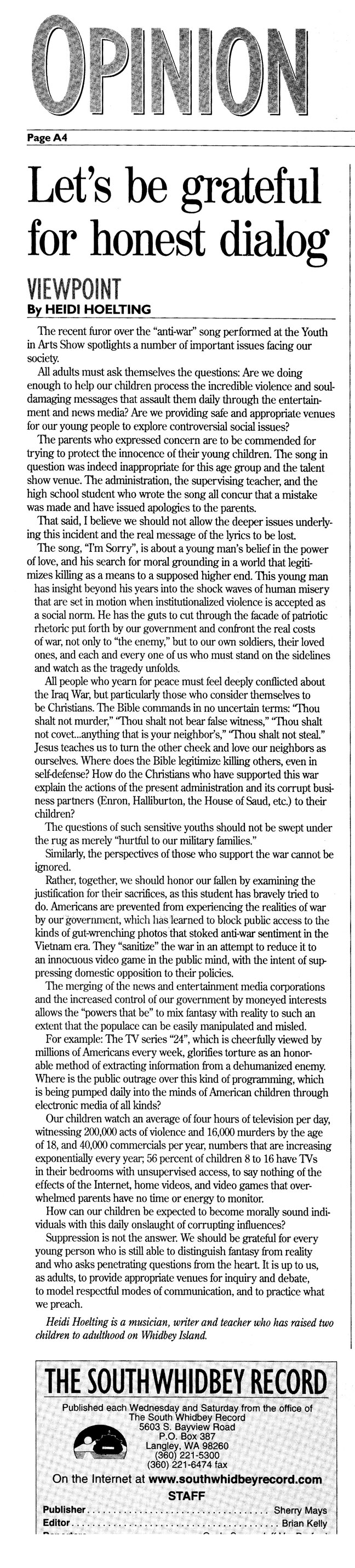 Let's be grateful for honest
dialog
Let's be grateful for honest
dialog
VIEWPOINT
By HEIDI HOELTING