WELCOME | HOME | WERTHER | LINKS | WHO WE ARE | CONTACT
Click on each picture to expand and read its caption


GERMAN ROMANTICISM
Germany is the only country in Europe whose golden age of literature occurred in the 18th century. Germany’s
revolution was called “Storm and Stress” (Sturm und Drang), spearheaded by Goethe, Schiller, and Herder. These writers followed their emotions to the point that they came into conflict with the existing values of a moribund German society. They rejected Enlightenment conventionality, defied authority, and promoted greater naturalness of expression and openness to the nonrational side of human experience. German literature’s development leads from Sturm und Drang to the cultural movement known as Romanticism.

During the late-18th century there was a growing emphasis on sentiment throughout Europe. Passionate friendships and the overt expression of feelings flourished. Occasions for emotional display were actively sought; tears were shed not only for sorrow, but for joy and gratitude. The expression of friendship took extravagant forms. People avidly wrote letters and exchanged albums (Stammbuchen) among dear ones for their inscriptions (similar to our present-day exchanging of school yearbooks for personal wishes). Romanticism thrived from the late-18th to mid-19th centuries. It valued imagination as paramount, the influences of music and visual arts were valued…it was dreamy and nostalgic...idolized nature, images of night, melancholy, and death. Beauty married to strangeness. It was the German Romantics who first pursued subjectivism to the point where it conflicted with the rational.

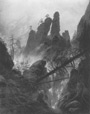
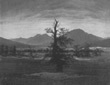
Around 1800, in German painting there was a move away from classical traditions toward the emotional and the irrational. One tendency which emerged was a response to nature that was imbued with a strong mystical element.
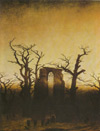
The contemplation of nature was seen as a mystical act of submerging the self in the universal. Some artists developed pantheistic approaches to nature. Caspar David Friedrich declared that one should “seek the Divine in everything.” His paintings were inquiries into the workings of nature, and showed the Romantic propensity for seeing even the most commonplace things anew. Ruins decaying in natural settings symbolized his feelings about beauty and transience. Some artists saw aesthetic sensibility as a kind of religious experience, or spiritual ecstasy, and tried to produce art that was a pure expression of their complex emotions. The view of beauty as a representation of the infinite became a common assumption among Romantics throughout Europe (as later, among Symbolists). Writers like Novalis, Schlegel, and Holderin were not seeking a static and harmonious beauty, but a dynamic one. It was therefore discordant because (as Shakespeare and the Mannerists had shown) beauty can spring even from ugliness, form from formlessness.

18th century Germany was an atomized patchwork of 1500 small states and principalities. This may help to explain why a desire arose for greater unity and closer union…of state with state, man with man, man with nature. This desire often took a pantheistic form: “the one united with the all,” a longing which finds voice in Werther’s strivings to merge with nature in our film.

GOETHE’S “WERTHER”
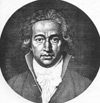
Johann Wolfgang von Goethe (1749-1832) wrote “The Sorrows of Young Werther” (Die Leiden des jungen
Werthers) at age 24, and his revised edition was published in 1786 (the edition to which our film relates). Acclaimed as a literary messiah almost from the start, he stands at the true beginning of imaginative literature in Germany. He avoided stultification by becoming an endless experimenter (as today Jean-Luc Godard is doing in film). An iconoclast, Goethe inherited everything that is most idiosyncratic in Western culture, and his writings exemplify the essence of strong poetry in their radical originality and controlled wildness. His feeling of nature ecstasy may be seen in the 1774 poem “Ganymed:”

Wie im Morgenglanze
Du rings mich anglühst,
Frühling, Geliebter!
Mit tausendfacher Liebeswonne
Sich an mein Herz drängt
Deiner ewigen Wärme
Heilig Gefühl,
Unendliche Schöne!

Daß ich dich fassen möcht
In diesen Arm!

Ach, an deinem Busen
Lieg ich, schmachte,
Und deine Blumen, dein Gras
Drängen sich an mein Herz.
Du kühlst den brennenden
Durst meines Busens,
Lieblicher Morgenwind!
Ruft drein die Nachtigall
Liebend nach mir aus dem Nebeltal.

Ich komm, ich komme!
Wohin? Ach, wohin?
Hinauf! Hinauf strebts.
Es schweben die Wolken
Abwärts, die Wolken
Neigen sich der sehnenden Liebe.
Mir! Mir!
In euerm Schoße
Aufwärts!
Umfangend umfangen!
Aufwärts an deinen Busen,
Alliebender Vater!

 
How in the morning gleam
All around you glow at me, Springtime, belovèd!
With joy of love a thousandfold Rushes to my heart
Of your eternal warmth
A holy feeling,
Infinite beauty!

That in this arm I might
Hold you.

Ah, upon your breast
I stretch out, swoon,
And your flowers, your grass
Rush to my heart.
You slake the burning
Thirst in my breast,
Delicate morning wind,
Withal the nightingale lovingly
Calls from the misty vale to me.

I am coming, coming,
Where, ah where?
Up, a striving upward.
The clouds are floating
Down, the clouds
Bow to love that is yearning.
Take me, take me,
Clouds, in your lap,
Upward,
Embraced embracing!
Upward to your breast,
All-loving father!

Goethe is himself an entire culture: the culture of literary humanism. His multiple abilities in poetry, drama, novel, memoirs, criticism, science, and administration, along with his fertile self-regard, all constitute a model for Emersonian self-reliance. Goethe would perhaps feel at home in the USA today, with its pluralism and diversity. His greatest strength may have been his own personality: In his artwork, he was able to make public and universalize what he found within himself. He was probably the first writer to become a public celebrity. During the last years of his life, a visit to Weimar and an audience with the great man was an essential item in the itinerary of any cultivated young man making a Grand Tour of Europe.
Longing (Sehnsucht), which is the common ground of both religion and love, formed the background to
much Romantic literature. “The Sorrows of Young Werther” was written at a time when young spirits in Germany were in ferment, dissatisfied with the material and spiritual conditions of existence, and it constitutes the first literary expression of an emerging individualism. The book was a mirror of a generation of people before the French Revolution, filled with yearning to burst the empty forms of an antiquated social structure, who saw in Werther an outburst of individualism. It may be considered the first psychological novel, since it is Werther’s psyche from which his world emanates. He projects his subjective states into both nature and humans, and experiences them through his moods.

“Sorrows” may be considered the first cult novel, owing to its popularity in Europe. In Germany, it became a part of the heritage of every educated citizen, and for almost a century the story of Werther and Lotte (Charlotte) was familiar to Germans of all classes. There were several editions of "Sorrows" early in the 19th century. As late as the 1850s Werther parodies were performed on the stages of Germany and Austria…Werther poems, set to music or sung to old tunes, became folk songs. “Sorrows” was popular among readers of those countries where it was the first work of Goethe to become known.
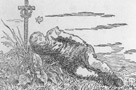
A frustrated generation sensed in “Sorrows” a poetic expression of its own crisis, for Werther’s suicide was a
poignant expression of the doubts which many had about life in what was no longer felt to be the best of all possible worlds. In the novella, people recognized melancholy, pathos, despair, idealized nature, and social revolt. Werther’s rebellion against the limits of the world became a longing for timelessness and death. His suicide symbolized the fate of those who are unable to impress their stamp upon the world about them…dead, he remains a symbol of the never-satisfied longings of the sensitive and the suffering.

I have seldom been able to feel feelings. How better to extend myself than through Romanticism, with its emotional intensity and effusion? I can pretend that I’m someone different…a passionate, vibrant someone.

“A Romantic is an artist who is made creative by his great dissatisfaction with himself—one who looks away from himself and the world around him...” --Friedrich Nietzsche. Unlike Christian aspiration, Romantic dissatisfaction does not contrast the reality of this world with some divine afterlife. In pure form, Romanticism is dissatisfaction with any world, whether real or not.

SOME RECOMMENDED READINGS:
Johann Wolfgang von Goethe, The Sorrows of Young Werther (Trans. Elizabeth Mayer & Louise Bogan; foreword by W.H. Auden…perhaps the best English translation).
Stuart Pratt Atkins, The Testament of Werther in Poetry and Drama.
Nicholas Boyle, Goethe: The Poet and the Age (Cited by Harold Bloom as the definitive biography).
W.H. Bruford, Germany in the Eighteenth Century: The Social Background and the Literary Revival.
Alice A. Kuzniar (Ed.), Outing Goethe and His Age.
William Rose, From Goethe to Byron.
William Rose, Men, Myths, and Movements in German Literature.
Hinrich Sieveking, Fuseli to Menzel: Drawings and Watercolors in the Age of Goethe.
William Vaughan, German Romantic Painting.


Hosted by www.Geocities.ws

1