
Best In The Business
MBA salaries may
make you gasp a little less now. But it is still the best way to make money,
this side of the law
PREMCHAND PALETY
It’s a period of churning for business schools in India. The 1990s saw a rapid proliferation of institutes offering management degrees—and the implicit promise of high-paying, jetsetting jobs in India and abroad.
Hundreds of thousands of young men and women applied, sat for entrance exams, paid high fees. The stockmarkets boomed, the world economy was in fine fettle. And many young Indian mbas did get those high-paying, jetsetting jobs in India and abroad. Things have taken a tumble since then. The last two fiscals have seen an economic slowdown across the world, making jobs rarer. This has had a cascading effect on nearly all business schools, except the top ones like the Indian Institutes of Management (IIMs).
After the swift growth in the 1990s, many Indian business schools suddenly appear to be stagnating, and some seem to be even in a state of steep decline. There are reports of many schools not being able to get enough students. Many government-aided business schools, which do not have the autonomy necessary to respond dynamically to the changing environment, are moving downhill. So are some private business schools which do not have enough resources, or which tolerate and promote incompetence. This year, after the questionnaires were sent off to all the business schools for our annual survey, directors of over a dozen schools called back to say they would not be participating because they had not performed well, and were sure would get a low rank.
Suddenly, business schools have to compete far more aggressively for both students and recruiters. And among the developing trends in management education we spotted during our study, the clearest one was: to win they will have to have best-in-breed governance systems and a visionary leadership.
Managing Management Schools
What could be the best governance model for Indian business schools? Speaking with dozens of professors and managers, a few factors emerged. A transparent process of student acquisition, systematic academic management and continuous industry interface seem to be key contributors to long-term sustainable competitive advantage for any business school. Our surveys over the past few years also indicate that of all success variables, industry interface and intellectual capital are the key differences between a top school and an also-ran.
The variation in these areas between the elite schools and the rest—industry interface and intellectual capital—is amazingly high. And as far as industry interface goes, even our top schools are nowhere near the levels seen in the West. Says Dr A.K. Sengupta, director, sies College of Management Studies, Navi Mumbai: "Unlike in the West, our business schools, including the IIMs, have failed to achieve any pathbreaking research that can revolutionise either theory or practice. The reason is absence of a symbiotic relation with industry."
Business schools interface with industry at different levels in India: guest lectures by corporate executives-actual practitioners of the art and science of management, seminars, workshops, students working on live projects for companies in the real marketplace, management development programmes (MDP) conducted by the business schools for working managers, and industry-sponsored research and consultancy. Though many Indian business schools are now doing well in organising lectures and seminars nearly every week, research in collaboration with industry is still a neglected area. "Of all the interface levels, research and consultancy should be the highest. It has been low but things are changing now. With competition growing, industry has realised the importance of research," says Dr S. Neelamegham, director, NIILM Centre for Management Studies, Delhi.

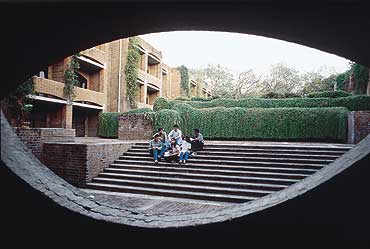
B-SCHOOL BRIGRADE: Students at the S.J. Mehta SoM, IIT Bombay
The big push is coming from some private business schools which have a continuous and open-ended process of creation of intellectual capital and industry interaction. For example, the business schools run by the ICFAI University. "We are proud that today we have emerged as the largest contributor of case studies to the prestigious European Case Clearing House (ECCH) and our cases are being referred to in reputed institutes like the London School of Business," says Dr Panduranga Rao, director, ICFAI B-school. Another institute which has focused on this area is the Indian Institute of Planning and Management (IIPM). Its turnover from consultancy is close to Rs 5 crore.
Our survey shows nine business schools in the private sector have a revenue of over Rs 1 crore from consultancy and MDPs. Most of them have a dedicated team to market their intellectual capital.
Infrastructure Focus
In the area of infrastructure, the gap is showing between the winners and losers, especially in the university business schools. Amphitheatre classrooms, wireless campuses, a laptop computer for every student, electronic databases in libraries are the new additions in some of the country’s best schools. The Indian School of Business (ISB) in Hyderabad has set some new infrastructural benchmarks (see story on page 56).
Take a glance at the computer/student ratios of the top institutes. The IIMs at Ahmedabad and Lucknow have more than two computers per student. Among the private schools, Amity Business School, Delhi, S.P. Jain Institute of Management and Research, Mumbai and imt Ghaziabad have nearly two computers per student. Most of the better institutes are today fully wired, and students can access their libraries’ electronic databases without having to step out of their hostel rooms.
Geography Is History
Distance education is another area where a number of business schools see great potential. The availability of satellite technology is the key reason this area has got a fillip. Four business schools, including xlri and Indian Institute of Management, Kozhikode have partnered with Hughes Network Systems-owned Direcway Global Education for real-time interactive education for working managers.
The system works something like this. The management professor may be seated in a studio in Gurgaon, Bangalore, Kozhikode or Jamshedpur. He makes his presentation to the TV camera placed in front of him. Students seated in special classrooms all over India can interact with him via satellite. Says Amit Tripathi, vice-president, Direcway: "It’s better than distance education and e-learning although it cannot replace the intimate classroom ambience. This is best for working managers as they can continue their education even if they are transferred to different cities. Also one gets to learn from the top faculty." In 15 months, Direcway has developed 35 classrooms in 23 cities. About 1,500 students have used this method of education and attrition rate is only 2 per cent.
Employment Outlook
On the jobs front, post 9/11, foreign employment has taken a beating. Last year, 23 per cent of IIM Ahmedabad graduates got foreign jobs and the top annual salary was $1,55,000. This year, the percentage has fallen to 20—the maximum salary offered plummeted to $90,000. In IIM Calcutta, the percentage of students placed abroad has dropped from seven to four, and the maximum salary declined from a whopping $2,00,000 to a reality-check $90,000. Overall, the percentage placed abroad has come down by over 30 per cent, and the average dollar salary by over 25 per cent.

BRIGHT TIMES: The VG School of Management, Kharagpur has jumped up two ranks this year
But things have improved in the domestic market, riding on an industrial turnaround. The average salary in the top business schools has grown by 10-15 per cent over last year. For the top 10 schools, the average works out to about Rs 40,000 a month. This figure, however, drops sharply to Rs 15,000 per month or thereabouts for second-rung schools, and to a poor Rs 8,000 per month for the rest. The minimum salary reported this year is Rs 5,000 per month.
Private Universities
An interesting development is the birth of private universities in young states like Chhattisgarh and Uttaranchal through acts of state legislatures. As many as 24 business schools have acquired or are in the process of acquiring private university status. "This is a right move," says Dr Rajan Saxena who quit the directorship of IIM Indore as he was frustrated with bureaucratic bottlenecks. "This way good business schools will have more flexibility to grow. Too much job security to faculty has vitiated the government-run institutes."
Some schools like the Principal L.N. Welingkar Institute of Management Development and Research and ICFAI B-school are opting for international accreditation. This would be important for their international recognition in 2005 when gats (General Agreement on Trade in Services) comes into force. As many as 11 business schools have acquired international linkages this year. Some are even contemplating opening branches abroad! But 77 per cent of the business schools surveyed have no exchange programmes at all. In all, the news from the management education front is mixed. The positives: domestic employment scenario has improved, progressive institutes are using technology to make the learning processes easier and faster, interaction with the corporate world is growing. Negatives: many business schools are finding it difficult to attract both students and recruiters, the aspiration value of management education may be reducing.
But the negatives too may have a silver lining. There have been too many business schools set up by too many people with only the profit motive in mind. Too many students have paid too much money and got meagre returns on investment. Now, increased competition means business schools have to excel or perish. And it’s time students realised that just any old mba degree does not guarantee those jetsetting jobs.
=========================================================================
Big Bees
Outlook-Cfore Survey of top B-schools -- more than rankings, the figures reveal that all is not quite well in MBA land.
GAURI BHATIA, PREMCHAND PALETY
First, the insights that the Outlook-Cfore survey threw up, beyond the basic issue of rankings.
Much has changed since last year. Some for the worse, some for the better. Let’s tackle the bad news first.
The state of our economy is best mirrored in the placement performance of business schools this year. Sample the statistics: 68 per cent of the schools surveyed couldn’t place even 50 per cent of their
graduates. If we leave out the top 10 schools, the average salary for Indian jobs this year was a mere Rs 10,000 a month! This, after the student spent at least Rs 2 lakh as academic fees. You don’t need to be a finance whiz to figure out that that’s a pretty poor return on investment.
And while the Indian Institutes of Management (IIMs) and other top business schools completed their placement seasons in the customary one or two days, the average placement season this year lasted an interminable three months. Foreign placements too showed a negative trend. Last year, IIM Ahmedabad (IIM-A) placed 32 per cent of its students abroad. This year, the figure is 23 per cent. Needless to say, beyond the IIMs, there has hardly been any foreign offer. The downturn of the IT sector contributed. Last year, 27 per cent of graduates got IT jobs. This year, 17.
Now the good news. More professors are writing books and papers, indicating an increase in research. There has been a 17 per cent rise in the number of books published over last year, a 22 per cent rise in research papers and an 18 per cent rise in case studies. Industry interface has also improved, in terms of management development programmes (MDPS) conducted for executives and seminars and workshops held, an increase of 18 per cent and 26 per cent respectively.
Most of the better B-schools are investing heavily in improving infrastructure. The student-to-computer ratio, 4:1 last year, is now 3:1. The change in university departments is striking. Some of them are doing away with bureaucratic hurdles and tuning in to the latest trends, be it research ambience, integration with industry, infrastructure: FMS, Delhi, boasts air-conditioned classrooms; UBS, Chandigarh, has revamped its curriculum and increased financial flexibility, with student bodies empowered to utilise funds.
That’s the ambience part but the dearth of good educators is a serious problem, as reflected in the findings of our student satisfaction survey. Schools like ICFAI have moved proactively by starting an institute for faculty training. The shortage of good faculty, unlike infrastructure, is something which cannot be bridged in a short period by money. Poaching is on the rise. Holding on to good faculty may now become the real measure of good leadership.
But of all the trends, the most striking is the job crisis. Meet any fresh MBA from a below-top-20 institute and he will tell you how relieved he is if he has found a job. If not, the stock response is: "I’m weighing various options," a euphemism for "desperately seeking employment".
From dreaming of dollar salaries and foreign postings, MBAs have been brought down to earth, and with a thud. For campus recruitment, 2002 has been the worst year ever. There has been a dip of over 40 per cent and salaries have plummeted. Even in premier institutes, some pay packages have shrunk 25 per cent. Students from the second- and third-rung B-schools are accepting jobs that pay Rs 7,000-8,000 a month. The prevalent question on campuses today is not "what’s your take-home" but "have you got placed?"
According to Arun Tadanki, country manager of jobsite monsterIndia.com, the average number of job offers for students in the top 20 B-schools has come down from 1.6 per person in 2000 to 1.1 in 2002. "Some students from the top schools even went without a single offer, a situation that couldn’t be imagined two years ago." With dotcom CVs still floating around and companies freezing recruitment budgets, hiring a management trainee is seen as a luxury. "A fresh MBA today is an overhead that few companies want to take. If you hire an experienced hand, you get output right away," says Jaydev Parthasarthy of head-hunting firm Footprints.
According to students, this year XLRI invited 50 firms, up from 25 last year, to better the chances of placements. "Even those companies that literally had to return home from the airport last time as placements were over on the first day itself made it to Day One this year," says a fresh XLRI graduate. The Big Five consulting majors—McKinsey, KPMG, Accenture, Deloitte & Touche and Ernst & Young—were conspicuous by their near-absence. In the wake of the Andersen scandal, they have cut campus recruitment by over 60 per cent. Students spend anything between Rs 2 lakh and Rs 5 lakh for an MBA course and where earlier you could recover that money in a couple of months, today, it will take that much longer. "With international salaries sharply reduced, averages have come down to Indian levels. Earlier too, the averages were more a statistical deduction and never really gave the real picture," says K. Pandia Rajan, MD, Mafoi, a leading HR service provider.
Companies that visited the B-rung B-schools came looking to strike a bargain and made take-it-or-leave-it offers to students who were forced to accept. In fact, all MBA students this year were governed by a rule which prevented them from juggling job offers (not that there were plenty on offer). If you got one job offer, you had a day to decide on it and were then out of the placement process. "From the companies’ point of view, though, it reduced their chances of getting the best guys," says Dony Kuriakose of Edge Consultancy. In Pune, for the first time, many of the city’s business schools decided to go in for pool placement. CVs of students from all the colleges were sent to companies and only those short-listed were called to participate in group discussions and interviews at a common venue, instead of companies visiting colleges individually.
It is easy to blame it all on the recession but some fingers must be pointed at the B-schools themselves. "The mushrooming of B-schools has created a glut. In the last two years, we have seen 15 new schools in Tamil Nadu alone," says Rajan. "In the ’90s, a strong second rung of MBA schools appeared as the IIMs couldn’t meet the demand. Today, a dip in that demand has seen students from these schools go without jobs."
Another issue has contributed to the fall in MBA intake. If a company hired MBAs from both the first- and second-tier institutes, it faces serious internal equity issues after about two years. "Now that the second-tier MBA has also proven himself, he demands the same salary as his IIM colleague," says the HR manager of an FMCG company. So it was that many recruiters, this year, decided to stick to one kind of B-school to avoid such equivalence problems and hey! anyway, they only had a couple of guys to pick.
=======================================================================
15 SEPTEMBER, 2003
OUTLOOK-CFORE SURVEY
Top Business Schools
 |
 |
Name of the Institute | IC | II | I&F | PP | E C A(80) | I
L (150/) |
RS (200) | SS (60) | FS (60) |  |
|
IC : Intellectual
Capital; II: Industry Interface; I&F :
Infrastructure & Facilities; PP: Placement Performance |
||||||||||||
|
|
||||||||||||
| 1 | 1 | IIM, Ahmedabad | 184.36 | 147.00 | 168.94 | 293.98 | 23.73 | 87.11 | 165 | 56 | 45 | 1171 |
| 2 | 2 | IIM, Bangalore | 172.24 | 127.59 | 151.47 | 292.15 | 33.14 | 61.93 | 164 | 53 | 49 | 1105 |
| 3 | 3 | IIM, Calcutta | 210.14 | 125.53 | 144.14 | 249.23 | 40.20 | 63.93 | 166 | 54 | 48 | 1101 |
| 4 | - | IIM, Lucknow | 164.52 | 83.95 | 171.17 | 232.79 | 24.71 | 63.74 | 162 | 52 | 45 | 1000 |
| 5 | 5 | XLRI, Jamshedpur | 162.45 | 115.77 | 107.62 | 205.37 | 77.65 | 56.04 | 161 | 53 | 54 | 993 |
| 6 | 6 | NITIE, Mumbai | 154.61 | 100.90 | 127.57 | 244.97 | 80.00 | 39.73 | 152 | 51 | 39 | 990 |
| 7 | 4 | FMS, Delhi | 166.92 | 74.65 | 57.81 | 285.26 | 78.82 | 67.86 | 158 | 42 | 40 | 971 |
| 8 | 12 | IIFT, New Delhi | 154.00 | 41.77 | 108.38 | 184.12 | 55.29 | 80.45 | 149 | 48 | 45 | 866 |
| 9 | 10 | S P Jain Institute, Mumbai | 104.10 | 118.94 | 91.08 | 213.36 | 63.53 | 31.66 | 148 | 45 | 39 | 855 |
| 10 | 11 | S J Mehta SoM, IIT Bombay | 124.60 | 32.17 | 104.44 | 283.42 | 38.43 | 15.87 | 146 | 47 | 46 | 838 |
| 9 | IIM, Kozhikode | 133.92 | 71.10 | 136.10 | 185.44 | 40.78 | 24.29 | 147 | 51 | 48 | 838 | |
| 11 | 8 | IIM, Indore | 151.32 | 62.63 | 120.98 | 194.60 | 25.49 | 0.00 | 148 | 50 | 47 | 800 |
| 12 | 22 | ICFAI B-school, Hyderabad | 171.06 | 100.15 | 51.08 | 135.38 | 68.63 | 10.91 | 146 | 47 | 45 | 775 |
| 13 | IMT, Ghaziabad | 138.27 | 41.82 | 89.51 | 204.40 | 11.18 | 49.81 | 148 | 45 | 47 | 775 | |
| 13 | 15 | VG SoM, IIT Kharagpur | 142.15 | 39.29 | 98.86 | 202.84 | 22.55 | 17.33 | 147 | 48 | 46 | 764 |
| 14 | 17 | IMI, Delhi | 161.12 | 74.14 | 63.09 | 148.87 | 48.43 | 25.72 | 145 | 45 | 52 | 763 |
| 15 | 17 | IIT Delhi (DMS) | 151.49 | 40.53 | 85.74 | 194.85 | 9.02 | 35.29 | 150 | 43 | 40 | 750 |
| 20 | Amity Business School, Noida | 105.29 | 79.90 | 109.88 | 140.01 | 45.88 | 44.79 | 141 | 46 | 37 | 750 | |
| 16 | 31 | Principal L N Welingkar Institute, Mumbai | 102.48 | 68.08 | 94.93 | 160.29 | 31.57 | 51.23 | 143 | 48 | 46 | 746 |
| 17 | 18 | IIPM, Delhi | 125.31 | 123.53 | 32.21 | 136.70 | 52.55 | 60.57 | 132 | 40 | 38 | 741 |
| 18 | 23 | Lal Bahadur Shastri Institute, Delhi | 132.98 | 34.16 | 62.38 | 203.19 | 40.20 | 17.87 | 138 | 50 | 52 | 731 |
| 19 | 19 | T A Pai Management Institute, Manipal | 128.49 | 64.68 | 65.37 | 161.00 | 45.10 | 0.00 | 152 | 55 | 50 | 722 |
| 20 | Bharathidasan Institute, Tiruchirappalli | 130.03 | 58.27 | 65.14 | 178.23 | 45.10 | 0.00 | 146 | 48 | 47 | 718 | |
| 21 | 16 | University Business School, Chandigarh | 163.78 | 30.06 | 72.77 | 171.10 | 48.82 | 17.57 | 138 | 35 | 37 | 714 |
| 21 | Symbiosis Institute of Bus Mgmt, Pune | 124.26 | 59.35 | 48.94 | 192.12 | 37.25 | 0.00 | 151 | 51 | 50 | 714 | |
| 22 | 27 | NIILM Centre for Management, Delhi | 129.17 | 26.28 | 70.49 | 146.43 | 18.24 | 30.02 | 140 | 50 | 45 | 656 |
| 23 | 28 | Nirma Institute of Management, Ahmedabad | 124.54 | 26.62 | 104.96 | 110.91 | 14.90 | 5.88 | 147 | 46 | 47 | 628 |
| 24 | 25 | K J Somaiya Institute, Mumbai | 83.39 | 51.31 | 54.19 | 169.62 | 10.00 | 10.90 | 148 | 48 | 51 | 626 |
| 34 | ITM, Navi Mumbai | 73.94 | 19.15 | 84.99 | 160.05 | 19.22 | 27.36 | 145 | 46 | 50 | 626 | |
| 25 | 32 | School of Comm. & Management, Kochi | 100.01 | 30.81 | 51.93 | 131.57 | 13.73 | 58.48 | 142 | 48 | 45 | 622 |
| 26 | 36 | Christ College Institute of Mgmt, Bangalore | 110.25 | 56.06 | 59.49 | 136.20 | 13.33 | 7.15 | 144 | 43 | 49 | 618 |
| 27 | 37 | Alliance Business Academy, Bangalore | 148.45 | 15.12 | 56.56 | 120.14 | 36.86 | 16.70 | 141 | 40 | 41 | 616 |
| 28 | IILM, Delhi | 129.30 | 34.11 | 59.32 | 129.75 | 11.37 | 23.05 | 138 | 44 | 43 | 612 | |
| 29 | 44 | Indian Institute of Modern Mgmt, Pune | 129.33 | 59.56 | 38.57 | 145.24 | 14.51 | 0.00 | 139 | 42 | 43 | 611 |
| 30 | 26 | DMS REC, Tiruchirappalli | 92.03 | 51.31 | 100.40 | 121.67 | 12.55 | 0.00 | 134 | 46 | 42 | 600 |
| 31 | Jagan Institute of Management, Delhi | 136.60 | 10.90 | 71.34 | 95.75 | 15.88 | 5.70 | 142 | 48 | 48 | 574 | |
| 41 | SIES College of Mgmt Studies, Navi Mumbai | 101.77 | 28.57 | 50.01 | 152.11 | 20.20 | 0.00 | 139 | 42 | 40 | 574 | |
| 32 | Rajagiri School of Management, Kochi | 109.63 | 2.68 | 51.53 | 143.67 | 31.37 | 21.57 | 135 | 35 | 38 | 568 | |
| 33 | 29 | PSG Institute of Management, Coimbatore | 122.19 | 10.20 | 49.63 | 147.25 | 27.65 | 0.00 | 133 | 39 | 37 | 566 |
| XIME, Bangalore | 82.33 | 38.27 | 38.43 | 115.54 | 54.12 | 4.12 | 142 | 46 | 45 | 566 | ||
| 34 | 30 | Regional College of Mgmt, Bhubaneshwar | 106.33 | 31.88 | 47.12 | 115.82 | 22.35 | 6.66 | 142 | 43 | 44 | 559 |
| 35 | 38 | Amrita Institute of Mgmt, Coimbatore | 103.03 | 16.95 | 78.45 | 104.72 | 20.39 | 0.00 | 147 | 42 | 45 | 558 |
| 36 | 49 | Jaipuria Institute of Mgmt, Lucknow | 69.04 | 37.33 | 66.25 | 130.13 | 30.20 | 2.06 | 139 | 41 | 42 | 557 |
| 37 | 48 | Prestige Institute of Mgmt, Indore | 153.51 | 29.68 | 21.88 | 86.60 | 30.20 | 1.45 | 145 | 42 | 46 | 556 |
| 38 | 43 | Birla Institute of Management, New Delhi | 111.50 | 29.25 | 46.70 | 114.53 | 11.76 | 4.12 | 144 | 44 | 48 | 554 |
| 39 | 47 | Symbiosis Institute of Intl Business, Pune | 50.00 | 23.81 | 53.81 | 165.16 | 3.33 | 24.55 | 145 | 45 | 42 | 553 |
| 40 | 46 | Mount Carmel Inst. of Mgmt, Bangalore | 119.75 | 21.47 | 39.60 | 111.17 | 33.92 | 27.14 | 130 | 34 | 35 | 552 |
| 41 | RIMS, Rourkela | 111.10 | 18.96 | 56.07 | 104.35 | 17.06 | 3.88 | 143 | 44 | 43 | 541 | |
| 42 | Kirloskar Institute, Harihar | 111.43 | 28.35 | 56.39 | 97.63 | 15.88 | 0.00 | 139 | 41 | 39 | 529 | |
| 43 | IBAT, Bhubaneshwar | 111.83 | 24.46 | 49.11 | 90.54 | 22.35 | 0.00 | 141 | 42 | 43 | 524 | |
| 44 | 45 | Rizvi Institute of Management, Mumbai | 111.75 | 24.83 | 39.25 | 108.72 | 3.33 | 0.00 | 140 | 45 | 48 | 521 |
| 45 | SDM Institute of Mgmt, Mysore | 77.31 | 25.91 | 65.29 | 106.63 | 4.51 | 0.00 | 139 | 40 | 39 | 498 | |
| 46 | Lal Bahadur Shastri Institute, Bareilly | 87.61 | 21.66 | 42.61 | 99.36 | 11.18 | 7.51 | 140 | 42 | 41 | 493 | |
| 47 | 50 | Badruka College P G Centre, Hyderabad | 76.19 | 37.47 | 22.22 | 92.73 | 0.00 | 27.88 | 143 | 45 | 43 | 487 |
| 48 | IME, Sahibabad | 70.15 | 9.04 | 18.94 | 157.06 | 13.33 | 0.00 | 135 | 41 | 40 | 485 | |
| 49 | Siva Sivani Institute, Secunderabad | 84.05 | 23.17 | 18.55 | 129.06 | 3.33 | 0.00 | 134 | 45 | 43 | 480 | |
| 50 | Vignana Jyothi, Secunderabad | 112.06 | 11.95 | 17.87 | 98.45 | 10.20 | 0 | 138 | 45 | 43 | 477 | |
IC : Intellectual Capital; II:
Industry Interface; I&F : Infrastructure & Facilities; PP:
Placement Performance
ECA: Extra Curricular Activities IL: International Linkages RS:
Recruiters Satisfaction Score; SS: Students Satisfaction Score; FS:
Faculty Satisfaction Score
============================================================
2002
Top B-Schools In India
|
|
Name of the Institute | City | IC | II | I&F | PP | RS (160) | SS (50) | FS (50) | |
| 1 | 1 | IIM, A | AHMEDABAD | 221 | 143 | 170 | 292 | 142 | 42 | 37 | 1047 |
| 2 | 3 | IIM, B | BANGALORE | 198 | 121 | 155 | 285 | 140 | 43 | 39 | 981 |
| 3 | 2 | IIM, C | KOLKATA | 205 | 119 | 153 | 261 | 143 | 44 | 40 | 965 |
| 4 | 6 | FMS, DELHI | DELHI | 165 | 69 | 49 | 296 | 139 | 27 | 27 | 772 |
| 5 | 5 | XLRI | JAMSHEDPUR | 185 | 75 | 95 | 212 | 140 | 34 | 30 | 771 |
| 6 | 6 | (NITIE) NATIONAL INSTITUTE OF INDUSTRIAL ENGINEERING | MUMBAI | 168 | 79 | 102 | 224 | 135 | 29 | 27 | 764 |
| 7 | 9 | JAMNALAL BAJAJ INSTITUTE OF MANAGEMENT STUDIES | MUMBAI | 142 | 67 | 40 | 250 | 138 | 32 | 32 | 701 |
| 8 | 7 | IIM, INDORE | INDORE | 163 | 68 | 89 | 159 | 138 | 38 | 35 | 690 |
| 9 | - | IIM, KOZHIKODE | KOZHIKODE | 166 | 48 | 81 | 190 | 136 | 35 | 33 | 689 |
| 10 | 8 | S P JAIN INSTITUTE OF MANAGEMENT & RESEARCH | MUMBAI | 121 | 68 | 48 | 259 | 136 | 30 | 25 | 688 |
| 11 | 12 | IIT, MUMBAI- SALLESH J. MEHTA SCHOOL OF MANAGEMENT | MUMBAI | 85 | 72 | 54 | 251 | 138 | 36 | 30 | 666 |
| 12 | 12 | INDIAN INSTITUTE OF FOREIGN TRADE | NEW DELHI | 147 | 30 | 53 | 229 | 138 | 36 | 28 | 661 |
| 13 | - | INSTITUTE OF MANAGEMENT TECHNOLOGY | GHAZIABAD | 162 | 33 | 59 | 200 | 134 | 30 | 27 | 645 |
| 13 | 11 | XIM, BHUBANESHWAR | BHUBANESWAR | 141 | 90 | 87 | 136 | 132 | 30 | 29 | 645 |
| 14 | 10 | NARSEE MONJEE INSTITUTE OF MANAGEMENT STUDIES | MUMBAI | 143 | 56 | 56 | 172 | 138 | 33 | 29 | 627 |
| 15 | 22 | VINOD GUPTA SCHOOL OF MANAGEMENT | KHARAGPUR | 133 | 31 | 63 | 183 | 137 | 36 | 31 | 614 |
| 16 | 18 | UNIVERSITY BUSINESS SCHOOL | CHANDIGARH | 156 | 30 | 76 | 154 | 135 | 35 | 27 | 613 |
| 17 | - | INTERNATIONAL MANAGEMENT INSTITUTE | NEW DELHI | 141 | 49 | 55 | 151 | 136 | 33 | 33 | 598 |
| 17 | 13 | DMS, IIT DELHI | NEW DELHI | 104 | 31 | 122 | 147 | 132 | 32 | 30 | 598 |
| 18 | - | THE INDIAN INSTITUTE OF PLANNING AND MANAGEMENT | NEW DELHI | 136 | 103 | 28 | 127 | 131 | 32 | 30 | 587 |
| 19 | 13 | T A PAI MANAGEMENT INSTITUTE | MANIPAL | 144 | 41 | 34 | 172 | 134 | 32 | 29 | 586 |
| 20 | 20 | AMITY BUSINESS SCHOOL | NOIDA | 152 | 50 | 51 | 142 | 134 | 29 | 26 | 584 |
| 21 | 17 | SYMBIOSIS CENTRE FOR MANAGEMENT & HRD | PUNE | 100 | 58 | 57 | 175 | 133 | 32 | 28 | 583 |
| 22 | 15 | ICFAI BUSINESS SCHOOL | HYDERABAD | 167 | 56 | 27 | 122 | 130 | 32 | 27 | 561 |
| 23 | 20 | LAL BAHADUR SHASTRI INSTITUTE OF MANAGEMENT | NEW DELHI | 140 | 30 | 36 | 156 | 130 | 31 | 29 | 552 |
| 24 | - | SYDENHAM MANAGEMENT ASSOCIATION | MUMBAI | 124 | 13 | 39 | 158 | 128 | 31 | 32 | 525 |
| 25 | 16 | K J SOMAIYA INSTITUTE OF MANAGEMENT STUDIES AND RESEARCH | MUMBAI | 133 | 29 | 37 | 128 | 132 | 36 | 29 | 524 |
| 26 | - | REGIONAL ENGINEERING COLLEGE (DEPARTMENT OF MANAGEMENT STUDIES) | TIRUCHIRAPALLI | 108 | 31 | 62 | 114 | 136 | 31 | 32 | 514 |
| 27 | 29 | NIILM CENTRE FOR MANAGEMENT STUDIES | NEW DELHI | 117 | 11 | 49 | 148 | 130 | 29 | 26 | 510 |
| 27 | 28 | B K SCHOOL | AHMEDABAD | 123 | 10 | 17 | 188 | 121 | 28 | 23 | 510 |
| 28 | 21 | NIRMA INSTITUTE OF MANAGEMENT | AHMEDABAD | 99 | 16 | 70 | 141 | 124 | 28 | 30 | 508 |
| 29 | 26 | PSG INSTITUTE OF MANAGEMENT | COIMBATORE | 106 | 8 | 49 | 167 | 115 | 33 | 27 | 505 |
| 30 | 46 | REGIONAL COLLEGE OF MANAGEMENT | BHUBANESWAR | 118 | 23 | 48 | 133 | 126 | 28 | 26 | 502 |
| 31 | 22 | PRIN L N WELINGKAR INSTITUTE OF MANAGEMENT DEVELOPMENT & RESEARCH | MUMBAI | 107 | 41 | 25 | 133 | 130 | 28 | 30 | 494 |
| 32 | 32 | SCHOOL OF COMMUNICATION & MANAGEMENT STUDIES | COCHIN | 116 | 15 | 45 | 125 | 128 | 30 | 33 | 492 |
| 33 | - | INDIAN INSTITUTE OF SOCIAL WELFARE & BUSINESS MANAGEMENT | KOLKATA | 133 | 29 | 35 | 108 | 128 | 31 | 27 | 491 |
| 34 | 30 | INSTITUTE FOR TECHNOLOGY & MANAGEMENT | NAVI MUMBAI | 113 | 15 | 31 | 139 | 127 | 31 | 29 | 485 |
| 35 | 26 | LOYOLA INSTITUTE OF BUSINESS ADMINISTRATION (LIBA) | CHENNAI | 107 | 30 | 54 | 105 | 129 | 29 | 27 | 481 |
| 36 | 39 | CHRIST COLLEGE INSTITUTE OF MANAGEMENT | BANGALORE | 112 | 29 | 37 | 112 | 128 | 31 | 30 | 479 |
| 37 | - | ALLIANCE BUSINESS ACADEMY | BANGALORE | 114 | 15 | 42 | 122 | 125 | 30 | 30 | 478 |
| 38 | 30 | AMRITA INSTITUTE OF MANAGEMENT | COIMBATORE | 92 | 32 | 55 | 111 | 129 | 28 | 30 | 477 |
| 38 | - | DEPARTMENT OF MANAGEMENT SCIENCES | PUNE | 89 | 26 | 43 | 124 | 133 | 31 | 31 | 477 |
| 39 | 25 | XAVIER INSTITUTE OF SOCIAL SERVICE | RANCHI | 118 | 25 | 30 | 101 | 129 | 32 | 36 | 471 |
| 40 | 33 | INTERNATIONAL INSTITUTE OF PROFESSIONAL STUDIES | INDORE | 86 | 27 | 52 | 119 | 128 | 28 | 29 | 469 |
| 41 | - | S I E S COLLEGE OF MANAGEMENT STUDIES | NAVI MUMBAI | 97 | 29 | 13 | 133 | 127 | 31 | 32 | 462 |
| 42 | - | CHETANA'S R. K. INSTITUTE OF MANAGEMENT & RESEARCH | MUMBAI | 96 | 41 | 14 | 120 | 127 | 31 | 32 | 461 |
| 43 | - | BIRLA INSTITUTE OF MANAGEMENT TECHNOLOGY | NEW DELHI | 107 | 23 | 41 | 110 | 120 | 28 | 31 | 460 |
| 44 | - | (IIMM) INDIAN INSTITUTE OF MODERN MANAGEMENT | PUNE | 101 | 31 | 41 | 112 | 118 | 27 | 28 | 458 |
| 44 | - | INSTITUTE OF FINANCE & INTERNATIONAL MANAGEMENT | BANGALORE | 101 | 35 | 38 | 103 | 118 | 31 | 32 | 458 |
| 45 | - | RIZVI INSTITUTE OF MANAGEMENT STUDIES & RESEARCH | MUMBAI | 86 | 32 | 40 | 112 | 122 | 33 | 32 | 457 |
| 45 | - | INSTITUTE OF PUBLIC ENTERPRISE | HYDERABAD | 139 | 36 | 16 | 79 | 125 | 30 | 32 | 457 |
| 46 | - | MOUNT CARMEL INSTITUTE OF MANAGEMENT | BANGALORE | 84 | 23 | 56 | 119 | 118 | 27 | 26 | 453 |
| 47 | - | SYMBIOSIS INSTITUTE OF INTERNATIONAL BUSINESS | PUNE | 70 | 16 | 24 | 146 | 128 | 32 | 36 | 452 |
| 48 | 38 | PRESTIGE INSTITUTE OF MANAGEMENT AND RESEARCH | INDORE | 147 | 27 | 26 | 67 | 120 | 29 | 30 | 446 |
| 49 | 34 | JAIPURIA INSTITUTE OF MANAGEMENT | LUCKNOW | 75 | 29 | 42 | 110 | 125 | 32 | 33 | 446 |
| 50 | - | BADRUKA COLLEGE POST GRADUATE CENTRE | HYDERABAD | 114 | 36 | 21 | 88 | 122 | 30 | 31 | 442 |
IC : Intellectual Capital; II:
Industry Interface; I&F : Infrastructure & Facilities; PP:
Placement Performance
RS: Recruiters Satisfaction Score; SS: Students Satisfaction
Score; FS: Faculty Satisfaction Score
==============================================================
2001
|
Rank |
Name Of The Institute | City | Academic Env. |
Industry Interface |
Infras
- tructure |
Place- ments |
Total |
| 1 | IIM, Ahmedabad | Ahmedabad | 296 | 130 | 90 | 335 | 852 |
| 2 | IIM, Calcutta | Calcutta | 211 | 74 | 82 | 363 | 729 |
| 3 | IIM, Bangalore | Bangalore | 193 | 98 | 86 | 344 | 722 |
| 4 | IIM, Lucknow | Lucknow | 228 | 52 | 100 | 305 | 685 |
| 5 | XLRI | Jamshedpur | 191 | 40 | 41 | 276 | 548 |
| 6 | Faculty of Management Studies (Delhi) | Delhi | 180 | 35 | 35 | 287 | 537 |
| 7 | IIM, Indore | Indore | 141 | 14 | 39 | 265 | 459 |
| 8 | S. P. Jain Institute of Management & Research | Mumbai | 104 | 15 | 22 | 276 | 418 |
| 9 | Jamnalal Bajaj Institute of Management Studies | Mumbai | 113 | 14 | 34 | 251 | 413 |
| 10 | Narsee Monjee Institute of Management Studies | Mumbai | 166 | 32 | 21 | 190 | 409 |
| 11 | Management Development Institute | Gurgaon | 134 | 57 | 40 | 164 | 395 |
| Xavier Institute of Management | Bhubaneswar | 115 | 61 | 45 | 174 | 395 | |
| 13 | FORE School of Management | New Delhi | 133 | 24 | 20 | 182 | 358 |
| 14 | T. A Pai Management Institute | Manipal | 131 | 27 | 33 | 161 | 352 |
| 15 | Bharathidasan Institute of Management | Tiruchirapalli | 125 | 20 | 33 | 174 | 351 |
| 16 | The ICFAI Business Schools | H Q Hyderabad | 141 | 34 | 26 | 140 | 341 |
| 17 | K. J. Somaiya Institute of Management Studies and Research | Mumbai | 128 | 16 | 18 | 172 | 335 |
| 18 | Symbiosis Institute of Business Management | Pune | 95 | 30 | 36 | 170 | 332 |
| Symbiosis Centre for MGT and HRD | Pune | 109 | 30 | 36 | 156 | 332 | |
| 20 | University Business School | Chandigarh | 133 | 23 | 38 | 134 | 328 |
| 21 | Goa Institute of Management | Goa | 111 | 29 | 37 | 146 | 323 |
| 22 | Amity Business School | Noida | 105 | 22 | 20 | 174 | 321 |
| 23 | Nirma Institute of Management | Ahmedabad | 125 | 13 | 28 | 153 | 320 |
| 24 | Lal Bahadur Shastri Institute of Management | New Delhi | 112 | 9 | 18 | 177 | 315 |
| 25 | Prin.L. N. Welingkar Institute of Management Development @ Research | Mumbai | 98 | 17 | 17 | 150 | 282 |
| 26 | Institute for Technology & Management | New Mumbai | 122 | 13 | 19 | 126 | 280 |
| 27 | Xavier Institute of Social Service | Ranchi | 115 | 2 | 36 | 115 | 268 |
| 28 | Loyola Institute of Business Administration (LIBA) | Chennai | 102 | 2 | 36 | 125 | 266 |
| 29 | PSG Institute of Management (PSG College of Technology) | Coimbatore | 74 | 5 | 36 | 150 | 265 |
| 30 | Kirloskar Institute of Advanced Management Studies | Harihar | 98 | 5 | 18 | 136 | 257 |
| SDM Institute for Management Development | Mysore | 104 | 8 | 20 | 125 | 257 | |
| 32 | B. K. School of Business Management | Ahmedabad | 73 | 7 | 35 | 134 | 249 |
| 33 | NIILM Centre for Management Studies | New Delhi | 86 | 4 | 31 | 126 | 247 |
| 34 | Amrita Institute of Management | Coimbatore | 79 | 9 | 36 | 119 | 244 |
| 35 | M. S. Ramaiah Institute of Management | Bangalore | 63 | 6 | 31 | 144 | 243 |
| School of Communication and Management Studies | Cochin | 105 | 3 | 17 | 116 | 243 | |
| 37 | Dept of Business Mgmt, Osmania Univ. | Hyderabad | 101 | 10 | 31 | 98 | 240 |
| 38 | Devi Ahilya University, International Institute of Professional Studies | Indore | 91 | 13 | 33 | 98 | 235 |
| 39 | Jaipuria Institute of Management | Lucknow | 63 | 13 | 18 | 132 | 227 |
| 40 | School of Management Studies (Cochin) | Kochi | 71 | 6 | 28 | 120 | 226 |
| 41 | Devi Ahilya Vidyalaya, Institute of Management Studies | Indore | 73 | 9 | 16 | 123 | 221 |
| 42 | Institute of Productivity & Management | Lucknow | 83 | 2 | 31 | 104 | 220 |
| 43 | Prestige Institute of Management and Research | Indore | 129 | 5 | 17 | 66 | 217 |
| 44 | Madurai Kamaraj University, Department of Management Studies | Madurai | 74 | 2 | 35 | 104 | 215 |
| Christ College Institute of Management | Bangalore | 63 | 6 | 25 | 121 | 215 | |
| 46 | Thiagarajar School of Management | Thiruparankundrum | 77 | 19 | 17 | 101 | 214 |
| 47 | Graduate School of Business & Administration (MBA) | Greater Noida | 90 | 1 | 16 | 103 | 211 |
| 48 | Vignana Jyothi Institute of Management | Secunderabad | 76 | 3 | 36 | 94 | 210 |
| Dhruva College of Management | Hyderabad | 81 | 4 | 1 | 125 | 210 | |
| Al-Ameen Institute of Management Studies | Bangalore | 30 | 11 | 16 | 153 | 210 | |
| 51 | IILM, Institute for Integrated Learning in Management | Delhi | 63 | 9 | 16 | 118 | 206 |
| 52 | Institute of Technology & Management | Bangalore | 71 | 1 | 17 | 116 | 205 |
| 53 | DE Society's Institute of Management Development & Research | Pune | 60 | 2 | 17 | 124 | 202 |
| 54 | Regional College of Management | Bhubaneswar | 84 | 13 | 17 | 86 | 200 |
| 55 | Rourkela Institutute of Management Studies | Rourkela | 81 | 13 | 16 | 86 | 195 |
| 56 | Institute of Management Education | Ghaziabad | 75 | 2 | 36 | 78 | 192 |
| 57 | Institute of Business Administration and Training (IBAT) | Bhubaneswar | 56 | 17 | 33 | 81 | 187 |
=========================================================================
Extra! Extra!
Rock-climbing, the Art of Living, sushi, golf: the curriculum broadens
ARINDAM MUKHERJEE, GAURI BHATIA, SAUMYA ROY, VAISHNA ROY
They train graduates on how to meditate and concentrate. They teach them French, German or Spanish. They tell them how to sit at a Korean dinner or how to roll a sushi.
And, they also inculcate in them the science of running a successful business. The curriculum in many of India’s top B-schools is changing dramatically. It now takes students beyond academics, to help them fight stress and wriggle out of tricky situations. And, to make them better human
beings.
Across institutes, the Outlook survey found a number of new activities in the syllabi that go beyond conventions. "We don’t believe in classroom teaching only. Modern management requires overall human skills and a hands-on experience right from the student stage. It requires intellectual and emotional development as much as knowledge," explains B. Shukla, director (corporate resource centre), Amity Business School, Noida. In fact, Amity also evaluates its students on intellectual, emotional and personal traits. Says Naresh Kumar, CEO of the Alliance Business School, Bangalore: "We tell our students that they cannot learn management by just sitting in class. Physical and emotional development is as important."
At Delhi’s Indian Institute for Planning and Management (IIPM), students are asked to climb rocks covered with fishnets. Says A. Sandeep, dean at IIPM’s Centre for Advanced Consulting and Research: "These are like health audits at the end of which students’ physical fitness is assessed. The exercises are of course combined with managerial learning."
Amongst the various clubs for areas like theatre, advertising and the environment, IIPM has a Health Industry Club—to make students realise that good health is a prerequisite to being a successful manager. The club regularly holds a sports week when students are put through rigorous fitness routines, largely imported from commando training programmes. Fitness is also given prominence at Mumbai’s Welingkar Institute of Management and Research. "We tell our students that physical fitness leads to fiscal fitness," says director Uday N. Salunkhe. Under him, the management realised that they wanted students with ‘soft skills’, so they included psychometric tests and management games in the admissions procedure.
Salunkhe was a wizard at turning around sick units before joining Welingkar. Housed in a swish new building with rooms named Logic and Nirvana, Welingkar is now buzzing with unusual but exciting ideas. Here, students recently went on an outdoor camp and were put through management games mingled with adventure sports by mountaineer Charuhas Joshi. Even the faculty wasn’t spared: they too were put through a three-day camp where, in one of the games, an individual was made to stand on a wall and fall backwards, with the rest of the group there as a safety net. Says Joshi: "The idea is to take them out of their comfort zone and make them learn through their experiences and from each other."
Apart from physical fitness, B-schools try and ensure that their students have the right emotional balance to react to crises and work comfortably with their colleagues. At the Hyderabad-based Indian School of Business (ISB), a black belt champ runs karate classes on campus. The students are also put through a seven-day ice-breaker/induction programme in the first week of the course where they build a missile launcher using odds and ends like sticks, paper clips, and screws.... Or, they rappel down a 30-ft wall a la Mission Impossible. The idea: to break down inhibitions and help students know each other better.
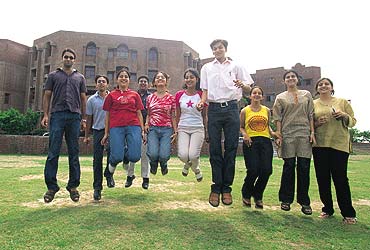
JOGGER'S PARK: Amity B-School, Noida, students at a physical fitness routine
Close by, at the ICFAI Business School, students are put through mock interviews and are taught psychometric analysis for personality profiling by experts. Says ICFAI director Panduranga Rao: "Students appreciate these a lot. Such programmes teach them survival skills that are beyond academics." The institute also conducts a soft skills programme for students for oral and written communication skills, presentation and aptitude skills, career visioning and negotiation skills. There is one package for each term.
Explains T.C. Alexander, dean, Xavier Institute of Management Entrepreneurship (XIME) , Bangalore: "The main purpose of these programmes is not to stereotype the student into the ‘ideal manager’s role’ but to cascade their unique talents into a dynamic skill set relevant to a manager performing in a highly competitive environment." Since the new manager is likely to work in a globalised world, business schools are paying attention to foreign language skills. At Welingkar, it is now compulsory for students to learn at least one foreign language. The hot favourites are French, German, Japanese and Spanish. Some, like Amity, have even started courses for regional Indian languages.
One area that management schools are paying attention to is spirituality amongst its students. Delhi’s Faculty of Management Studies (FMS) held an Art of Living course over 6-7 days for second-year students earlier this year. Besides this, one of its faculty members, Mala Sinha, has developed a programme called the Spiritual Quotient under which students read the original and interpretations of the Isha Upanishad and then present a term paper on it. Sinha describes these workshops as transformational. "These two-day workshops bring out the very non-competitive and non-commercial personality of the students. Many of them even start crying." A truly cathartic experience.
Similarly, Bangalore’s Alliance Business School puts all its students through a week-long session on the Art of Living at the beginning of the academic session. Subsequently, students are made to go through other sessions of meditation and concentration from time to time "to fine-tune their inner faculties". Says Kumar: "We had strong endorsements from CEOs of leading companies about the effectiveness of these sessions with their managers." So, the institute decided to try it out with students to engage them into the routine right from the beginning. And the results, Kumar claims, are phenomenal. "The changes that we see after the sessions are qualitative. Our students have attained a greater degree of maturity because of this," he adds. At isb, students can choose whether they wish to take classes on yoga, salsa dancing, aerobics or all three.
Amity Business School wants to go beyond all academic linkages. The school plans to train its students in cross-cultural etiquette. Says Shukla: "Shaking hands with ladies differs from country to country. Exchanging business cards in Japan is so different from that in the US. You need to learn all that in a business school." Amity even plans to bring in chefs from abroad to introduce its students to different cuisines and the routines and disciplines associated with them. What if a business deal has to be signed over a cup of tea in Japan? Or over dinner in Korea? And since a lot of deals are signed on the golf course, Amity is planning to push students to play golf.
But at what point does one draw a line as far as the teaching these diverse skills goes? No one knows. One thing is certain, however: suddenly, mba courses have become a whole lot of fun.
By Arindam Mukherjee with Gauri Bhatia, Saumya Roy in Mumbai and Vaishna Roy in Hyderabad ========================================================================
| September 4, 2003 | |||||||||||||||||||||||||||||||||||||||||||
 |
|||||||||||||||||||||||||||||||||||||||||||
|
|||||||||||||||||||||||||||||||||||||||||||
============================================================
MAGAZINE: 15 SEPTEMBER,
2003
OUTLOOK-CFORE SURVEY
Top 10: Indices
Industry Interface, Infrastructure,
Placement, International Linkages, Computer/Students, Intellectual Capital,
Extra-Curricular Activities.
|
Industry Interface |
|
| Rank | Institute |
| 1 | IIM, Ahmedabad |
| 2 | IIM, Bangalore |
| 3 | IIM, Calcutta |
| 4 | IIPM, New Delhi |
| 5 | SP Jain Institute, Mumbai |
| 6 | XLRI, Jamshedpur |
| 7 | NITIE, Mumbai |
| 8 | The ICFAI B-School, Hyderabad |
| 9 | IIM, Lucknow |
| 10 | Amity Business School, Noida |
|
Infrastructure |
|
| 1 | IIM, Lucknow |
| 2 | IIM, Ahmedabad |
| 3 | IIM, Bangalore |
| 4 | IIM, Calcutta |
| 5 | IIM, Kozhikode |
| 6 | NITIE, Mumbai |
| 7 | IIM, Indore |
| 8 | Amity Business School, Noida |
| 9 | IIFT, New Delhi |
| 10 | XLRI, Jamshedpur |
|
Placement |
|
| 1 | IIM, Ahmedabad |
| 2 | IIM, Bangalore |
| 3 | FMS, Delhi |
| 4 | SJ Mehta School, Mumbai |
| 5 | IIM, Calcutta |
| 6 | NITIE, Mumbai |
| 7 | IIM, Lucknow |
| 8 | SP Jain Institute, Mumbai |
| 9 | XLRI, Jamshedpur |
| 10 | IMT, Ghaziabad |
|
International Linkages |
|
| 1 | IIM, Ahmedabad |
| 2 | IIFT, Delhi |
| 3 | FMS, Delhi |
| 4 | IIM, Calcutta |
| 5 | IIM, Lucknow |
| 6 | IIM, Bangalore |
| 7 | IIPM, Delhi |
| 8 | SCMS, Kochi |
| 9 | XLRI, Jamshedpur |
| 10 | PLN Welingkar Inst., Mumbai |
|
Computer/Students |
|
| 1 | IIM, Ahmedabad |
| 2 | IIM, Lucknow |
| 3 | IIM, Kozhikode |
| 4 | IIM, Calcutta |
| 5 | IIM, Bangalore |
| 6 | Amity Business School, Noida |
| 7 | SP Jain Institute, Mumbai |
| 8 | IMT, Ghaziabad |
| 9 | NITIE, Mumbai |
| 10 | XLRI, Jamshedpur |
|
Intellectual Capital |
|
| 1 | IIM, Calcutta |
| 2 | IIM, Ahmedabad |
| 3 | IIM, Bangalore |
| 4 | The ICFAI B-School, Hyderabad |
| 5 | FMS, Delhi |
| 6 | IIM, Lucknow |
| 7 | UBS, Chandigarh |
| 8 | XLRI, Jamshedpur |
| 9 | IMI, New Delhi |
| 10 | NITIE, Mumbai |
|
Extra-Curricular Activities |
|
| 1 | NITIE, Mumbai |
| 2 | XLRI, Jamshedpur |
| 3 | FMS, Delhi |
| 4 | The ICFAI B-School, Hyderabad |
| 5 | SP Jain Institute, Mumbai |
| 6 | IIFT, New Delhi |
| 7 | XIME, Bangalore |
| 8 | IIPM, Delhi |
| 9 | UBS, Chandigarh |
| 10 | IMI, New Delhi |
================================================================
| Sep 09, 2002 |
|
|
||||||||||||||||||||||||||||||||||||||||||||||||||||||||||||||||||||||||||||||||||||||||||||||||||||||||||||||||||||||||||||||||||||||||||||||||||||
|
||||||||||||||||||||||||||||||||||||||||||||||||||||||||||||||||||||||||||||||||||||||||||||||||||||||||||||||||||||||||||||||||||||||||||||||||||||
|
|
|||||||||||||||||||||||||||||||||||||||||||||||||||||||||||||||||||||||||||||||||||||||||||||||||||||||||||||||||||||||||||||||||||||||||||||||||||
=============================================================
Top 10: Placement Details
|
Name of the Institute | City / Dist | INDIAN
JOBS Salary per annum in Rs. lakh |
FOREIGN
JOBS Salary pa in USD thousand |
||||
| Avg. | Med. | Max. | Min | Placed (%) | Max | |||
| 1 | IIM, A | AHMEDABAD | 5.88 | 5.50 | 13.52 | 3.25 | 23.00 | 155.00 |
| 2 | IIM, B | BANGALORE | 7.30 | 7.40 | 15.00 | 3.50 | 11.00 | 145.20 |
| 3 | IIM, C | KOLKATA | 5.72 | 6.03 | 14.00 | 2.50 | 7.00 | 200.00 |
| 4 | FMS, DELHI | DELHI | 7.02 | 6.75 | 13.75 | 4.25 | 10.00 | 100.00 |
| 5 | XLRI | JAMSHEDPUR | 6.01 | 6.00 | 12.00 | 4.00 | 0.08 | 25.00 |
| 6 | (NITIE) NATIONAL INSTITUTE OF INDUSTRIAL ENGINEERING | MUMBAI | 6.23 | 4.75 | 15.00 | 3.00 | 5.60 | 66.50 |
| 7 | JAMNALAL BAJAJ INSTITUTE OF MANAGEMENT STUDIES | MUMBAI | 6.50 | 3.50 | 16.00 | 2.00 | 10.00 | 90.00 |
| 8 | IIM, I | INDORE | 5.22 | 4.25 | 8.00 | 2.73 | 0.00 | 0.00 |
| 9 | IIM, K | KOZHIKODE | 5.46 | 5.97 | 12.00 | 3.00 | 0.00 | 0.00 |
| 10 | S P JAIN INSTITUTE OF MANAGEMENT & RESEARCH | MUMBAI | 6.60 | 6.10 | 15.00 | 4.00 | 6.00 | 100.00 |
============================================================================
| Sep 09, 2002 |
|
|
||||||||||||||||||||||||||||||||||
|
||||||||||||||||||||||||||||||||||
|
Top 10 - Placement Performance
|
|||||||||||||||||||||||||||||||||
=======================================================
| September 4, 2003 | |||||||||||||||||||||||||||||||||||||||||||||||||||||||||||||||||||||||||
|
|||||||||||||||||||||||||||||||||||||||||||||||||||||||||||||||||||||||||
|
|||||||||||||||||||||||||||||||||||||||||||||||||||||||||||||||||||||||||
============================================================
Bee's Knees
The votes are in and the rankings are out. The nation's best B-schools, as they stand.
SANDIPAN DEB
Strangely enough, the biggest boom that the Indian economic reforms ushered in has not been very well reported: the business school explosion. As the private sector has upped and replaced the bureaucracy and public sector on all status-related parameters, as our vast middle class has turned radically materialistic and as India has proceeded stumbling into the global economy, a management degree has become the hottest and most coveted academic qualification in the country. For lakhs of youngsters and parents with stars in their eyes, the galaxies are spelt mba.
And, consequently, schools churning out mbas have proliferated.
B-schools in India can be divided into three broad categories: government-aided autonomous B-schools (the most famous of these being the Indian Institutes of Management, the iims), university B-schools and private B-schools. Among the iims, the ones at Ahmedabad, Bangalore, Calcutta and Lucknow are well-embedded in the Indian psyche and the two newcomers at Indore and Kozhikode have a bit of catching up to do.
University B-schools suffer from the usual bureaucratic bottlenecks. From curriculum revision to upgradation of facilities, there are a whole lot of permissions to be taken at every step. So it's all the more creditable for schools like the Faculty of Management Studies (fms) at Delhi University, and Jamnalal Bajaj in Mumbai to have managed to maintain their brand image in the face of the private onslaught. For instance, even to buy a water cooler, fms needs to seek ugc permission and then go through the tendering rigmarole before placing an order. Annual fund allocations are constantly delayed due to red-tapism and bureaucratic apathy. "But we have managed to perform despite such odds," says Prof S.P. Gupta, fms dean. "In the last three years, placements ended within 36 hours with average salaries at about Rs 12,50,000 per annum."
In fact, Chennai's Jesuit-run Loyola Institute of Business Administration (liba) prefers to offer just a diploma and not a post-graduate degree since that would mean that everything has to be modified according to university guidelines. Says A.C. Fernando, professor of economics: "liba prefers to retain its autonomy."
But the private B-schools are another kettle of fish altogether. In 1990, there were about 30 of them recognised by the All India Council of Technical Education. Today, they are 600! Obviously, they cater to far more students than the government-aided and university B-schools. But the disturbing truth which the Outlook-mdra survey has uncovered is that many of these institutes, which charge Rs 2-3.5 lakh for two-year courses, offer little learning and poor placements.
Says Dr R.A. Yadav, director of Delhi's Lal Bahadur Shastri Institute of Management (lbsim): "These schools have been set up by businessmen purely from a profit motive, with no respect for learning." Says Fernando of liba: "Being a missionary institute, we are not given to profit pressures. In other self-financing colleges, profit-making is the criterion."
If good jobs are the principal objective for getting into a B-school, the truth is that this year, in 30 per cent of these private institutions there were no campus placements, a sure indicator of recruiter interest. Even among those that did offer campus placements, the average salary is a paltry Rs 6,000 per month (while the students often paid Rs 10,000 a month and higher)! Faculty shortage is acute.About 60 per cent of these schools have less than seven permanent faculty members. And the average student-to-permanent faculty ratio is an inefficient 30:1.
On an average, they spend only 25 per cent of their revenues on faculty. The salary paid to permanent faculty varies from Rs 7,000 to Rs 1,00,000 per month, the average being Rs 18,000. Shortage of permanent faculty is met by visiting faculty who are paid by the hour (Rs 500-1,500 per hour). Interaction with industry, a vital part of management education, is also very low: 45 per cent of the institutes have not conducted any mdp (Management Development Programme) or taken any consultancy project in 2000-01. As far as infrastructure goes, 65 per cent of the institutes have less than 5,000 books in their libraries.
However, there are some private management institutes with the necessary infrastructure, academic environment and pedigree to produce competent managers. Some of them have also built strategic alliances with institutes abroad to build expertise.
Placements: Among the parameters Outlook and mdra used to rank B-schools, we gave the highest weightage to placement performance: what sort of jobs did the students get? Represen-tatives from several institutes requested us not to make it the most important parameter. However, the majority of B-school professors agreed that there was no way to avoid making placements the biggest parameter. We found while conducting the survey that B-schools are extremely sensitive about these rankings (indeed, we are resigned to receive irate phone calls and mails about our rankings even though we have kept our methodology totally transparent and objective (see page 52). So to recheck, we used mdra's website www. indiabschools. com to ask whether placements should be the most important criterion. A good 3,000 visitors to the website cast their vote, and more than 75 per cent voted "yes".
But the tragedy is that most of the institutes talk to industry only when placement season looms. Whereas interaction with industry has to be a continuous process, right from student selection to curriculum development. Says Dr Panduranga Rao of icfai Business School, Hyderabad: "We have a 16-week faculty-supervised summer internship programme and also provide on-the-job training opportunity to students, projects where students work for four days in industry and attend classes for two days a week. This exposure has culminated in final placements with premier companies."
For, in spite of all the hype and hoopla, the truth is that, except for top-league B-schools, placement performance in 2000-01 has not been that great. "Our aim should be to fill up important positions with our boys in all mncs, not only in India but abroad," says Dr Pritam Singh, director, iim Lucknow. In pursuance of this goal, some B-schools are even offering foreign languages as an elective. But in more than 80 per cent of B-schools, there are no foreign placements and among those which do attract international recruiters, very few have 10 per cent or more of their students placed abroad.
Intellectual Capital: In a recent conference where both mba students and industry representatives were present, a student raised the old swadeshi point: "With so many mncs coming, won't our nation be subjugated like the British days?" Replied an executive: "If that happens with so many B-schools around, then we deserve to be subjugated."
But the critical issue here would be the quality of faculty.And the findings of our study on this count are rather dismal. In more than 50 per cent of B-schools, not a single book, article or case study has been authored by their faculty in the last year. The administration is partly responsible for this intellectual inactivity. For, in more than 70 per cent of private schools, the faculty has to teach up to eight courses in a year. With such a high workload, who would have the time for research?
Another popular area of debate is whether to hire permanent faculty or depend on visiting faculty. With the ugc prescribing higher salaries for professors on the basis of the Fifth Pay Commission's recommendations, institutions find it easier on the pocket to pay part-time faculty by the hour. After all, visiting faculty have no overheads and statutory perks like provident fund. But most students interviewed found visiting faculty lacking commitment. Says Jayati, a student in fore School of Management, Delhi: "The visiting faculty should be drawn from industry and should be masters in their field so that we can gain from their experience. But such courses should be specialised and few. The foundation courses should be taught only by permanent faculty."
Infrastructure: A wired campus of more than 100 acres, air-conditioned classrooms with lcd projectors and video conferencing facilities, hostels with single-occupancy rooms and each student provided with a computer with total interconnectivity, a library with links to international databases, gym, canteen, 24-hour access to the computer lab and library, that's the ideal B-school infrastructure. But how many in India boast this? Hardly any, beyond the iims.
Only in 10 per cent of B-schools is it mandatory to stay in a hostel. Does it help? Of course, says Dr A.K. Sengupta, director, S.P. Jain Institute, Mumbai. "It helps in developing team spirit." But our survey shows only 20 per cent of B-schools provide residential facilities to students and of these, more than 80 per cent don't provide single-occupancy rooms.
Outlook-indiabschools.com Perception Survey: For the first time in India, a perception survey was carried out on the Net to gauge the satisfaction of relevant stakeholders. More than 3,000 students, 250 faculty members and 300 executives participated. The survey was supplemented by field visits of mdra staff to B-schools to interview students and faculty.
The satisfaction level of students in government-aided autonomous B-schools (iims, etc) and some top private B-schools is highest. But in university departments and most private B-schools, the students were highly dissatisfied with infrastructure and facilities. The faculty in most of private B-schools felt dissatisfied with the workload.
Under the B-school boom simmer a lot of problems. As Dr Devi Singh, director of the Gurgaon-based Management Develop-ment Institute, says: "When the crowds increase, people realise sub-standard products have filled the markets. And it's only then they look for standards." But a lot of people could get hurt on the way.
Sandipan Deb And Premchand Palety With bureau reports
