by Jojo Soria de Veyra

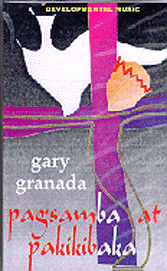
PAGSAMBA AT PAKIKIBAKA (1989?, Sigya Records)
IN this age of new-millennium sounds standardized by American and British producers and recording institutions, independent home recordings -- especially those using a singular acoustic instrument and cheaper mike for the singing vocals -- create a rare kind of relative organic effect akin to the charm of turned-low AM radio. It's a matter of appropriateness, I think, understandable for example in a bunch of mainstream jazzmen's clamoring for that faked vinyl record sound on their '50s-inspired record. Not that P&P lacks bass, but today's audience would always expect that regular woofing thump on their bass speakers care of the world's finest electric bass guitars and bass drums.
In P&P, Granada makes his kind of organic-ness highly appropriate for a true alternative ethos, towards an aesthetics of poverty foregrounding his folk music-inspired Christian socialist poeticizing, Marxist environmentalism, accusing nationalism, and -- above all -- pastoral lyricism.
The beauty of this claim to organic-ness would rely much, however, on the depth and strength of one's sympathy for Granada's political singings. In this sense, Granada would be a true alternative singer-songwriter coming from the fringes, as against one from the so-called "alternative music scene" embraced by the corporate music industry. To yuppies jaded by the redundancy of leftist lectures and hypnotized by the hype on West-dominated globalization, therefore, it's the sophisticated Western recordings of even acoustic/folk instruments that already create their own deep beauty without any partisanship and politics, supposedly readily visceral even under the light of the most insignificant or inane or juvenile lyrics. We can't help that, of course, since musical tastes of a day are reflections of that time's majority's politics.
Perhaps this would be the reason why the most gut-wrenching songs in this album would be the ones with the most popular empathy-calls, despite their subtlety, namely "Manggagawa" and "Bahay". The latter, a call for a definition of what may be appropriately referenced as a shelter, would be the runaway hit. And "Manggagawa" would be the contender, with its melodious lament over underpaid workers' unending, progress-seeking treadmill. To the church-going, the title song could very well be a popular one, except that liberation theology ("pakikibaka" is such a contentious referent word) would be a turn-off to present-day takes on the Christian philosophy.
In "Dam," Granada sets his acoustic guitar fingers to the dance mode (I'm reminded of Jews dancing in the movies), as if to parody our celebrations over progress ("dam" rhymes with "dumb", got it?).
Despite the pictures of hopelessness around the religious atmosphere that Granada paints, we must not however overlook the songwriter's optimism between the words, that optimism that even became a song in "Kanluran". Undoubtedly a wish-song about the West's leaving the East alone, it uses the sunset metaphor as an image of rest, peace, reminiscence, and happy evenings. This is Granada's Hard Day's Night. And maybe all of the songs here are.
Should Pagsamba & Pakikibaka's kind of ultra-organic supra-indie sound within 29:29 minutes be the Filipino model for any impending neo-folk movement in the Philippines in reaction to present global standards of sonic depth? I'm thinking in terms of what the Manila Sound consciously/unconsciously did to compete. Well, let's just cross our fingers, while we make signs of the cross. (8/02)ADDENDUM: It's the year 2004, and a neo-folk movement has indeed come, via the acoustic guitar-based oeuvres of three popular "folk" singers. When the most popular hit from this trio turns out to be a song about the lights of Paris, I wonder now if I've lost touch with a new definition of "folk". Perhaps I should try to get back to the corporate yuppie world of Makati. (8/04)
Copyright © 2002 Jojo Soria de Veyra. All rights reserved. Readers are welcome to view, save, file and print out single copies of this webpage for their personal use. No reproduction, display, performance, multiple copy, transmission, or distribution of the work herein, or any excerpt, adaptation, abridgment or translation of same, may be made without written permission from the author. Any person who does any unauthorized act in relation to this work will be liable to criminal prosecution and civil claims for damages.