EARTHQUAKE SAFETY
Before the Earthquake
During the Earthquake
After the Earthquake Our
Risks
Before
-
Develop a family earthquake plan. Prepare yourself and your home by completing
the activities on this checklist.
-
Decide how and where your family will reunite if separated.
-
Know the safe spots in each room: under sturdy tables, desks, or against
inside walls.
-
Know the danger spots: windows, mirrors, hanging objects, fireplaces and
tall, unsecured furniture.
-
Learn first aid and CPR (cardiopulmonary resuscitation) from your local American
Red Cross chapter or other community organization.
-
Learn how to shut off gas, water and electricity in case the lines are damaged.
(Safety note: Do not attempt to relight a gas pilot).
-
Secure water heaters and appliances that could move enough to rupture lines.
-
Secure heavy furniture, hanging plants, heavy pictures or mirrors.
-
Keep flammable or hazardous liquids in cabinets or on lower shelves.
-
Maintain emergency food, water and other supplies, including a flashlight,
a portable battery-operated radio, extra batteries, medicines, first aid
kit and clothing.
During
-
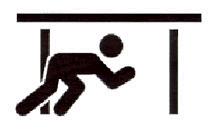
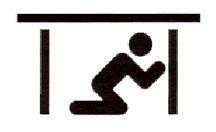
If indoors, stay there and take cover under a table, desk, or other sturdy
furniture.
-
Face away from windows and glass doors.
-
A doorway without a door is an acceptable location in which to stand.
-
Lie, kneel or sit near a structurally sound interior wall or corner away
from windows, brick fireplaces, glass walls, etc.
-
Protect your head and body from falling or flying objects.
-
Remain where you are until shaking stops. Think out your plan of action first,
then move.
-
Know exit routes if in a commercial building. Take cover and don't move until
the shaking stops.
-
If outside, get into an open area away from trees, buildings, walls and power
lines.
-
Lie down or crouch low to maintain balance.
-
Get to the best available shelter if there is no open area available.
-
If driving, stop safely as soon as possible. Stay inside your vehicle until
the shaking stops.
-
Do not stop your vehicle under overpasses or bridges.
-
Stay below window level in your vehicle.
-
Turn off the engine and turn on the radio. Follow emergency instructions.
-
Stay in the vehicle if downed power lines have fallen across it. Do not touch
metal. Wait for help. You might be able to back away from lines.
After
-
Check for injuries. Render first aid. Do not move seriously injured victims
unless they are in immediate danger. Do not use the telephone immediately
unless there is a serious injury, fire or other emergency. Hunt for hazards.
-
Check for other hazards and control them (fire, chemical spills, toxic fumes
and possible collapse).
-
Check utilities (water, gas, electric). If there is damage, turn the utility
off at the source.
-
Check building for cracks and damage, including roof, chimneys, and foundation.
-
Check food and water supplies.
-
Never use matches, lighters or candles inside.
-
Turn on the radio and listen for emergency broadcasts/announcements, news
reports, and instructions. Cooperate with public safety officials.
-
Do not use your vehicle unless there is an emergency. Keep the streets clear
for emergency vehicles.
-
Be prepared for aftershocks.
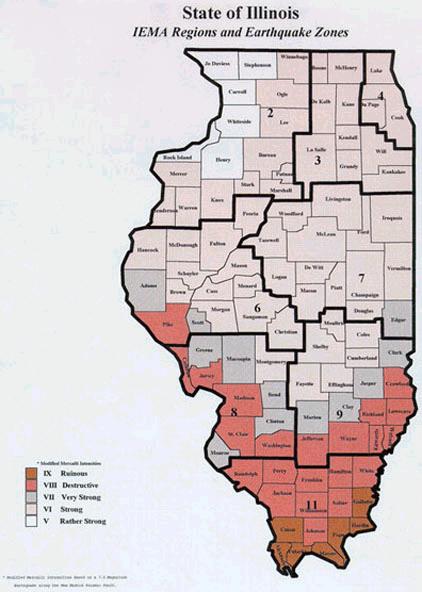
OUR RISKS IN ILLINOIS-Wabash County sits in
the Wabash Valley Fault System Destructive Zone. The magnitude 5.0 earthquake
of June 18, 2002 had its epicenter between Mt. Vernon and West Franklin in
Posey County, southwestern Indiana and was felt here in Wabash County.