Links for convenience -
From John Muir* -
The headlights are adjustable. You can adjust them yourself by shining them on the wall of a building. Draw some lines on the wall for level and straight. The low beams should be under level and about 6" from straight ahead. The high beams should center on the level line (height of lights from ground) and be just to the right of center (straight ahead). You should adjust them every time you put in a new headlight unit. Remember to put air in your tires before you adjust the lights. You can do all the work on the lights with a medium screwdriver, a phillips screwdriver, and the Scout knife. Check your Owner's Manual for location of the adjusting screws.
*How to Keep Your Volkswagen Alive --
A Manual of Step-by-Step Procedures
for the Compleat Idiot,
1976 Edition, page 312.
Someone wrote -
I have a 1974 Beetle and would like to know about increasing headlight power. If I increase the wattage of the bulb, will this melt wires etc? My headlights seem very dim and I want to do something about them. Also, how do you know when your headlights are focused properly?
Rob responded with a description of Australian headlights -
Since you're in Australia you might get some unusual answers from US folks - their lighting laws are different to ours, and their 12-volt Beetles usually have sealed beams, where we usually have the globe-and-reflector type.
To check this, have a look through the glass. A sealed beam has the filaments 'exposed' in the center of the reflector, a globe will be obvious if you have that type.
If it's the globe type, good lights are easy. First take out the globe - unscrew the single screw at the bottom of the light housing, and gently pry up the bottom edge of the chrome light-surround. The headlight unit will pop free and the three prong plug can be pulled off the back of the globe and the globe rotated out of the reflector.
You'll probably find it's a 40/45 watt globe. The glass should be spherical. Now take the globe with you to K Mart, Target or an auto parts store and get an H4 halogen globes rated at 55/60 watts. Make sure the shape of the base is the same as the one you have - there are at least three different designs for the H4 globe. (The two numbers refer to low/high beam incidentally). This will plug straight back into the reflector with no changes needed to wiring etc.
You'll be amazed at the improvement - I've been using H4 Halogens for 20 years in my Beetle. They are perfectly legal in Australia too, and the focus of the light is unchanged.
And a word of warning about handling halogen globes - DON'T TOUCH THE GLASS WITH YOUR FINGERS. These globes run HOT, and any trace of sweat from your fingers will cook into the glass and reduce light output.
Be careful at getting higher ratings though, as they also come in something like 60/90 or higher wattages. The standard wiring may not be up to the task for these globes, and relays and uprated fuses would be needed. Stay with 55/60s and you are safe on the standard wiring and fuses.
There is also a 75/75 watt 'standard' globe, which I've tried, but these don't seem to add much light, I think because the wiring is on it's limits with this current.
Also check the connections to the globe and to ground. These should be clean and bright for a good electrical path.
Focussing the lights is easy. The quick method is to get out on a dark night, and with no other traffic around, you should see (on low beam) a distinct line across the road several car lengths ahead of you, with a 'kink' in the line on the left side, which means the light travels further down the road on the left hand side than the right (to all you US folks reading this, we drive on the left OK?). This cuttoff line prevents oncoming cars getting too much glare, but allows you to see the pedestrians on the footpath. On high beam, there should be an even spread of light much further down the road, with no cut-off line visible. Each light should point ahead of the car, and you can check this by covering each light in turn with a piece of cardboard etc, then get back in the car and look at the reamining light from behind the wheel.
This is a fairly 'quick and dirty' method, but accurate enough to give you good lights without blinding oncoming motorists.
Rob wrote -
We still use the globe and reflector headlights, not the sealed beams you've got in the US. I have found that the H4 55/60 Halogen headlights I have are just fine for night driving.
We can get a 6volt 55/60 watt H4 Halogens for the older VWs too. GREAT lights compared to the original 35/40watt (I think) 6-volt candles.
What wattage are the sealed beams? Some sealed beams for other cars here come in 75/75 watt varieties. (Had and old GM car with these once). Not bad, and the VW wiring can definitely handle the 75 watts. I had 75/75 watt globes in mine just before the H4s became available in the mid-70s. I still have one in my box of tricks in the shed. Needed the next size up fuse though (20 amps instead of 15 I think). The original 12volt VW globes for the globe-and-reflector lights are 40/45 watt.
Dave responded -
The headlights we are using in our Bug are Sylvania H6024 halogens, 60/40 watts (I assume this means high/low). The H6024 is supposed to replace the H6014 and H6015, if that means anything to you. I don't know whether there's a higher wattage sealed beam on the market or not -- have to check it out next time I'm at the parts store.
Rob wrote -
The 60/40 watts is high/low as you thought it's usual for the high beem to be a bit brighter than the low, and the low beam filament usually has a partial shield over it so only the upper part of the reflector is used -- to reduce the glare to oncoming drivers (the upper part of the reflector provides the 'lower' part of the beam).
Dave wrote during the rebuilding of his car after having it painted -
Then to the headlights. Everything is new, including the drains, the electrical connection, and the screw that holds the chrome trim.
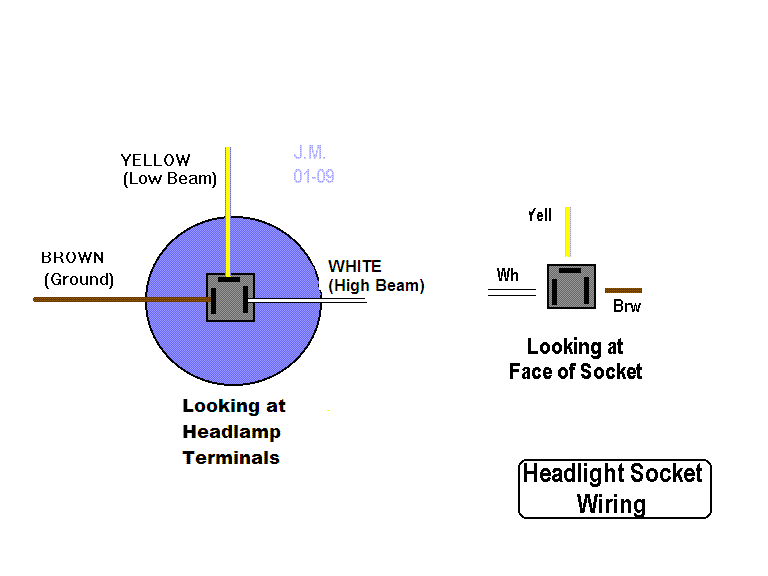
"Speedy Jim" has provided a good Schematic Drawing of the headlight wiring on "Speedy Jim's" Home Page.
I made an interesting discovery that everybody else probably already knows -- it's LOTS easier to start the screw on the bottom of the headlight trim FIRST. If you attach the top of the trim first, it's almost impossible to start the screw at the bottom. With the screw just caught, it's still possible to slip the top over the catch-lip, and you can SEE the screw to find the hole. The right trim piece went on just fine, but the trim piece around the left one won't go on for love nor money. It appears to be about a quarter inch too big in diameter -- I may have to order another one.
Looking closely at the left headlight - the one I can't seem to get the trim ring on. Looking at the tab inside the headlight well (after taking the headlight back out) it does seem to be bent back a bit - I don't know whether I can bend it far enough forward to make a difference or not.
Point of information -- the screw is fairly long and has a threadless section at the tip to help position it into the thread in the tab.
(Later) Dave determined that the hole that the left headlight rim bolt screws into is stripped. He at first thought he would have to redrill and tap the hole.
Rob suggested the use of "one of those body clip devices which have a "thread catcher," slipped down over the tab, and then use the original bolt." Dave indicated that the hole the bolt is supposed to screw into is right at the bottom of the tab -- in fact the bottom of the hole is flush with the body. There is another, larger hole in the tab about 5mm to the right of the regular hole -- the PO was using that hole with a large, unsightly wood screw. The left headlight rim has always been a problem on this car, probably because of the accident that bashed in that side of the car.
(Rob indicated that he had exactly the same problem in his '68 Bug -- a wood screw holding the rim on the left headlight!)
Dave finally got that situation fixed --� and it was Rob's suggestion that fixed it! The stainless steel bolts that I bought turned out to be too small in diameter for the stripped-out holes in the tab inside the headlight well, but I found that they DO fit into the larger of the clips (with the "thread catcher") that I bought, and the clip DOES fit over the tab in the headlight well! So --� all fixed, once again thanks to Rob's good advice. A longer stainless steel bolt and the appropriately sized clip make it a dead easy fix.
Rob wrote of a strange problem with the headlights in his '68 Bug -
High beam was fine, but low beam was like they are wired in series - very dim, but the filaments were definitely getting some power. When Rob pulled the connector and direct wired them he get normal bright lights. Rob suspected that the PO cross-wired either the light switch or the hi-low relay, since that wiring needed to be moved when he (badly) installed the radio.
Rob spoke with "Speedy Jim" about the problem. Jim said the dimmer relay (hi-lo relay) can get partly burned and provide bad contacts and suggested a test. Rob said he had to remove the radio so he could get at the light switch to check the two connections there.
The resolution of Rob's problem turned out to be simple, but very difficult to track down. One of the globes was a non-VW one, which worked fine but did not have the 2-step base the normal VW globes have. It turned out that the three prongs on the back of this globe have two wires reversed when compared to the VW globe. The PO must have found this out when he tried to fit the globe, and in trying to sort the problem then, reversed the wiring for BOTH headlights. The effect was that it ran the power through the low beams, then back through the high beams, so they were effectively ALL running on 6v when the lights were dimmed. All fixed now -- the lights are normal bright.
Rob said it was a big jump-for-joy job -- the problem had been bothering him since he got the car. He could drive it OK with street lights around, since the lights were plenty bright enough for other cars to see him, but on dark roads they had only a candle glow on the road.
Rob talked to the VW shop today and mentioned that his '68 Bug has one headlight reflector which is a little tarnished (they still use the bulb/reflector lights in Australia - never used the sealed beams). Anyway, you can get new reflectors from Brazil (the $20 price is right but the reflectors are rubbish) or German ones - outstanding quality, but $80 each. A few years ago new reflectors were unobtainable, so someone must have decided there was a market for them.
Dave wrote about a problem that developed with his taillights -
Driving behind his son (who was driving their '73 SB) Dave noticed that the tail lights in the Bug were out, both of them. When they got home Dave checked out the whole system and discovered that the front parking lights were out, too. The turn signal lights and brake lights worked.
Dave laid awake for a while ponderating. The tail lights and parking lights on each side come from different fuses, #1 and #2. It was very unlikely that both fuses would blow at once. Besides, the turn signals come from these same fuses, and they work. Hmm... Dave got the manual down and looked at the wiring diagrams. The only common point is the SWITCH. When Dave was fiddling up under there with the defroster tube he accidently dislodged the headlight switch. He was able to snap it back into place back there behind the dash, but it's possible that the single wire that goes from the switch, then splits to go to the two fuses, has come off of the switch.
Dave laid his big bod out under the dash and tried unsuccessfully to figure out why the tail lights and parking lights don't work. He found two empty spade connectors on the headlight switch but no loose wires. Bentley tells how to get the switch in and out but does not show which wire goes where. Dave sorely felt the need of a good electrical manual that clearly shows such things -- a good, clear wiring diagram that shows "what goes where and why"!
Later Dave fiddled with the headlight switch trying to figure out why our tail lights and parking lights don't work. He drew it all out, and in the process discovered that the wiring diagrams in the Bentley Manual have color codes (even though they're black and white), and the connection points are numbered. Corresponding numbers are stamped on the actual switch. Cool! But still couldn't find the problem...
Dave replaced the headlight switch wire for wire -- and then learned a most important lesson. ALWAYS remove the grounding strap on the battery before doing anything electrical!! The wires grounded while he was putting the switch back in -- burned the insulation off of the power wire all the way back to the fuse! Filled the car with smoke and scared Dave half to death! Fortunately his old ticker has been refurbished and could withstand the scare. So Dave immediately removed the grounding strap, then replaced the red wire from the #8 fuse to the headlight switch. Everything worked (whew!) EXCEPT the blankedty-blank tail lights and parking lights! Very confusing.
"Speedy Jim" wrote -
There are two fuses (#1 and #2) which control ONLY the tail lights and parking lights (and license plate light). No other lights are affected by these two fuses. Since you already replaced the headlight switch I would double check these fuses. Even if they look good, they may not be making adequate contact. Remove them, sand the fuse holder contacts and clean the fuses or replace them. If you have some sort of tester, you can check the voltage at both sides of the fuse holder (to ground).
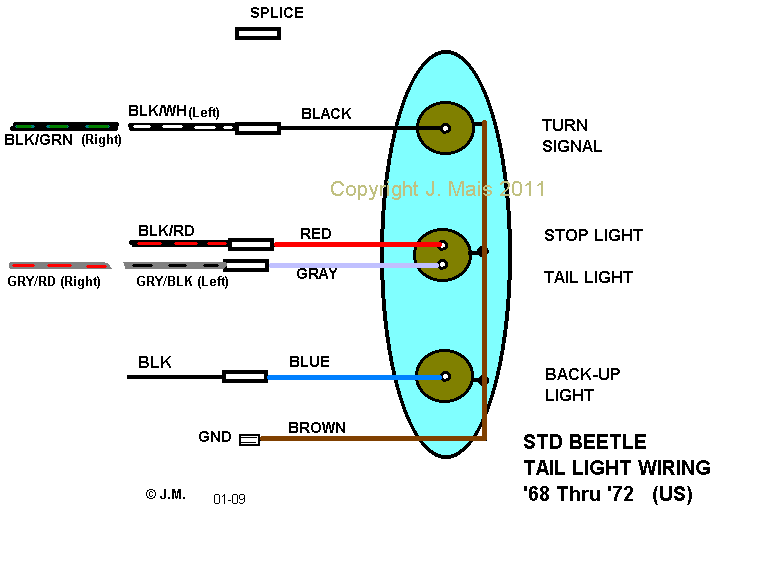
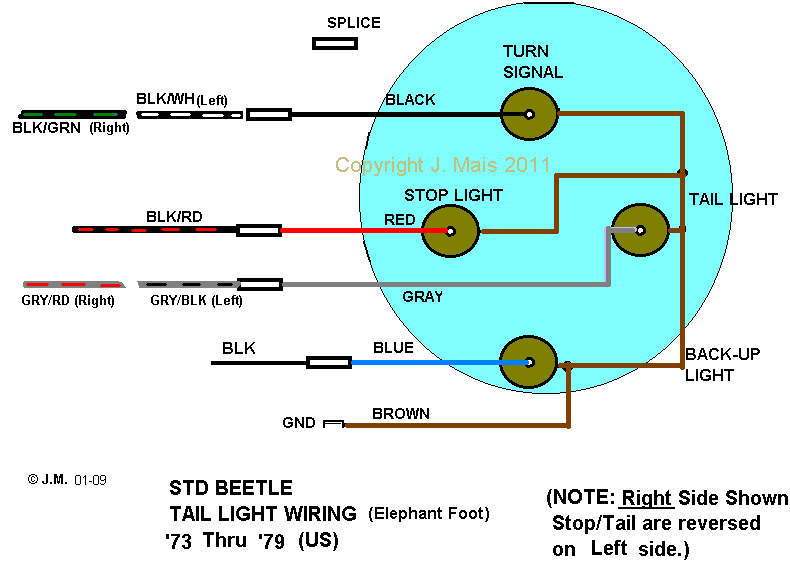
On his Home Page "Speedy Jim" has provided excellent schematic drawings of the taillight wiring for the Standard Beetle -- '68 - '72 and the Standard Beetle -- '73 - '79.
Dave finally reported success with his taillight wiring -
I tested through the whole system with my handy dandy VOM and found 12 volts all the way to the taillight sockets, where I discovered that the lights burned brightly with the lenses removed! So I got to fiddling around and discovered that the inside of the lenses were pushing the bulbs IN and causing them to lose their ground.
There's a piece of metal inside the lens that runs horizontally from one side to the other, between the tail/brake lights and the backup light. It was preventing the lens from sliding all the way onto the fixture, so I folded it over. Mistake! It's a spacer, designed to hold the lens away from the bulb. A little too deep perhaps, but I folded it over too far. The fix just didn't tighten the lens down quite so much, and the taillights now shine brightly.
Dave wrote, much later, after retreiving the car from the paint shop -
I have some more studying to do on the taillight wiring. I carefully labeled each of the five wires, but in the process of stripping and painting the car my labels are illegible for the most part. I'll probably just end up attaching the wires one at a time and then see what happens when I step on the brake, etc.
We have the large "elephant foot" tailights on our '73 SB. Under the lens there is a large, heavy, strangely-shaped metal part that the four bulbs fit into, with the electrical connections on the back (all right, front! :-) side. This piece has four bolts embedded in it, one at each of the four "corners." It has a black seal around it, which leads me to believe that it is mounted directly onto the fender.
Rob responded -
Mine has the metal housing bolted to the curved fender and the light assembly mounted on the metal housing. So only the two bolts for the housing project through the fender (plus the grommet for the wiring of course.)
Dave wrote -
I'm going to get busy and do what it takes to get the car started as soon as possible. The headlights and wiper motor aren't hooked up, but the headlight switch is there -- it's the connection point for the main power from the rear to the front (thick red wires).
Since the wiring got dirtied up in the prep and painting of the car, I'm going to take some steel wool to the wires to determine the colors (taking care with the two-color wires, as the "thread" color can be easily rubbed off). Then I will wire the taillights up exactly in accordance with "Speedy Jim's" diagram.
So the taillight assembly, when all put together, will look like this. from the inside out, left to right -
- Body/Backing Plate/Light Assembly/Lens
Not like this -
- Backing Plate/Body/Light Assembly/Lens
That's been keeping me awake at night :-) - glad to have it sorted out.
Dave wrote later, after getting the taillights reassembled -
I've still got a problem with the taillights -- I thought I had that all squared away, but when we checked them last night we found that the brake lights didn't work on one side, and the wrong light came on on the other side. Sigh ...
The "Compleat Idiot" strikes again! "When all else fails, read the instructions!" I opened the 1973 VW Owner's Manual and read about the bulbs in the taillight fixture. The back-up lights are all the same (US #1073), tail lights are smaller (US #67). The &#*@ PO didn't even think to look in the Owner's Manual, and I followed along with all four lights the same -- fat, dumb and happy. It's no wonder the tail light lenses melted -- the bulb wattage was too-high and the bulbs got too hot!
Someone wrote -
I pulled the lenses off the front turn park lights and discovered there is a big bulb and a small bulb on the housing. So I looked at the wiring and there are only three wires coming and connecting to the big bulb. I do have parking lights and turn signals from this big bulb but what is the little bulb for?
Rob responded -
In many countries, the parking lights are inside the headlights, and the headlights themselves are the bulb and reflector type similar to the old 6v style. (This makes it VERY easy to update the headlights to 55/60w halogens - it's a straight bulb swap :-)
With this style of lighting, the housing on the fender has only one bulb - the turn signal.
But in the US, the 12-volt Bugs headlights are sealed beams (just the two filaments and no space for a parking bulb) and so the parking lights are moved to the housing on top of the front fenders, so you have two bulbs up there.
The smaller of the two bulbs is the parking light (probably about 4-5watts), and the larger is the turn indicator (about 18-21 watts).
Hopefully your wiring has grey, blue (maybe with a white stripe) and brown connecting wires (with a black wire inside the housing).
The grey wire connects to the large bulb (one of the two terminals on the base) and a black wire goes from there to the small bulb (single terminal). The blue wire goes to the other terminal on the large bulb. The brown wire is and earth wire, connecting to the side of the bulb bases.
Disclaimer stuff: Rob and Dave have prepared this information from their own experiences. We have not assumed any specialised mechanical knowledge, but we DO assume that anyone using this information has at least some basic mechanical ability.
We hope you find this information useful, but we don't take any responsibility for anything which happens to you, other people, your VW or any other property or goods resulting from your use of this material.
Feel free to print off any of this information for your own use. If you intend to link this material to another site, reprint it, or in any other way redistribute it, please leave the information complete, including this disclaimer section, and provide a link to this Web site.
Last revised 5 May 2004.