|
Somebody has finally done it. An Airport book. The kind of
page-turning, scamper 50 pages in airport lounge chairs or Jet Blue middle
seats, heart-rending or heart-warming running novel demanding you reach
the finish line in a rush. There are also quite a few scenes in airports,
with time segues illustrating how harrier dreams and realities diverge
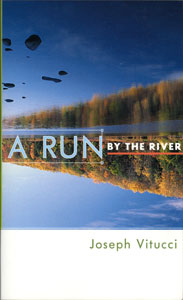
during the protracted marathon of life. Joe Vitucci’s A Run By the
River (1st Books Library) blends a genre triptych of Mystery, Romance and
Harrier Adventures much like a good 5K race: the first 2 miles or 200
pages, you bridle yourself, waiting for the right moment to strike, or for
the plot and characters suddenly to pick up the pace. Only then does the
runner/reader hurtle pell mell toward a fantastic yet indeterminate
outcome.
Twenty years post-university sojourn, John Meyer amidst airport musings
reflects back to when he found himself ensconced in Stradford University,
an idyllic setting on highway 27 in Southeastern Ohio, where the team is
called ‘the Reds’ and the student population is 15,000. For road atlas
sleuths, the locale for this rollicking fable to unfold somewhat
strikingly resembles Miami University, on highway 27 in Southeastern Ohio
and Oxford, whose team is ‘the Redbirds,’ and has a student population of
15,000. Notwithstanding the academic havens’ similarities being solved on
page 343, we are thrust into our airport book with abandon. Meyer’s fellow
Red harriers provide more the backdrop than actual central plottage during
the evolution of college life for a quiet man amidst the diverse set of
male and female characters encountered when one first leaves home to find
one’s legs in more than one manner. Although you’ve got to love a
tentatively explosive team with a guy like ‘Grenade’ on it, Meyer’s quest
to discover his own destiny involves trial by character fire primarily
from a strong cast who find distance running the fancy of those too thin
to know better. He must inevitably deal with roommate Brandon Gild, a
gilt-edged cunning scoundrel whose superficial collegiate raisons
d’être are hustling women and pranksterish revenge for his own
shortcomings. The shy, pensive Meyer must decide between the stunning
southern belle Angela from Tennessee, and the erudite and aesthetically
valuable Jenny Clayton for either romantic interludes or mental
sustenance. Then there is the Pre-like, or perhaps more accurately,
Lindgren-like Steve Rustin, whose talent from high school achievements may
or may not bloom at Stradford. Of course there is a college dive, the
Waterhole, where for additional inspiration conspicuously is found a
poster of Steve Prefontaine. Stradford Begins and Ends Here, a sign
reads. Yet in between there are many twists and turns for student harriers
who occasionally glimpse a mysterious shirtless runner ephemerally
shooting by or find themselves galloping near that river which surfaces
only for 1.71 miles. Then Vitucci thrusts upon us the parallel tale of
trucker Jonas Cromwell, a prescient dreamer who while asleep often
clairvoyantly foresees the future with startling accuracy. While Vitucci’s
writing has rather the succinct, best-selling nature of a Carol Higgins
Clark rather than the ponderously esoteric general knowledge innuendos of
a James Joyce, a great deal of time is devoted, thankfully, to the dreams
of many of the characters, both villainous or heroic. We learn motivations
through their thought processes, those often myterious but necessary
cogitations of looking before leaping—even if the latter is the focus of
those daring to negotiate Mother Earth rapidly on foot. Road Vapors of
Nothing, as Vitucci distinctively coins. Yet the spirited cross
country racing over hill and dale or college green acts more as starting
gate and finishing chute for the parable of collegiate life itself, where
again, each young student must find his or her wings with books, bells,
and consorts and co-conspirators of one gender or another. Without
revealing any outcomes involving mirages of the mind, affairs of the feet,
or affaires of the heart, it must be said that A Run By the River nicely
ties up the loose ends by book end. This reviewer was left with one
question and one nit. Vitucci chooses to animate the city of Stradford, a
literary device which sometimes acts as a creative alternative for
exposition and at others a somewhat distracting intrusion. The question is
whether the device helps or hinders the narrative. You make the call. Then
the nit involves the choices of a bibliophilic Jenny Clayton. “Jenny’s
foremost area was an exquisite and varied knowledge of the classics,”
writes Vitucci. “Fitzgerald, Twain, Kafka, Shakespeare, Nietzsche, Plato,
Salinger, Conrad and Thoreau were the authors perpetually roaming her
brain.” One might have thought such a literate character with the name
‘Jenny’ might have included at least one or two from a list such as
Wharton, Bronte, Sand, Dinesen, Cather, Christie, or St. Vincent Millay.
Yet this nit should be brushed off like a leaf caught under a shoelace
before a halcyon ramble on your favorite trail or byway. And every
engaging read must pose questions or present criticisms, even if written
by Shakespeare, Dickens or St. Vincent-Millay. Joseph Vitucci’s skillfully
traversed A Run By the River raises many questions by its finish line,
just the sort of inquiries into the meaning of life itself we all eagerly
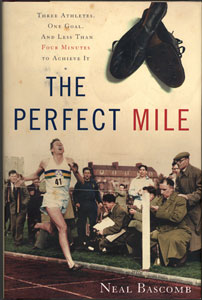
seek through both real and vicarious journeys...The Perfect Mile (Houghton
Mifflin) is another triptych or words, this one a wonderfully inventive
non-fictional recounting of the middle-distance quests of the legendary
Roger Bannister, John Landy and Wes Santee.
The trio find themselves battling for the singularity of being the
first human negotiating four laps of a cinder or dirt track in under four
minutes. Before their time, the incremental attempts were wildly popular
and grandly publicized. Even monumental, much like World Cup soccer or the
Super Bowl today. In the 1930s, when clockings were still more than 10
seconds off from the magic sub-four dead, many an hour throughout the
world was spent eagerly anticipating and then watching the great efforts
falling short. The mark itself was a compelling siren perhaps like no
other in athletic history. Author (Higher: A Historic Race to the Sky and
the Making of a City) and New York Times contributer Neal
Bascomb begins with the parallel tales of the aforementioned
threesome. Wes Santee’s father and the patriarch’s Kansas farmwork
comprise the U.S. miler’s biggest initial hurdle; Landy’s agricultural
studies in Melbourne and Bannister’s medical school investigations in
London intrude demanding necessary pursuits and related time constraints.
But a common thread bonds all three of these intrepid adventurers. Each
uses Failure or Adversity as if the discovery of a lost arc or book of
totemic instruction. There is something to be learned from every stumble,
bumble, or fall. Great athletes, it would seem, are neither mistake free
nor flawless in judgment. Rather they are those indefatigable souls who
simply find barriers and mistakes the fuel and fodder subsidizing eventual
nonpareil accomplishment. Then there are their respective work ethics. All
three run poorly in the 1952 Olympic Games in Helsinki. During those Games
Landy makes the effort to meet and go for a run with the Czech triple gold
medalist (5000, 10,000 and marathon) Emil Zatopek. The Australian—after
the trio all surprisingly have their first encounter independently of one
another in a post-Olympic London four-mile relay race—returns home, and
will no longer take the advice of the madcap Percy Cerutty. Landy must
work and study during the day. Only at night does he run, and run, and run
himself to exhaustion. Initially he can do no more than 4:14. But finally,
after weeks and weeks of training, he heads on foot to Olympic Park—where
no Olympic Games have been held. Landy is hungry and has a chocolate
sunday; still hungry and eats two meat pies. The cinder track’s lane one
is chewed up from past rains, and Landy, who will only decide mid-race if
an all-out effort is to be attempted, narrowly makes the start after
missing the starter’s call. The national record is 4:09+. Landy runs
4:02.1. A new era’s race for the elusive time is on. Bannister knows.
Santee is aware...Bascomb also historically glides us through the amazing
extents men will explore to excel at distance running. Over time, training
techniques evolve from carrying a sheep for strength, walking great
distances for endurance, holding one’s breath, losing one’s breath,
jumping, hopping, skipping, bounding, short sprinting, to eventually
incorporating more of the specific productive bipedal action when both
feet are off the ground. Historically, exercise has always been a behavior
considered either deleterious to health, or, as Bascomb reminds us the
ancient Greeks believed, a pattern thought to compliment the development
of mental process—mens sana in corpore sano—a sound mind in a sound
body. But by the time 20th Century Paavo Nurmi and Zatopek have dazzled
the sports world, hard work and more of it generally become the call of
the miled. Santee nearly packs it in after refusing to run another in too
many Drake Relays races for his KU coach Bill Easton. The Kansan whiz next
is bated when he hears Finnish miler Denis Johansson, who reputedly smoked
27 cigarettes a day, announce in so many arrogant words that the American
is unseasoned and needs a lot more work before their encounter in Compton,
California. After a slow Compton first 900m, Santee crushes everyone in a
time nearly as fast as Landy earlier recorded in Australia. All the while
Bascomb continues to set the scene for that one successful venture during
the ongoing unparallelled tripartite rivalry of the fourbreaker. The
author is at the height of his powers during character development and
profiling, when inevitable unique or bizarre traits and occurrences
illuminate to incandescence. His race expositions are nearly as
compelling, while raising the pulse and quickening the reading pace. It is
always a challenge to depict with flair that from which the outcome is
known. Bascomb rises to the challenge, and it is in his depiction of
Bannister’s physiological investigations that we realize that the man who
has both studied all aspects of his quest as well as done the training,
will experience paramount success. But not yet. In 1953 the pace quickens
as the plot thickens. Bannister learns Santee is planning a June 27th
stab. The Englishman decides by making an attempt the same day at Motspur
Park, he might gain the mark six hours earlier. Bannister enlists Chris
Brasher and even Australian Don Macmillan to assist—with Harold Abraham on
hand—for an effort during a schoolboys meet. Although Macmillan takes him
through 800 in 2:01, and Brasher controversially lags back a lap to assist
through the fourth, Bannister becomes the third in the exceptional trio to
run 4:02. Later that day on a hiking expedition he learns Santee has
missed, as well. Then Landy is studying, his season ended by it being
winter in the southern hemisphere. Gunder Haegg’s 4:01.4 world record and
the elusive sub-four still seem impregnable. Bascomb deftly continues to
weave a skein of parallel development. Landy tries again in front of a
massive crowd at Melbourne’s Olympic Park: no cigar. Santee goes for it in
front of huge mob at windy and wet KU Relays: sorry, not this time.
Finally, Bannister learns May 6, 1954 will have to be it, lest Landy will
be in Finland where the tracks, competition and fans all will lend
velocity to any attempt. Destiny and some luck would have it that
Bannister, with salient advice and bolstering from Austrian Franz Stampfl
as well as pacing by Chris Chataway and Brasher, would perform his magic
at Iffley Road track; and not long afterwards encounter Landy to prevail
at the Empire Games—which, alas, Santee could not participate in due to
those past Anglo-American encounters of 1776. And The Perfect Mile?
Probably depends upon one’s perspective. For Landy, it may well have been
his world record race in Turku, Finland. For Bannister, the book’s Empire
Games eponymous mile put to rest all the criticism of being able only to
race the clock rather than his fellow milers. A truly perfect mile at the
time would have thrown Santee into the mix as well. But he was hamstrung
by an AAU ban (for trying to get a German camera in return for racing in
that country) to compete internationally, as well as U.S. Marine boot camp
which could not be delayed. Yet each distance runner, hopefully, has
experienced if not the Perfect Mile, then the perfect race. One where the
perception is of firing on all cylinders effortlessly and then either
coming up with a phenomenal time or beating a thought-to-be invincible
competitor...A motion picture by the makers of Seabiscuit apparently is in
the works, and the challenge will be to see if it can match the impact of
Chariots of Fire...Meanwhile, Bascomb’s work is eminently readable,
readily digestible, and throughly enjoyable. The Perfect Mile must be
admitted to that select library of historical distance running depictions
displaying a delightful mixture of serious scholarship and captivating
presentation. Many may find themselves coursing steadily through it, yet
not wanting it to end, while carried to those conclusions already known
but again recreated through the magic electricity of superb
writing...RS...Dieter Hogen may have been
disappointed after the Olympic Games in Atlanta, but the man ostensibly
knows how to coach. His first remarkable protégée, the charismatic Uta
Pippig, won three Bostons; then Evans Rutto topped out LaSalle
Bank Chicago and Flora London; and Timothy Cherigat Boston. Now
another debutant of note is about to avail himself of the German’s
resources: Bob Kennedy. Just when many felt Bob was down and out,
his wife told him to get out the door and get going. She encouraged that
he still had work to do and improvements to be made. Now he has a Cardinal
27:37.45 personal best for 10,000m. In November, however, mentored by
Hogen, Kennedy will hit the streets of New York for the ING NYCM. If the
weather is right, the question may not be whether Kennedy will break 2:10
on his first 26.2-mile outing, but just how far under he will go...Spain
has named its Olympic marathon team: Julio Rey (World Champs silver
medalist recovering from injury), Toni Peña (‘03 Lake
Biwa/2:07:59), and José Rios (Otsu/2:07:42). Beatriz Ros,
María Abel and Dolores Pulido will comprise the women’s
team...
|
|
Copyright© 2004 Running Stats. Brief and
fair usage quoting or referencing, as well as blogging, may occur with
proper credit of ‘Courtesy of RunningStats.com’.
RUNNING STATS, the 37 times per year
newsletter, includes the above results, related stories, squib results,
industry announcements and information, athlete quotes and a fairly
regular people column, as well as occasional photos and extensive
interviews. For more results, and textural stories regarding results, you
are invited to subscribe to our four page newsletter, as follows: TO
SUBSCRIBE TO RUNNING STATS: Send a check drawn on a US bank or Int'l
Postal Money Order for US$60(US, Canada & Mexico)/37 issues, US$35/19
issues, or US$80(rest of world)/37 issues foreign airmail to: Running
Stats - 704 Mohawk, Suite 19 - Boulder, CO 80302. *New Subscribers only -
US$10/10 Issues or/send for one free issue!*
TO SEND RESULTS (within RS parameters):
mailto:[email protected]. Include
Top Open Finishers, Times, Prize Monies, Weather, Race Report, Quotes,
Your Telephone Number, etc.
Editor and Publisher
Paul Christman
|
Production Manager
Benji Durden |
Copy Editor
Guest |
Consulting
Statisticians
USATF RRIC Staff & Marty
Post
Correspondents
Peter Angwenyi
(Kenya), Bud Baldaro (Britain), Filbert Bayi (Eastern Africa), Franco
Civai (Italy), Nic Bideau (Australia), Bruce Delia (Northeast), Ernesto
Diaz (Spain), Martin Dixon (Canada), Riel Hauman (Southern Africa), Shawn
Hellebuyck (roving), Glenn Latimer (roving), Pasi Mattila (Finland), Carol
McLatchie (relays), Claude Minni (France), Sérgio Nogueira (Brazil),
Patricia Owens (roving), Dick Patrick (roving), Luis Pineda (Mexico),
Wilfried Raatz (Germany), Ken Rogers (roving), Andy Senorski (Sweden),
Susumu Sunahara (Japan), Richard Umberg (Switzerland/Austria), Wim van
Hemert (Holland), Luis Vinker (Argentina), and Mark Winitz
(California)... |