|
GUIDE: |
|
CLASS NOTES
 A compendium of downloadable
notes in Philosophy and other subjects (Word or Adobe Format). A compendium of downloadable
notes in Philosophy and other subjects (Word or Adobe Format). |
|
CLASS
BULLETIN
It serves as
bulletin of class announcements and information.
|
|
ONLINE
PRACTICE LINKS
These
are linkages to online practice learning materials. Students
are
advised to submit useful links they have encountered.
|
|
POWERPOINT
FILES
A list of
lessons or student assignments prepared in powerpoint format and
uploaded in slideshare.net.
|
|
BOOK-USERS'
FORUM
An interactive
site where Vitasophia book-users' nationwide may exchange insights,
views and suggestions.
|
| BOOK-USERS'
FRIENDSTER |
|
A
Friendster's site designed every semester for all Vitasophia
book-users. This aims to develop acquaintances among students. |
|
| LOGIC:
A TEXBOOK-WORKBOOK FOR COLLEGE STUDENTS (2007 Third Edition) |
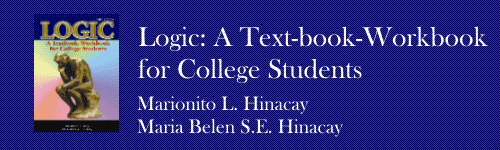
Logic:
A Textbook-Workbook for
College Students
has been widely used in
logic classes for around seven years.
In
its third edition, this
worktext still
maintains its stature of being an organized
lecture notes. The language
and content of each lesson are reviewed only for the purpose of
offering a most
simple, clear, and understandable step-by-step
presentation of the
basics of informal and formal logic.
Lesson supplements are enriched
with the addenda of new sets of
practice exercises, group discussion
questions, home assignments and other suggested activities in order to
make the
classroom instruction more interactive and totally
self-teaching for
students. This
worktext offers every student in logic the fundamentals of going
through the
practical decisions of life and of appreciating its inherent value in
the study
of philosophy. Assuredly,
in this piece
of work is a true “user” friendly book in Logic.
|
|
| THE
HUMAN PERSON: A TEXBOOK-WORKBOOK FOR COLLEGE STUDENTS (2006 Maiden
Edition) |
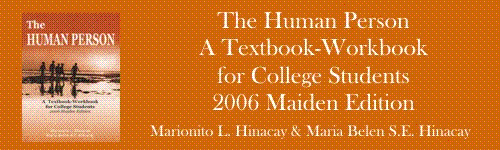
THE HUMAN PERSON is purposely written as a
textbook-workbook for the course, Philosophy of the Human Person. The subject matters include
those that advance
significantly the students’ understanding of man.
It is presented in an organized
lecture notes
that emphasize the important points which every student could easily
remember
and contextualize.
Salient Features:
- It adopts a
title and contents pursuant to CHED Memo No. 44, Series of
1997, Policies & Standards for Humanities, Social
Sciences & Communication Education (HSC).
- It includes a course
outline of lessons, schedule of readings, and reference
materials.
- It
provides readily formulated course, chapter, and lesson
objectives, which can be a helpful guide in daily class
interaction.
- It departs from
the rhetorical language of philosophy and uses simple and
familiar words for easy comprehension.
- It selects themes
for each lesson with short explanations giving the readers the task to
explain it further in their own language and understanding.
- It provides worksheets
after every lesson. Worksheets are mostly divided into two
parts: key knowledge test and key skills
test. The former is more of review questions while
the latter are questions that involve reflection and inference.
- It suggests Learning
Enhancement Activities that will further develop the
students’ mind to think rather than to simply memorize; to apply it in
concrete real life situations.
- It advances the
Filipinization of
Western-Eastern philosophical thoughts and promotes the inculcation of
a value-laden instruction.
- It features
with permission the articles: “The Pope on the Human Person,”
by James V. Schall of Georgetown
University,
and “Becoming Human and Filipino in the Global Era,”
by Dr. Manuel B. Dy, Jr. of Ateneo de Manila University.
- And finally, it
claims no originality of thoughts but newness in
the treatment of ideas and presentation of methodology.
|
|
|
