Tantalum
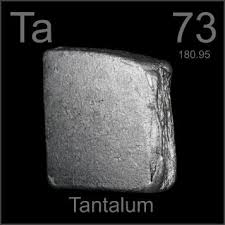
Tantalum is a chemical element with the symbol Ta and atomic number 73. Previously known as tantalium, the name comes from Tantalus, a character from Greek mythology. Tantalum is a rare, hard, blue-gray, lustrous transition metal that is highly corrosion resistant. It is part of the refractory metals group, which are widely used as minor components in alloys. The chemical inertness of tantalum makes it a valuable substance for laboratory equipment and a substitute for platinum, but its main use today is in tantalum capacitors in electronic equipment such as mobile phones, DVD players, video game systems and computers. Tantalum, always together with the chemically similar niobium, occurs in the minerals tantalite, columbite and coltan (a mix of columbite and tantalite).
Tantalum was discovered in Sweden in 1802 by Anders Ekeberg. One year earlier, Charles Hatchett had discovered the element columbium.[4] In 1809, the English chemist William Hyde Wollaston compared the oxides derived from both columbium—columbite, with a density 5.918 g/cm3, and tantalum—tantalite, with a density 7.935 g/cm3, and concluded that the two oxides, despite their difference in measured density, were identical. He decided to keep the name tantalum. After Friedrich Wöhler confirmed these results, it was thought that columbium and tantalum were the same element. This conclusion was disputed in 1846 by the German chemist Heinrich Rose, who argued that there were two additional elements in the tantalite sample, and he named them after the children of Tantalus: niobium (from Niobe, the goddess of tears), and pelopium (from Pelops). The supposed element "pelopium" was later identified as a mixture of tantalum and niobium, and it was found that the niobium was identical to the columbium already discovered in 1801 by Hatchett.