Polonium
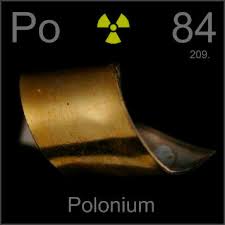
Polonium is a chemical element with the symbol Po and atomic number 84, discovered in 1898 by Maria Skłodowska-Curie and Pierre Curie. A rare and highly radioactive element with no stable isotopes, polonium is chemically similar to bismuth and tellurium, and it occurs in uranium ores. Applications of polonium are few, and include heaters in space probes, antistatic devices, and sources of neutrons and alpha particles. Because of its position in the periodic table, polonium is sometimes classified as a metalloid. However, other sources say that on the basis of its properties and behavior, it is "unambiguously a metal".
Polonium has 33 known isotopes, all of which are radioactive. They have atomic masses that range from 188 to 220 u. 210Po (half-life 138.376 days) is the most widely available. 209Po (half-life 103 years) and 208Po (half-life 2.9 years) can be made through the alpha, proton, or deuteron bombardment of lead or bismuth in a cyclotron.