Mendelevium
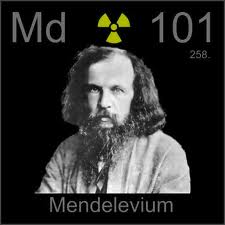
Mendelevium is a synthetic element with the symbol Md (formerly Mv) and the atomic number 101. A metallic radioactive transuranic element in the actinide series, mendelevium is usually synthesized by bombarding einsteinium with alpha particles. It was named after Dmitri Ivanovich Mendeleev, who created the Periodic Table. Mendeleev's periodic system is the fundamental way to classify all the chemical elements. The name "mendelevium" was accepted by the International Union of Pure and Applied Chemistry (IUPAC) in 1955 with symbol "Mv", which was changed to "Md" in the next IUPAC General Assembly (Paris, 1957).
Researchers have shown that mendelevium has a moderately stable dipositive (II) oxidation state in addition to the more characteristic (for actinide elements) tripositive (III) oxidation state, the latter being the more dominantly exhibited state in an aqueous solution (chromatography being the process used). 256Md has been used to find out some of the chemical properties of this element while in an aqueous solution. There are no other known uses of mendelevium and only trace amounts of the element have ever been produced. Other isotopes of mendelevium, all radioactive, have been discovered, with 258Md being the most stable with a two-month half-life (about 55 days). Other isotopes range from 248 to 258 mass numbers and half-lives from a few seconds to about 51 days. The original 256Md had a half-life of 87 minutes.