Gallium
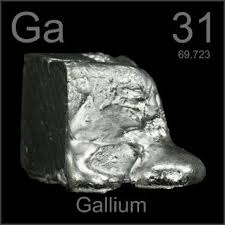
Gallium is a chemical element with symbol Ga and atomic number 31. Elemental gallium does not occur in nature, but as the gallium(III) compounds that are in trace amounts in zinc ores and in bauxite. Gallium is a soft silvery metal, and elemental gallium is a brittle solid at low temperatures. If it is held in the human hand long enough, gallium will melt, since it melts at the temperature of about 29.76 °C (85.57 °F) (slightly above room temperature). The melting point of gallium is used as a temperature reference point. The alloy galinstan (68.5% gallium, 21.5% indium, and 10% tin) has the even lower melting point of −19 °C (−2 °F), well below the freezing point of water. Beginning with its discovery in 1875 through the era of semiconductors, gallium was used primarily as an agent to make alloys that melt at low temperatures. Then, gallium became useful in semiconductors, including as a dopant.
Today, nearly all gallium is used in electronics. Gallium arsenide, the primary chemical compound of gallium in electronics, is used in microwave circuits, high-speed switching circuits, and infrared circuits. Gallium nitride and indium gallium nitride, minority semiconductor uses, produce blue and violet light-emitting diodes (LEDs) and diode lasers.