Cesium
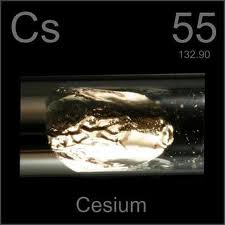
Caesium or cesium is a chemical element with symbol Cs and atomic number 55. It is a soft, silvery-gold alkali metal with a melting point of 28 °C (82 °F), which makes it one of only five elemental metals that are liquid at or near room temperature.[note 2] Caesium is an alkali metal and has physical and chemical properties similar to those of rubidium and potassium. The metal is extremely reactive and pyrophoric, reacting with water even at −116 °C (−177 °F). It is the least electronegative element with a stable isotope, caesium-133. Caesium is mined mostly from pollucite, while the radioisotopes, especially caesium-137, a fission product, are extracted from waste produced by nuclear reactors.
Two German chemists, Robert Bunsen and Gustav Kirchhoff, discovered caesium in 1860 by the newly developed method of flame spectroscopy. The first small-scale applications for caesium were as a "getter" in vacuum tubes and in photoelectric cells. In 1967, a specific frequency from the emission spectrum of caesium-133 was chosen to be used in the definition of the second by the International System of Units. Since then, caesium has been widely used in atomic clocks.