Beryllium
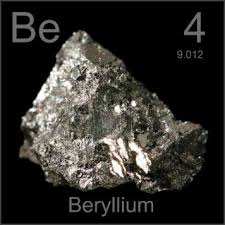
Beryllium is the chemical element with the symbol Be and atomic number 4. Because any beryllium synthesized in stars is short-lived, it is a relatively rare element in both the universe and in the crust of the Earth. It is a divalent element which occurs naturally only in combination with other elements in minerals. Notable gemstones which contain beryllium include beryl (aquamarine, emerald) and chrysoberyl. As a free element it is a steel-gray, strong, lightweight and brittle alkaline earth metal.
Beryllium increases hardness and resistance to corrosion when alloyed with aluminium, cobalt, copper (notably beryllium copper), iron and nickel. In structural applications, high flexural rigidity, thermal stability, thermal conductivity and low density (1.85 times that of water) make beryllium a quality aerospace material for high-speed aircraft, missiles, space vehicles and communication satellites. Because of its low density and atomic mass, beryllium is relatively transparent to X-rays and other forms of ionizing radiation; therefore, it is the most common window material for X-ray equipment and in particle physics experiments. The high thermal conductivities of beryllium and beryllium oxide have led to their use in heat transport and heat sinking applications.