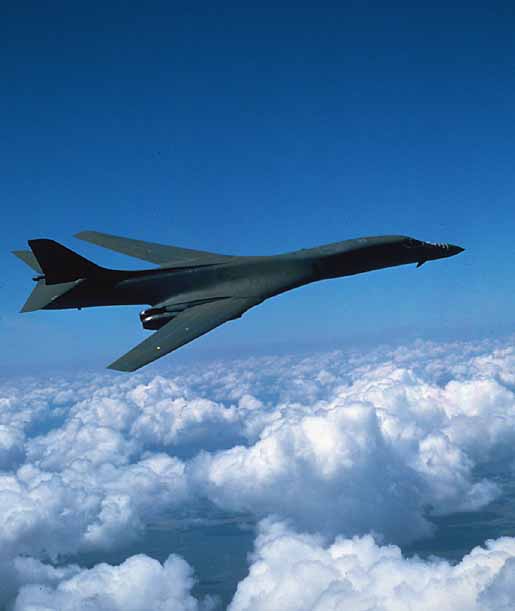
B-1 Lancer
A SMALL INTRODUCTION TO THE B-1b LANCER (IMAGINE THE
CONTENTS):
THE CONTENTS:
The B-1A model of the new long-range multi-role bomber never went into production. USAF acquired four prototype flight test models in the 1970s, but the program was canceled in 1977. Flight test of the four B-1A models continued through 1981. The B-1B is the improved variant initiated by the Reagan administration in 1981. The first production model flew in October 1984, and the first B-1B was delivered to Dyess Air Force Base, Texas, in June 1985, with initial operational capability on Oct. 1, 1986. The final B-1B was delivered May 2, 1988. The B-1B holds several world records for speed, payload and distance. The National Aeronautic Association recognized the B-1B for completing one of the 10 most memorable record flights for 1994. The B-1B was first used in combat in support of operations against Iraq during Operation Desert Fox in December 1998. B-1s have been subsequently used in Operation Allied Force.
The B-1B's blended wing/body configuration, along with variable-geometry design and turbofan engines, combine to provide greater range and high speed with enhanced survivability. Forward wing settings are used for takeoff, landings and high-altitude maximum cruise. Aft wing settings are used in high subsonic and supersonic flight, enhancing the B-1B's maneuverability. The B-1B's speed, superior handling characteristics, and large payload make it a key element of any joint/composite strike force. The B-1B's offensive avionics include the forward-looking offensive radar set employing synthetic aperture radar, ground moving target indicator and terrain-following radar modes, an extremely accurate Global Positioning System/Inertial Navigation System, the avionics control unit complex, a Doppler radar, and a radar altimeter. These features enable aircrews to globally navigate, accurately refine aircraft position without the need for ground-based navigation aids, update mission information and target coordinates in-flight, and perform precision bombing. The B-1B's electronic jamming equipment, infrared countermeasures, radar location and warning systems complement its low-radar cross-section and form an integrated defense system for the aircraft that supports penetration of hostile airspace. The current defensive avionics system consist of the ALQ-161A radio frequency surveillance/electronic countermeasures system, the tail warning function, and the expendable countermeasures system, and is supplemented by the ALE-50 Towed Decoy System.