Pronunciation: kal-'der-&, kol-, -'dir-
Function: noun
Etymology: Spanish, literally, caldron, from Late Latin caldaria
Date: 1691
a volcanic crater that has a diameter many times that of the vent and is
formed by collapse of the central part of a volcano or by explosions of
extraordinary violence
is a Hawaiian term for
basaltic lava that has a smooth,
hummocky, or ropy surface. A
pahoehoe flow typically advances as
a series of small lobes and toes that
continually break out from a cooled
crust. The surface texture of
pahoehoe flows varies widely,
displaying all kinds of bizarre shapes
often referred to as lava sculpture
Pronunciation: rE-'�-l&-jE
Function: noun
Etymology: International Scientific Vocabulary
Date: 1929
a science dealing with the deformation and flow of matter; also : the
ability to flow or be deformed
rhe�o�log�i�cal /"rE'l�-ji-kl/ adjective
rhe�o�log�i�cal�ly /-k(&-)lE/ adverb
rhe�ol�o�gist /rE-'�-l&-jist/ noun
or
"glowing cloud" was first used by La Croix (1904)
in his description of the volcanic flows he observed in
the 1902 eruption of Mt Pelée, a historically
active volcano on the island of Martinique.
back to list
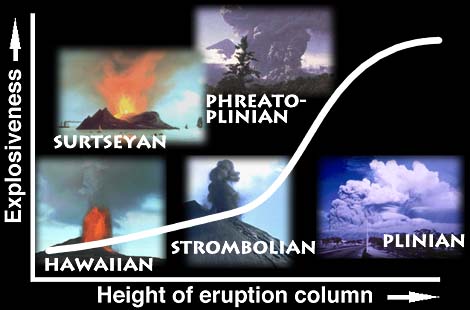
There are many different types of volcanic eruptions and landforms.
They can be classified according to the
degree of "explosiveness"
and the height of the eruption column:
![[line]](pictures/line.gif)
![[the devil made me do it!]](pictures/dvl.gif)
