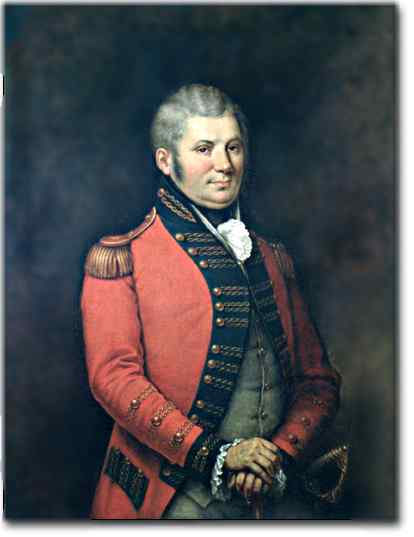
John Graves Simcoe, Prince of Toronto
Name: John
Graves Simcoe
Clan: Ventrue
Generation:
Apparent Age: Late 40’s
Haven: Rosedale Mansion
Concept: Prince
Physical Description: Slightly florid features, white hair and a
typical British Military bearing.
Background: Born in Cotterstock, England in 1752 to a family of
the
landed gentry of England, John Graves Simcoe was educated at
Oxford and
entered the army as a ensign of the 35th Foot in 1770.
In 1775, Simcoe was posted to Boston during the American
Revolution. He
fought for the creation of a special formation of light troops in
order
to fight the Americans on equal terms, this became the famed
Queen's
Rangers, founded in 1777, a loyalist unit under the command of
the
newly appointed Major Simcoe.
He took part in several operations in New York and Virginia
before
being invalided home as a Lieutenant-Colonel in 1781.
Simcoe married Elizabeth Posthuma Gwillim in 1782. She provided a
significant financial support for his career, enabling Simcoe to
purchase and restore Wolford Lodge as a major estate.
His nine years as a half-pay officer were spent managing his
estate,
pursuing military promotion and appointments and corresponding
with
members of his former command about land claims and problems
faced by
loyalists.
He entered Parliament in 1790 but took little part in debates. At
about
the same time he was notified that his campaign for preferment
had been
answered through the commission as first Lieutenant-Governor of
Upper
Canada.
In this capacity, Simcoe was instrumental in organizing the first
civil
government in what is now Ontario. Following the instructions of
the
Home Secretary, he organized the legislative and executive bodies
which
were to govern the province for the next fifty years.
Simcoe began the process of road construction and the survey of
town
and rural lots on which organized settlement were to be based. A
major
part of Simcoe's duties in Upper Canada included the maintenance
of
good relations with the Indians in the territory ceded to the
United
States in 1783. During the negotiation of Jay's Treaty in 1793
Simcoe
devoted much of his time to retaining the alliance with the
western
tribes while stopping short of openly supporting the resistance
to
American authority.
In 1796 Simcoe returned to England on leave but his command was
changed
from Upper Canada to Santa Domingo where he was expected to
restore
order by coping with a French invasion and slave revolt. He spent
only
eight months on the island and returned to England in 1797.
In 1799 he was promoted to the rank of Major-General in command
of the
garrison at Plymouth and his rank was increased again two years
later
to Lieutenant-General in command of coastal defence in
Devonshire. Most
of his time in this period was spent organizing and planning
defensive
measures against the expected invasion from France. In 1806
Simcoe was
appointed to the command of British forces in India, but during a
diplomatic mission to Portugal he became seriously ill and died
shortly
after returning to England.
Well, that’s what Canadian schoolchildren learn.
The full truth is that the man who died in 1806 was NOT John
Graves
Simcoe.
During the time that Simcoe was Lieutenant-Governor of Upper
Canada,
Kindred too were coming to Canada and the United States. In
particular, clan Ventrue saw endless opportunity in the resources
of
the New World, and endless possibilities in the growing British
Colony.
One of the Ventrue that made the long and, at the time, dangerous
trip
to the New World was Lord Dunreardon. Once he and other members
of the
clan settled themselves in the newly founded settlement of York
(later
Toronto), he began to watch those who were in charge.
And his eye settled on the Lieutenant Governor. He was impressed
by
Simcoe’s bearing, breeding, and his abilities. He Embraced
John Graves
Simcoe in 1795, found a man whom had a good physical resemblance
to
Simcoe and ghouled him as a cover. It was the ghoul who returned
to
England in 1796 and it was the ghoul who was killed in 1806 to
effectively end the known mortal life of John Graves Simcoe.
Simcoe eventually became Prince of the very city he helped to
found in
1949. He has a network of ghouls within the city’s business
sector, as
well as in Municipal and Provincial governments. The city’s
Ventrue,
mostly Anglo, view him as an ideal Prince, especially given his
own
role in the development of the beginnings of the city and the
Province.
Between his own clan and the Toreadors, he enjoys enough support
that
he’s been able to stave off attempts to topple him by the
Brujah and
the Gangrel, even after the amalgamation of Toronto with six
other
municipalities. When he was initially made Lieutenant Governor,
he
dreamed of creating an ideal British Colony, now he dreams of
establishing his city as a bastion of Ventrue and British ideals.