|
| |
|
|
|
|
|
Presenting the Wing'dmills (from the 2001 video script)
|
|
|
Suppose you want to pump water or air, far from electric or fuel supply, with steady winds too light to merit raising a ton of multiblade windrotor 35 feet up. Consider instead our oscillating uniblade windpump of much lower weight.
You solo can install it with just a hand cable puller to pump much more ground or surface water in soft winds at half the cost. Our wingblade swings back and forth crosswind to sweep a large sector of wind; reaching winds as high and as strong as a rotor without the cost and danger of its high tower. Therefore, the bearings are much lower, easier and safer to lubricate.
A rotor has a fixed crank and pump stroke: too long for starting in light winds; and then once started by the sheer torque of all those blades, increasingly too short to capture all the cubically rising power of the wind. Annually a wind rotor can only convert into useful water head just 1/10 of its shaft work on an ideal cubic rotary load.
The oscillating winged pumps are a much better match than all windrotors to single-acting pumps with fixed pressure loads. By virtue of our Spanish (spiral) coil winch, our stroke varies strongly with the cube of the swing, not loading a starting swing in only 3 knots, but still absorbing all the wind-power swept in a big swing in a good wind. Comparing powers in pumped watts versus windspeed, the wing'd mills pump twice as much water in light winds as the multiblade windpump at half the cost. Smoke photos reveal the unsteady non-linear aerodynamics that allow the wing'd mills to capture light winds so efficiently.
So the size and big extra cost of the sealed reservoir needed for reliable supply of drinking water is reduced.
Compressing air stores energy much more cheaply, if with a 35% cycle loss, but a mixed air & water tank saves waterline pumping work by smoothing the pump pulses out into steady lower friction flow. With a Pullpump, an air snifter below a non-return valve in the input to the tubeless tank above allows some air output at the same steady pressure as the water.
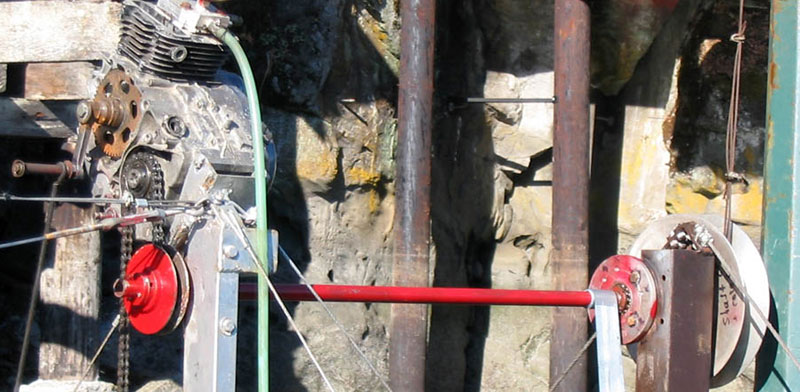
To compress any fraction air to a separate pressure, the head of a scrap motorcycle engine can be changed to a simple plate with reed valves and the crank countersprung. The winch can pull a chain ratcheting the sprocket shaft.
Our wing's unique oscillation self-starts when a light wind arises. At first the slightly tailheavy wing falls from highest to lowest in flipping. But 15 knots of wind will damp the flip in half, safely limiting the wing's oscillation.
Higher winds damp the wing flip to zero, automatically stopping its oscillation. Therefore, the wing and pendulum are stable and safe in a 40 knot storm, whereas a rotor has to rely on fallible mechanisms to yaw and brake it sideways to a gale. A latch automatically catches and holds the wing safe, if it overswings should the pump valves fail. This signals to anyone within a mile to fix the valves. Instead a rotor just keeps on cranking a broken pump, wearing and fooling the farmer.
When a hurricane with its flying debris is forecast, some counterweight is removed and the pendulum deliberately overswung to remove the wing easily by hand from ground level. Then the bare latched pendulum serves as a gin pole for raising and lowering our well base with only a hand cablepuller.
Solar panels driving electric pumps are convenient but $75/pumped watt is just too expensive for more than nominal pumping. A Wing'dmill pumps enough to be used for trickle or furrow irrigation of a small farm.
Nothing solar: panels, submersible motors nor rotary pumps can be made by artisans. Compare that with the simple construction of the Wing'dmill. The wood frame of the wing is a strong 35 pound truss of light and durable western red cedar. The light woven polyethyelene fabric is wrapped over it, stapled down, and wrinkles ironed away. With a coat of aluminum paint rolled on, this very low cost cover will last about 5 years in the sun.
The pendulum axle is an inexpensive threaded pipe turning in used truck taper roller bearings. The counterweight can be concrete or a steel box filled with sand. The tailvanes which yaw the wing and pendulum into the wind are whole sheets of plywood or metal roofing.
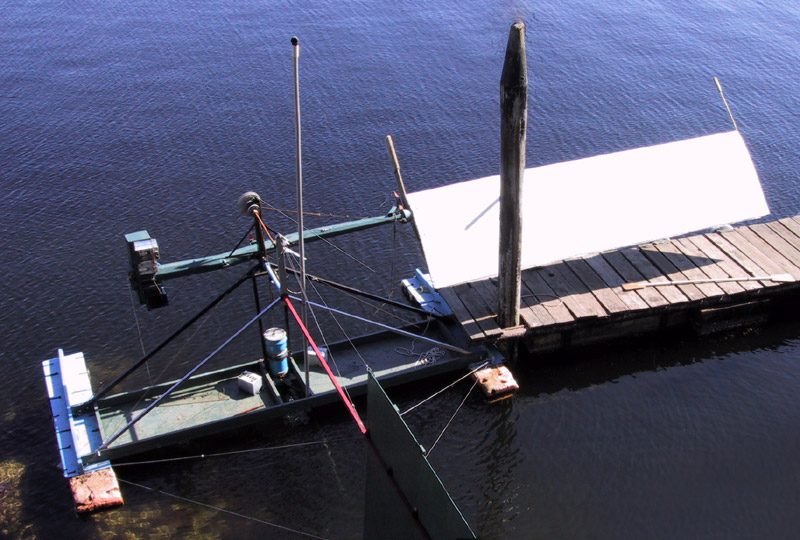
The different floating and well mountings of the wing and pendulum make the oscillating uniblade more versatile than the rotating multiblade.
|
|
|
|