 HomeAbout UsAbout FencingLinksPhoto GalleryImage Bank
 Reviews
 Book ReviewsMovie ReviewsFencing FunContact Us

UCFC Book Reviews
|
|
On Guard by Donna Jo Napoli Review by V. Bjerreskov |
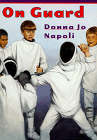
ISBN 0-525-45759-3 (hardcover), 0-141-30118-X (paperback), published 1997
Very little fiction is devoted to sport fencing, so to see a novel of any kind that will speak to fencers is a delight. On Guard is an easy read for the adult, and will no doubt be enjoyable for the younger members of our ranks. Napoli was a "fencing mom," and her experience with the sport and the people in it shows in her descriptions of not only the technical aspects of fencing, but of the atmosphere associated with it.
That said, some aspects of the book deserve a critical eye. First, some of the characters are very flat. Mikey's teachers, classmates, fellow fencing cadets and even parents come and go throughout the novel with very little fanfare or development, with only different names to show the reader that there are in fact several players on the stage. Mikey, his friend Bill, and Mikey's siblings are the only characters with any individuality, and even that is questionable at times. The Maître of the salle, only identified as "Coach," is not developed at all. His main role in the novel is to provide fencing instruction and expound the virtues of our fair sport. He provides an effective character foil (pun intended) for Mikey's overprotective, pacifist mother. He characterises a bout as "to the death" and uses aggressive actions and language. Mikey's mother, on the other hand, has trouble seeing fencing as a sport. Her aversion to weapons of any kind does not allow her to prevent Mikey from fencing, but she never appears completely comfortable with the idea of her son with a sport weapon. This opposition allows Napoli to set Mikey in the middle ground between these two extremes. Second, I found some of the dialogue and the interaction between the members of Mikey's family awkward and unbelievable. Napoli is attempting to emphasise the chaos inherent in the home of a family of six, but occasionally the dialogue distracted me from the message she was trying to communicate. Finally, the subplot of Hank and Bill seemed forced, as if it were merely thrown in to provide an appropriate ending scene for the novel.
However, Napoli's emphasis on strategy, form, and sportsmanship, rather than on the "stabbing and slashing" that draw many young people to the sport, is exemplary. Young fencers reading this novel will undoubtedly find their maîtres' lessons reinforced here. Mikey does not pick up a foil for six weeks, concentrating instead on footwork, distance, and form. His Maître praises strategy as the way to be a successful fencer. In addition, some of Napoli's "in-jokes," like the bit about left-handed fencers, are hilarious to anyone in the know.
Because I have not read the previous book in this series, I cannot comment on how much repetition of basic story and plot there is between the books, but I found this novel thoroughly enjoyable. The reading level seems a bit low for ages 9-12, but that merely means any fencer, whatever their age, can access this story. I would recommend this novel to parents whose children are interested in taking up the sport, as it is an accurate portrayal of learning to fence. If a fencer outside the reading level range is interested in a light read, this is a good book for it. The paperback is available for $8 Cdn at Chapters.
Home | About Us
| About Fencing
| Links | Photo Gallery
Image Bank | Reviews
| Fencing Fun | Contact Us