 HomeAbout UsAbout FencingLinksPhoto GalleryImage Bank
 Reviews
 Book ReviewsMovie ReviewsFencing FunContact Us

UCFC Book Reviews
|
|
The History of Fencing: Foundations of Modern European Swordplay by William M. Gaugler, Maestro di Scherma Review by N. Bell (02 03 04) |
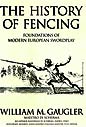
ISBN 1884528163, published 1998
This book is essentially a big bibliography of the books Gaugler feels are most significant in the development of the modern sport, from early rapier texts until the late 20th century. Gaugler tells us a little about each master, and gives a brief rundown of the techniques and ideas covered in each book. He covers both French and Italian schools, concentrating a little more on the latter as he is Italian trained. The end result is, Gaugler gives us a good picture of the development of the techniques and ideas which eventually led to our sport. In most cases, enough of the original information is presented to give the reader a sense of the style and technique of the given period. The variety of texts not only gives the reader a good indication of the similarities and differences between the French, Italian, and mixed schools, but also of the differences between masters within each school. I don't think I've read another book that has taught me as much about fencing.
I would strongly recommend this book as a starting point for Classical and Historic fencers, because it gives the reader a chance to contrast styles within a given period and learn some basics. Those few historical texts that have been translated and reproduced tend to be rather expensive, so Gaugler's book may at least serve as an introductory text, and a guide when expanding one's library. While Gaugler leaves out the sections in earlier texts on the use of multiple weapons, the basic instruction on the use of the single sword is intact. Most period masters agreed that learning the sword alone was the foundation of all other practice in arms. So, like I said, this book is a good starting point.
The later periods, the development from smallsword technique into a distinct foil practice and the eventual introduction of the duelling épée and sabre, are very well covered. Gaugler shows concepts developing too. For example, the first inklings of priority appear in 1782 when Alexandre Brémond stated "the attacker is correct."
The biggest shortcoming in this book is the conspicuous lack of discussion about the weapons employed. Gaugler includes information about arms, as presented in the original texts, but includes very little beyond this. So while we learn about the development of techniques, we learn very little about the development of the related weapons.
There is also a significant jump in time between texts at the beginning of the 18th century. The last 17th century text presented in any detail is Marcelli from 1686 (followed by 2 pages of Labat from 1696). From here we skip to Angelo, published in 1763. In other words, we go from the very last instructions in rapier and some of the earliest in true foil, to fully developed smallsword and foil practice.
Finally, while it is very informative, it is an excruciatingly boring read. The text is extremely dry, in many cases simply listing the techniques included in a given book. As we know, things change slowly, so from one author to the next, virtually the exact same information is given with minor differences noted here and there. Gaugler includes only a select few anecdotes from the lives or eras of the original authors. Duels are mentioned but never described. Very little is given in the way of analysis. I'll admit it took me three tries to get through the whole thing. It's definitely not a cover to cover read. Rather, use it as a reference text for the period or Master you're interested in. This was the original intent anyway.
If I was to commission Gaugler to write this book again, first I'd team him up with a French Master/historian, as well as an arms historian (Jacques Castanet would fill all these roles nicely). Then I'd get J. Christoph Amberger in on it to add some human interest to the history. And finally, I think by printing this as five separate volumes (one for each century covered) it would allow for more in-depth study of more authors, and more discussion and analysis of the techniques presented.
I definitely recommend this book to anyone interested in fencing as it was, and how we got from there to here. It is a useful reference for historical, classical, and historically curious fencers alike.
Just don't anticipate a light weekend read.
Home | About Us
| About Fencing
| Links | Photo Gallery
Image Bank | Reviews
| Fencing Fun | Contact Us