 HomeAbout UsAbout FencingLinksPhoto GalleryImage Bank
 Reviews
 Book ReviewsMovie ReviewsFencing FunContact Us

UCFC Book Reviews
|
|
The Art and Science of Fencing by Nick Evangelista Review by N. Bell (02 06 19) |
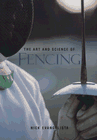
ISBN 1570280754, published 1996
The first time I read this book, I gave it a rather bad review. I didn't like it much. But I decided to give it another chance, to see what a second reading might reveal. End result: I still don't like it much. But before I begin I should make a couple of statements, just so you know where I'm coming from.
- Classical Fencing is a valid expression of the art, science, and sport.
- Modern Fencing is a valid expression of the art, science, and sport.
The problem is, this book doesn't quite fit into either school. Even describing Evangelista's approach as old-school modern doesn't seem right. He is critical of what he sees in the sport today, but his method isn't truly classical either.
I'll begin with Evangelista's complaint about pistol grips. He states they inevitably cause an over-reliance on power, and make fingering and the development of sentiment du fer impossible. Of course what Evangelista doesn't mention is that the French school has used these same complaints against the Italian grip for the past 200 years. Evangelista, by the way, recognises the Italian grip as valid because it is old. I would argue that a pistol grip is no more a guarantee of a sloppy, brutal fencer, than a French grip is a guarantee of a classical, delicate fencer. Evangelista also briefly describes electric fencing, and while he states it is neither good or bad, he goes on to compare electric fencers, waiting for the buzz of the box, to Pavlov's dogs, drooling at the sound of the dinner bell. Hardly a positive image.
But criticisms of equipment are not my only problem with this book. There are serious deficiencies in some of the information presented, questionable use of some terms and unusual categorisations or dismissals of certain techniques.
For starters, in the sections on parrying in all 3 weapons, Evangelista neglects to mention what part of the blade is used for parrying. Historically, masters have gone to great lengths to ensure students understood STRONG AGAINST WEAK. Evangelista skips this point. This is an example of an overall lack of detailed discussion in many of the techniques. Descriptions were largely generalised, and the finer mechanics left out. The entire section on épée was 17 pages long, and 17 pages of big print at that.
In another quirk, Evangelista repeatedly refers to the riposte as a counterattack. While I suppose this fits the broader dictionary definition of an attack in response to an attack, it doesn't reflect the special nature of the riposte as an attack following a defensive action. Most masters keep these two terms as distinct as possible.
Evangelista also fiddles somewhat with long accepted techniques. For example, he feels opposition parries are heavy-handed and should rarely be used. This ignores the inclusion of these actions for over 150 years in both the French and Italian schools. I've always read that opposition parries offer safe control of the opponent's blade and make for easy glide ripostes. Instead of traditional glide ripostes, Evangelista offers the croisé as a single-tempo parry riposte/counter attack. While use of the croisé as a counter attack is not unprecedented, it is also often taught as a prise de fer attack executed from one's own initiative. Evangelista ignores this use. Other examples of the re-casting of techniques, and techniques that I would consider questionable or non-traditional, exist throughout the book.
Evangelista's sabre guard places the arm well extended and the tip low and forward. This requires the withdrawal of the tip for the execution of any cuts. Fine, if you're employing the old Radaelli-style cuts from the elbow, but Evangelista recommends the modern pop-cuts delivered with the fingers. The guard is also one big invitation for attacks-on, or takings-of, the blade. Evangelista himself admits that the beat-cut to the arm is extremely difficult to defend against, yet his recommended guard dooms the user to repeated hits this way.
In terms of the publishing aspects, I found the drawings to be sloppy and substandard overall. In a few spots, there were significant discrepancies between a description of a position, and the drawing meant to represent it. Generally, the photos and drawings did a poor job of illustrating the points made. In a few spots, the writing gets a little awkward as well. The top paragraph of p.195 reads:
"The sabre is both a cutting weapon and a point weapon. This means that touches can be scored with either the tip or the edge of the blade, although sabre technique definitely stresses the former over the latter."
I assume by the context of the rest of the sabre section, in his use of 'former' and 'latter' he is referring to his first sentence and not the first half of his second sentence. Inconsistency causes confusion.
I do agree with Evangelista's charge that problems of bad fencing stem from a lack of discipline among both fencers and coaches. I find his emphasis on sportsmanship, discipline and respect admirable. Most books published these days don't concentrate enough on these.
In the end, I think Evangelista's intent was to write a book for beginners to the modern sport, which would teach them to respect the older forms and traditions, and warn them against the potential pitfalls of the modern game. But he paints modern fencing with such a negative brush, the beginner is likely to discard the sport entirely and search out a "Classical Fencing" club. Problem is, most classical groups work from more time-honoured and respected texts than this.
So I'll recommend this book only to the disgruntled old-school sport fencer. Beginners, competitive fencers, and true classical fencers needn't waste their time.
Home | About Us
| About Fencing
| Links | Photo Gallery
Image Bank | Reviews
| Fencing Fun | Contact Us