 HomeAbout UsAbout FencingLinksPhoto GalleryImage Bank
 Reviews
 Book ReviewsMovie ReviewsFencing FunContact Us

UCFC Book Reviews
|
|
The Hardy Boys: The Clue of the Broken Blade by Franklin W. Dixon (original text) Review by V. Bjerreskov, 02 07 09 |
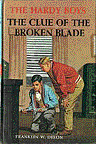
ISBN ?, published 1942
I was surprised when Nathan came to me and said my review of The Clue of the Broken Blade didn't match up his copy of the book at all. So he lent it to me, and I knew immediately upon reading the first page that this was an entirely different story than the one I had originally read.
Not to say that it was so different from the later version. The Hardy Boys are Hardy Boys, be they written in the 1940s, 1970s, or 2000s. They are still perfect, reckless, and more lucky than anyone has any right to be.
In this version, Frank and Joe start by practicing for a charity play (put on by Chet Morton, charity unspecified) by duelling with umbrellas. They are thereafter contracted by their father to help him track down a ring of truck theives, who load merchandise into trucks when it is delivered to port. Hijinks ensue, and they find themselves dealing with clues that come in the form of swords: one stolen, one broken and the blade stolen (hence the title). "Seemingly unrelated events" come together, including the missing amnesiac scion of a millionaire who ran off to join the circus (oh, please!), a missing snake, a Spanish fencing master with the same name as an emmigrated matador, kidnappings, bombs, fires, a ledger, and a general distrust of the deductive powers of the police force. I really don't think I'm spoiling anything; the plot is so convoluted you'd have to be the author to put all those pieces together.
This book is not so much about fencing as it is about swords. The broken blade in question is a Crusader's broadsword, with the man's name engraved upon it. Other swords make appearances, like a Spanish estoque, and two sharps that the Hardys' benefactor lends them to give their charity play an edge of realism. These sharps provide much hilarity as the Hardys chase away an intruder to their house with them, startle their aunt when they think that she's another intruder, and completely freak out their friends as they rehearse for the play. Never mind the fact that the Hardys don't know how to fence; they're invincible, don't you know? Chet Morton does go for a fencing lesson off stage (followed by a quart of ice cream and a boat ride, but he's the Hardys' geeky fat friend, isn't he?), but that is about the extent of swordplay in the book.
I suppose I sound a little cynical. Truth be told, I think this is the better of the two versions of this story. Granted, I think Frank and Joe are too good to be true, and definitely have more luck than any normal person should have, the plot is convoluted, and I have yet to figure out how a man can hold onto the hiltless blade of a broadsword and brandish it as a weapon, but at least these older Hardys don't make any pretension of their abilities (beyond an instinctive knack for sword work). In many places, they must force themselves to keep their cool, they are not always on top in a fight, and even their father makes his share of mistakes.
This book is only available as a used hardcover, published prior to 1970.
Home | About Us
| About Fencing
| Links | Photo Gallery
Image Bank | Reviews
| Fencing Fun | Contact Us
