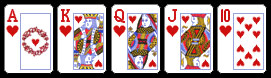
In the event of a tie: Two or more Royal Flushes split the pot.
Poker Hand Rankings
Five Card Poker Hand Values for High
Royal Flush:
An Ace, King, Queen, Jack, and Ten in the same suit.
In the event of a tie: Two or more
Royal Flushes split the pot.
Straight Flush:
Five cards in sequence, of the same suit.
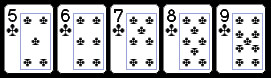
In the event of a tie: Highest rank at the top of the sequence wins.
Four Of A Kind:
Four cards of the same rank, and one side card.
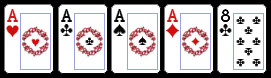
In the event of a tie: Highest four of a kind wins. In community card games
where players have the same four of a kind, the highest fifth side card
("kicker") wins.
Full House:
Three cards and the same rank, and two cards of a different matching rank.
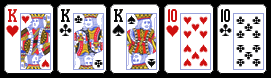
In the event of a tie: Highest three matching cards wins the pot. In community
card
games where players have the same three matching cards, the highest value of the
two matching cards wins.
Flush:
Five cards of the same suit.
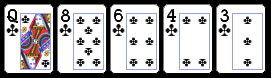
In the event of a tie: The player holding the highest ranked card wins. If
necessary,
the second-highest, third-highest, fourth-highest, and fifth-highest cards can
be
used to break the tie.
Straight:
Five cards in sequence.
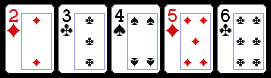
In the event of a tie: Highest ranking card at the top of the sequence wins.
Note: The Ace may be used at the top or bottom of the sequence, and is the only
card which can act in this manner.
Three Of A Kind:
Three cards of the same rank, and two unrelated side cards.
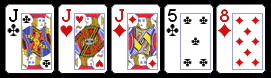
In the event of a tie: Highest ranking three of a kind wins. In community card
games
where players have the same three of a kind, the highest side card, and if
necessary,
the second-highest side card wins.
Two Pair:
Two cards of a matching rank, another two cards of a different matching rank,
and one side card.
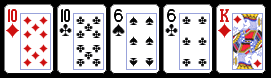
In the event of a tie: Highest pair wins. If players have the same highest pair,
highest second
pair wins. If both players have identical pairs, highest side card wins.
One Pair:
Two cards of a matching rank, and three unrelated side cards.
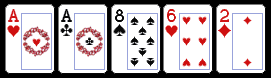
In the event of a tie: Highest pair wins. If players have the same pair, the
highest side card wins,
and if necessary, the second-highest and third-highest side card can be
used to break the tie.
High Card:
Any hand that does not qualify under a category listed above.
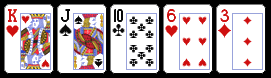
In the event
of a tie: Highest pair wins. If players have the same pair,
the highest side card wins, and if necessary, the second-highest and
third-highest side card can be used to break the tie.
Five Card
Poker Hand Values for Low
Note that suits and
sequences are irrelevant for low. A flush or straight does not "break"
a low poker hand. Aces are the lowest card when considering a low.
Five High, or
Wheel: The Five, Four, Three, Deuce and Ace.
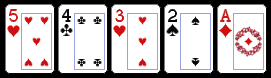
In the event of a tie: All Five-high hands split the pot.
Six High:
Any five unpaired cards with the highest card being a Six.
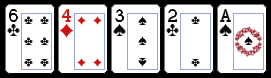
In the event of a tie: The lower second-highest ranking card wins the pot. Thus
6, 4, 3, 2, A defeats 6, 5, 4, 2, A. If necessary, the third-highest,
fourth-highest
and fifth-highest cards in the hand can be used to break the tie.
Seven High:
Any five unpaired cards with the highest card being a Seven.
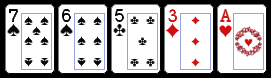
In the event of a tie: The lower second-highest ranking card wins the pot.
If necessary, the third-highest, fourth-highest and fifth-highest cards in the
hand can be used to break the tie.
Eight High:
Any five unpaired cards with the highest card being an Eight
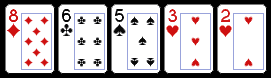
In the event of a tie: The lower second-highest ranking card wins the pot. If
necessary, the third-highest, fourth-highest and fifth-highest cards in
the hand can be used to break the tie.
An Eight High is
the weakest hand that qualifies for low in games
where the pot is split between the best high and low hands.